
Establishing that the construction of an academic discipline is a process of institutionalisation, this essay draws parallels between creative writing and the academic study of English literature. Through a historical description of progressive literary theorising, the work aims to demonstrate that theory is ultimately a redundant, circular process. The conclusion posits that creative writing and literary theory exist in opposition, asserting that creative writing tutors should resist the institutionalisation processes which befell ‘literature’.
There is a way of answering examination questions that is expected. It’s a sort of accepted ritual, it’s a game, with rules. And you must observe those rules.
from Educating Rita by Willy Russell[1]
The characteristic peculiar to the academic study of English is that it is a particularly amorphous discipline, more open to conjecture and polemic, and with fewer empirically justifiable ‘facts’ available to it than other disciplines. English has no definitive answers and it depends upon academic dogma to determine within which paradigms its accepted definitions lie.
As Terry Eagleton[2] relates, the ambiguity surrounding English was a barrier to its admission as a field of study within the Oxbridge universities in the early part of the twentieth century:
Fierce rearguard actions were fought by both ancient Universities against this distressingly dilettante subject; the definition of an academic subject was what could be examined, and since English was no more than idle gossip about literary taste it was difficult to know how to make it unpleasant enough to qualify as a proper academic pursuit.[3]
So a discipline can be admitted to the academic sphere only if competence in it can be empirically measured and quantified. In its raw state, English seems impervious to such value judgments and consequently difficult to situate within an examination system.
The primal question of any discipline concerns the way in which it is constituted. This process is concerned with drawing perimeters and creating paradigms which establish boundaries and provide a common frame of reference. Colin Evans[4] compares this with the creation of directory ‘trees’ within a computer filing system. The root is divided into directories and thence into sub-directories in a process of closure which progressively isolates differentiated areas of a discipline. Evans distinguishes between ‘discipline’ and ‘subject’, arguing that ‘discipline’ refers to the abstract mapping of an area of knowledge, whereas subjects are specific locations on that map.
Applying Evans’ computer directory metaphor in terms of the sciences, for example, we find that while science is the initial directory, individual subject areas extend from it. This might be expressed in terms of a ‘directory tree’ as follows:
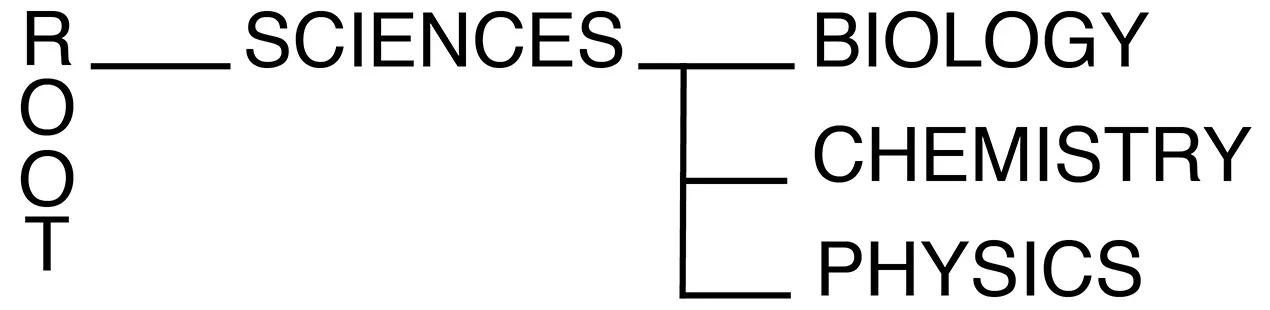
The ‘root’ of a computer filing system is the drive on which the subsequent directories are stored. In terms of this analogy, this can be seen as the institution which creates the division of subjects, translating them into school, college or university departments. So, as Evans asserts, the directory tree represents both an abstract map of an area of knowledge and an institutional organisational structure.
Of course the above diagram is something of an oversimplification. Biology, for example, might be divided subsequently into further subjects or ‘subdirectories’ such as botany or marine biology, and sub-divisions are possible within chemistry and physics. It is also somewhat inaccurate to delineate subject areas so rigidly — principles from each are relevant to the others. Although there is this overlap, each subject has its own clearly defined parameters. Broadly, biology is concerned with the function of living organisms, chemistry with the elemental composition of materials, and physics with the mechanical relationship between objects and energy. These distinctions are relatively distinct and easy to comprehend. As indicated above, however, such boundaries in the study of English are not so easily distinguishable.
If we apply the ‘directory’ model to creative writing, we might conclude that this subject (in Evans’ sense) is a sub-category of English. As suggested above, I am assuming that it is related to the field of English studies connected with the study of ‘literature’.
As Eagleton describes, ‘literature’ is a category of writing for which individuals may be able to find specific examples — Shakespeare, Dickens, Wordsworth — but which is inaccessible to succinct definition. It is rather a case of knowing literature when you see it than being able to explain exactly what it is.
The examples of ‘literature’ I have given are predominantly fictional forms, drawing on the imaginative skills of their authors, but this is not necessarily a prerequisite of ‘literature’ as Eagleton suggests:
Perhaps literature is definable not according to whether it is fictional or ‘imaginative’, but because it uses language in particular ways. On this theory, literature is a kind of writing which, in the words of the Russian critic Roman Jakobson, represents an ‘organised violence committed on ordinary speech’. Literature transforms and intensifies ordinary language, deviates systematically from everyday speech.[5]
Assuming that creative writing as an academic discipline aspires to the ‘literary’, the emphasis here is on the writing — if creative writers are to commit ‘organised violence’ on ‘ordinary speech’, they must be creative with the words as opposed to the subject — or, as Eagleton comments, ‘as the linguists might more technically put it, there is a disproportion between the signifiers and the signified.’[6]
With this description of the ‘literary’, transmogrified ‘ordinary speech’ (signifier) deviates from its subject (signified). Eagleton contends that this criterion can be applied successfully to writing which would not be considered either literary or creative. An example of this which occurs to me is the notice advising ‘BILL POSTERS WILL BE PROSECUTED’. From this notice we are presumably intended to conclude that legal action will be taken against anyone who pastes printed advertisements on the surface to which the notice is attached. However, it takes only a small leap in imagination to conclude that the notice is a statement concerning an individual named ‘Bill Posters’. If someone with a permanent marker adds ‘Bill Posters is innocent!’ a fictitious narrative begins.
Since signifieds regularly float within signifiers, it is not uncommon for a text to depart with its intended meaning — or to at least make that meaning ambiguous or open to deliberate misinterpretation. The comedian Dave Allen comments on the neon signs in Soho which read ‘Live Girls Dancing!’ ‘What were you expecting?’ he asks, ‘Stiffs on elastic?’[7]
Although these examples fulfil the criteria of literary or creative writing offered by Jakobson, it is somewhat unproductive to insist that they are literary, as Eagleton concludes:
This may well be a fruitless sort of pursuit, but it is not significantly more fruitless than claiming to hear the cut and thrust of the rapiers in some poetic description of a duel, and it at least has the advantage of suggesting that ‘literature’ may be at least as much a question of what people do to writing as of what writing does to them.[9]
So what counts as literary or creative writing cannot be deduced from texts by applying such criteria as that of Jakobson. The ‘literary’ arises from consensus amongst readers, as Eagleton continues:
Some texts are born literary, some achieve literariness, and some have literariness thrust upon them. Breeding in this respect may count for a good deal more than birth. What matters may not be where you came from but how people treat you. If they decide that you are literature then it seems that you are, irrespective of what you thought you were.[10]
Stanley Fish[11] confirms that literature cannot be recognised by text style and content alone, but from consensus within a readership community:
[…] the act of recognising literature is not constrained by something in the text, nor does it issue from an independent and arbitrary will: rather it proceeds from a collective decision as to what will count as literature, a decision that will be in force only so long as a community of readers or believers continues to abide by it.[12]
Academic recognition of the ‘literary’ is not as democratic a process as that described by Fish. John B Thompson[13] finds that:
[…] within the domain of written texts, the emergence and perpetuation of a canon of great literature is linked to the development of an educational system in which practices of literary criticism are institutionalised. These institutionalised practices operate as a selective filter for the extraction of certain works from the extensive domain of written texts, and for the constitution of those works as ‘literature’.[14]
The institutionalisation process therefore not only maps areas of knowledge, but defines what is to be admitted to these areas. As Evans[15] indicates, the evolution of the theory behind these structures is not composed linearly of discrete sequential positions, but each framework of thought overlaps the preceding and succeeding one. Nevertheless, literary theory has evolved progressively and, for all useful purposes, sequentially, in what I will argue is an essentially circular manner.
In order for English to be institutionalised it was necessary to move perceptions of the discipline away from the dilettante and towards the professional. Evans[16] comments that it was initially a subject which accorded more with the Cavalier pleasure principle than with the Roundhead work ethic. The study of English literature was a ‘leisure’ subject, frivolous and out of place within academia.
To associate more than purely aesthetic value with English literature, it was necessary to present it as a kind of social moral creed:
George Gordon, early Professor of English Literature at Oxford, commented in his inaugural lecture that ‘England is sick, and… English literature must save it. The Churches (as I understand) having failed, and social remedies being slow, English literature has now a triple function; still, I suppose, to delight and instruct us, but also, and above all, to save our souls and heal the state.’[17]
Whereas the Russian Formalists like Jakobson had sought literariness within texts, post-First World War academics — principally Cambridge University’s F R Leavis — sought to construct the literary canon themselves, insisting that it was not of their making, but a matter of providence. In 1932 Leavis launched Scrutiny a journal of literary criticism which focused on the moral centrality of English, setting the burgeoning discipline above the others in the academic sphere because of its supposed salubrious nature. Eagleton states that the new literary theory allowed Leavisites to answer a question which had eluded pre-war literary academic, Sir Walter Raleigh:
The strength of Leavisian criticism was that it was able to provide an answer, as Sir Walter Raleigh was not, to the question, why read literature? The answer, in a nutshell, was that it made you a better person.[18]
Leavis’s contemporary I A Richards, who influenced the development of American New Criticism, conducted a survey based upon an exercise in practical criticism. Undergraduates were invited to ‘appreciate’ texts by unnamed poets with the result that they treated those which were an accepted part of the canon with derision, while venerating obscure and unknown texts. Despite this, as Eagleton[19] indicates, Richards failed to make the theoretical leap to understanding that the cultural and social background of his respondents influenced their criticism as much as the content of the texts.
Although both the influence of Leavis and New Criticism succeeded in gaining the study of English acceptability in the academic sphere, it was based on subjective value judgments (which Leavis explained away by claiming the inherent, providential value of the literary canon) which did not lend themselves to objective discussion. In order to dispose of the high degree of subjectivity inherent in the Leavisites’ and New Criticism’s value judgments, it was necessary to examine — as Richards did not — the structures governing the creation and analysis of texts.
The alternative to New Criticism was pioneered by the Canadian Northrop Frye. Eagleton tells us that:
Frye’s belief was that criticism was in a sorry unscientific mess and needed to be smartly tidied up. It was a matter of subjective value-judgments and idle gossip, and badly required the discipline of an objective system. This was possible, Frye held, because literature itself formed such a system. It was not in fact just a random collection of writings strewn throughout history: if you examined it closely you could see that it worked by certain objective laws, and criticism could itself become systematic by formulating them.[20]
The structuralist approach of Frye differed to that of the New Critics in that it took the structures which governed the creation of texts as its starting point rather than the texts themselves. John Fiske[21] states that structuralism is an approach which sets about uncovering ‘the conceptual structures by which various cultures organise their perception and understanding of the world’. These structures prescribe perceptions and thus the creation of texts, the structuralists argue, rather than those perceptions and texts having any autonomous existence as with New Criticism.
Lévi-Strauss[22] sees structure as based on a system of binary opposites, meaning only being communicated when a sign is diametrically opposed by that which it is not. Thus, in language, we understand the word ‘tree’ not because of any concrete connection between that word and the physical object, but because we do not use that word in arbitrary connection with any other object. Therefore a tree is a tree because it is not a table and so on.
Any language system, Lévi-Strauss contends, is based on the mutual interdependence of its components — meaning only conveyed because language operates within a structure. Lévi-Strauss divides this system into structure and meaning, an infinite number of meanings, which he terms paroles, deriving from the deep structure, termed the langue. Thus in language, the language itself is the langue whereas the infinite meanings conveyed using it are all paroles.
The interdependent meaning system not only requires binary opposition but also that individual signs be used in syntactical formation. Thus language must be utilised in a manner prescribed by the limitations of grammar, punctuation and spelling. Since we are only able to think, understand and convey meaning using language, structuralists assert, we are constantly unconsciously influenced and constituted by language’s deep structure. Ultimately therefore we do not speak language, language speaks us.
Although structuralism dispensed with the pure subjectivity of its predecessors, its Achilles heel lies in the arbitrary application of words to objects, signifiers to signifieds. As we discovered earlier, although the way in which we use a language is governed by its deep structure, this structure is not infallible. Just as the notice ‘Dogs must be carried on the escalators’ can mean more than that if you have a dog you should carry it while travelling on an escalator, so no other statement can entirely and specifically convey its meaning.
This, Eagleton argues[23], is because no signifier is identical with its signified. To use our earlier example, the signifier ‘tree’ is never identical with the object because the determinants of language are further signifiers. If we seek the definition of tree in a dictionary we discover that it is ‘any large woody perennial plant with a distinct trunk giving rise to branches or leaves at some distance from the ground,’ but all we are given here is a gout of further signifiers with no less arbitrary a relationship to the signified object. Add to this the fact that ‘tree’ can mean more than just a large woody perennial plant (I have, for example, used the word in relation to computer files and organisational structures within this essay), and structuralism begins to appear a very much less objective approach.
Jacques Derrida termed this process of unpacking meaning ‘deconstruction’, asserting that language is self-contradictory and flawed objectively. He focused on constructs similar to our ‘Bill Posters’ and ‘Dogs must be carried’ examples in order to prove that language was eternally compromised, as Eagleton describes:
The tactic of deconstructive criticism […] is to show how texts come to embarrass their own ruling system of logic; and deconstruction shows this by fastening on the ‘symptomatic’ points, the aporia or impasses of meaning, where texts get into trouble, come unstuck, offer to contradict themselves.
This is not just an empirical observation about certain kinds of writing: it is a universal proposition about the nature of writing itself. For if the theory of signification […] is at all valid, then there is something in writing itself which finally evades all systems and logics. There is a continual flickering, spilling and diffusing of meaning — what Derrida calls ‘dissemination’ — which cannot be easily contained with the categories of the text’s structure, or within the categories of a conventional critical approach to it.[24]
Since dissemination cannot be contained precisely within a text it is impossible to construct a critical approach with which to objectively analyse texts. Such a critical approach requires a set of core values or structures which, since they are flawed by spillage of meaning, cannot be dogmatically asserted. Thought systems such as those of Leavis, Richards and Lévi-Strauss are dependent, as Eagleton puts it, on an ‘unassailable foundation’, what Derrida termed ‘metaphysical’ principles. If metaphysical principles cannot be established then it is impossible to construct objective academic theory.
The implications of this for the study of ‘literature’ is that it cannot be made a ‘legitimate’ subject in the empirical, ‘Roundhead’ sense. Dick Hebdige[25] shows that the effects of this are far-reaching:
According to the French philosopher, Jean Francois Lyotard, [the] ‘legitimation crisis’ has been solved through the invention of what he calls ‘the great meta-narratives’ of the modern period. By this he means all the overarching belief systems originating in the Enlightenment — from the belief in rationality, science and causality to the faith in human emancipation, progress and the class struggle. These great stories have been used over what he calls the past ‘two sanguinary centuries’ to legitimate everything from war, revolution, nuclear arsenals and concentration camps to social engineering, Taylorism, Fordist production models and the gulag [and ‘literature’]. The collapse of faith in these meta-narratives heralds what Lyotard calls the ‘post-modern condition’. None of the ‘centres of authority’ legitimate by these collapsed meta-narratives — including that essential ‘holding operation’, the modern nation-state — survives the transition into new times, at least as the latter are defined in post-modern theory.[26]
So with post-structuralist and post-modernist theory, the meta-narratives of formalism and structuralism are swept away, making it impossible to dogmatically establish a theory system either in the field of literature or elsewhere.
Post-structuralism sets the English student adrift on a sea of uncertainty with nothing on which to moor. If there is no meta-narrative to prevent the drift, then the theory circuit is complete — a position at which no value-judgments can be made with impunity brings us back to ‘idle gossip about literary taste’.
Evans states that English can be studied in both ‘masculine’ and ‘feminine’ ways. This has nothing to do with biological gender, but with an approach to texts. The ‘feminine’ is intuitive and emotional, while the ‘masculine’ is structured, professional, accordant with received institutional values. If these values are fundamentally questioned, theory is thrown back onto the ‘feminine’, the creative.
As I hope to have demonstrated, theory arose through a desire to legitimise the study of English. The institutionalisation process codified theory into a system of rules by which students could be examined. Just as Rita in Willy Russell’s play learns to operate within these rules, so too do all students who gain qualifications in English literature. The analogy of a ‘game’ persists because the ‘rules’ of theory seem to serve only to facilitate the institutionalisation of the study of English. It is appropriate to apply a structuralist analysis to this since we may see that students operate within the theory system in order to gain their qualifications.
I developed my notion of the study of English literature as a ‘game’ when reading for my ‘A’ level examination. Although the regime of my examining board was reasonably tolerant — inviting us to draw the conclusions we wished from set texts provided we could justify those conclusions from the texts — our answers were required to fall within certain boundaries. The course therefore largely consisted of learning the perimeters of those boundaries so that we might gain good grades in our examinations.
For many in my ‘A’ level group, including me, places at higher education institutions rested upon good examination results. We were thus absorbed with the pragmatics of learning to pass the examination, rather than concerning ourselves with engaging overmuch with the texts we were studying. Also taking the course were two elderly men who concerned themselves with the historical and social contexts of the set texts and discussed these at length to a degree which was irrelevant to the examination. These two men earned our resentment because we felt that by occupying our lecture time with irrelevant discussion, they were jeopardising our chances of examination success.
Although, as Evans points out, the rules of the game change once students enter university, the texts are still objects of study rather than something with which to engage. Within the game analogy, texts are counters on a board on which positions are marked out in terms of theory.
Such rigid delineation is the antithesis of creativity. We discovered in the previous essay that creativity depends on intuitive, unconscious activity, establishing that the dominance of left-brain activities — such as total immersion in theory — can hinder the creative process. Robert Fritz[27] feels that educational theory has ostracised what should be an essential part of education:
In the ‘back to basics’ mentality in education, the creative process is seen as a nice extracurricular activity that helps to broaden the student’s horizons. Educators think learning to create is not essential. Rather than being the centrepiece of education, the creative process is seen more as fluff, to which a few talented students might succumb.[28]
Evans’ research confirms this, an English student remarking:
The first essay I did, I didn’t get any mark, not even an F. The guy who marked it said, ‘I can’t give you a mark for this it’s… creative.’ Not an E, not an F — nothing.[29]
Fritz points out that the ability to create is fundamentally essential. Without this ability, he argues, nothing would ever have been achieved and, as such, the creative process is ‘The Most Successful Process In History’. Creative writing is certainly fundamental to literary theory — without this there would have been nothing to objectify and legitimise and hence, no literary theory.
On beginning this essay, I set out to question how creative writing might be institutionalised as an academic discipline. It was my hypothesis that this may occur through a process of theorising such as that surrounding the study of ‘literature’. On concluding, however, it seems that although the two appear to be related, creative writing and English literature are actually in polar opposition. At a fundamental level, English literature is self-referential and institutional, whereas creative writing is originative and proactive, but it seems that literary theory is also ultimately self-destructive. If we assume that post-structuralist theory is ultimately accepted, there is little to be gained from continuing the circular process of literary theory since it has no destination save its original position.
I confess a liking for theorising. Leavisite and New Criticism seem ultimately elitist and onanistic, but it is sometimes entertaining to pull apart texts using structuralist or post-structuralist discourses. I engage in these in much the same way as I might play chess or solitaire — they are engaging activities, but have little value beyond simple diversion. Literary theory therefore appears essentially frivolous and dilettante — ironically the opposite of what it is supposed to be.
The issues discussed herein could be the beginnings of an argument against the teaching of literary theory or English literature, but instead I would prefer use them to suggest that teachers of creative writing should oppose attempts to theorise, objectify and institutionalise the subject. The possibility that ‘there is something in writing itself which finally evades all systems and logics’ makes creative writing seem a far less infra dig activity than attempting to analyse ‘literature’, and teachers of creative writing should refuse to play this game.
Notes and references