
The great collective leveller
I joined my writers' group, Southwest Scriptwriters, in spring 1995. I was nearing the end of my creative writing MA course and was looking for a substitute community of writers for the one I'd formed with my postgraduate classmates since the previous autumn. I was also keen to be part of a group that centred on scriptwriting as my MA class had worked mostly in prose fiction and poetry.
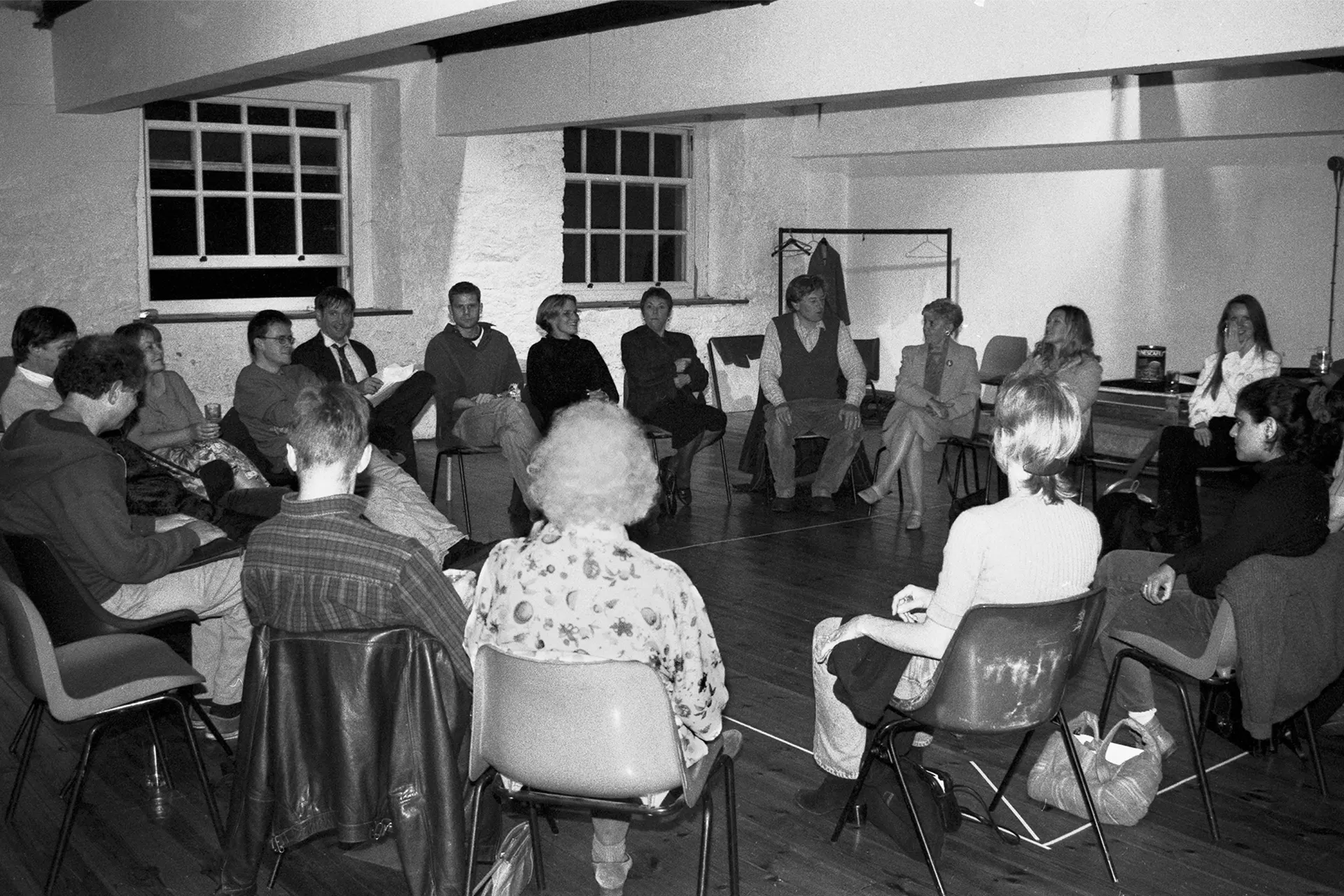
Southwest Scriptwriters then met in the Coopers' Loft at Bristol Old Vic. To reach the rehearsal room at the apex of the Coopers' Hall on King Street, group members entered the backstage area on the first floor and climbed a further two flights to the top of the building. There they found a short gangway over the roof before a few wooden steps to the Loft itself. Extreme accessibility issues aside, a garret room seemed an appropriate place to house a writers' group.
Moving to a local writers' group from an MA class invites unfair comparisons. In the mid-1990s postgraduate creative writing programmes were relatively rare (my course at Cardiff had only been convened the year before I started) and there was stiff competition for places. Then, as now, enrolling to study the subject meant staking thousands of pounds on a qualification that didn't promise particularly enhanced access to a career practicing its discipline. Students on postgraduate creative writing courses are, then, both selected for their aptitude and have invested substantially (personally and financially) in becoming writers. Those attending writers' groups are self-selecting and will often have learned all they know about writing by teaching themselves.
It's wrong to imagine, though, that your particular writing experience is either above or beneath that of a writers' group. This is because of a phenomenon that Robert McKee identifies in a cinema audience, which:
[…] as it settles into a darkened theatre its collective IQ jumps twenty-five points. When you go to the movies, don't you often feel you're more intelligent than what you're watching? That you know what characters are going to do before they do it? That you see the ending coming long before it arrives? The audience is not only smart, it's smarter than most films […] It's all a writer can do, using every bit of craft he's mastered, to keep ahead of the sharp perceptions of a focused audience.[1]
The same enhanced perception transpires in a writers' group, making for a great collective leveller. Those of us who have higher degrees in creative writing are most likely not as well endowed with talent and experience as our qualifications tempt us to believe, while raw beginners bring greater insight to a workshop than their rookie's uncertainty attests. And the current proliferation of creative writing courses in higher education means that you're far less likely to be the lone member of a writers' group with a relevant MA (or higher).
John Cleese[2] suggests that experienced writers ask the following four questions of those to whom they show their work:
1. Where were you bored?
2. Where could you not understand what was going on?
3. Where did you not find things credible?
4. Was there anything that you found emotionally confusing?[3]
It's unnecessary to have writing experience to be able to address these questions since, as with McKee's cinema audience, most will be able to identify how they have responded to work in the above terms. Cleese goes on to add that the thoughts of non-writers beyond this scope should be treated with scepticism, but at an essential level, everybody has something to contribute.
Having made the point about not assuming that a writers' group is either above or beneath you, I have to admit that, as an almost-MA in 1995, I was more impressed by Southwest Scriptwriters' meeting place than I was by the group. It was soon clear that the relationship between Bristol Old Vic and Southwest Scriptwriters was an arm's-length one — the group has been generously hosted by the theatre company for much of its history, and, while the two organisations have worked together on occasional projects, they have mostly maintained a respectful distance. On joining Southwest Scriptwriters I was mainly interested in writing for radio and television and so close connections with a theatre weren't a major attraction for me — my subsequent playwriting efforts came about through my involvement with Southwest Scriptwriters. I wasn't immune, though, to the frisson of being backstage at the historic building nor the commanding view of the cobblestones of King Street from the writerly eyrie.
Being a group without being a group
In the early days of the group, Southwest Scriptwriters meetings were quite formless. When everyone was gathered, someone would eventually bring the meeting to order with a cough and ask if anybody had brought anything to read. The general diffidence was born of a conviction that the group needed to stay as informal as possible. Introducing any kind of red tape would, the theory went, result in conflict that would lead inevitably to the group's early demise. Southwest Scriptwriters was founded on the remnants of an earlier group that had floundered when the Arts Council stopped funding it. There was, therefore, an antipathy to all forms of officialdom and the group aimed to be a group without being a group.
There is a lot to be said for keeping things informal but this tended towards a lack of focus to the extent that the in-meeting calls for material sent sessions off point. Adrian Mole's experience with his writers' group as imagined by Sue Townsend recalls for me Southwest Scriptwriters' early days:
Only four of us turned up for the Leicestershire and Rutland Creative Writing Group meeting tonight. […] Gladys read her latest crappy cat poem — something about “I love my little kitty because she is so pretty…” Naturally, because she is eighty-six, this received a round of applause. […] Gladys was not who I had in mind when I started the group.[4]
While there was no cat-inspired doggerel at Southwest Scriptwriters, the early, anybody-brought-anything-to-read? sessions did feature some equally ill-conceived verse — the couplets I recall, which I won't reshare, made the fictional Gladys' feline rhyme sound like Shakespeare. It's always irritating when people foist their poetry upon you — mention that you're a writer and some feel that they have carte blanche (although it's your fault for mentioning that you're a writer) — but its imposition is intensified at a group centred on scriptwriting; a bit like joining a squash club and finding yourself playing tennis, because, after all, both sports involve hitting a ball with a racket, right?
Following my initial encounters with Southwest Scriptwriters, I might have flounced off with my pending postgraduate qualification convinced that I was a cut above the local writers' group scene. I was impressed by Southwest Scriptwriters' meeting place, though, and John, the guy who collected the subs money, was a freelance copywriter; maybe he could give me a few career tips? (I needed to make the money back on my MA somehow…)
I was in, but I had some suggestions… Maybe we could sort out the material for meetings beforehand? — we could even announce the line-up in the newsletter to make a programme of events instead of just a list of dates… Also, it probably wouldn't hurt if somebody brought meetings together with more than just a clearing of the throat… And we're Southwest Scriptwriters, so no bloody poetry!
Having broken cover with my thoughts on advancing the group, I was in the frame for a key role in putting my ideas into action. I think I first fronted a meeting in 1995 and then led the majority of sessions for the next 21 years.
‘Not who I had in mind…’
Adrian Mole's above conclusion that the elderly Gladys was not who he had in mind when he started his writing group is more of an astute observation on Townsend's part than that about the cat poems. As I've suggested, my experience is that it's better not to bring too many expectations with you when you join a group. Anticipating, for example, that its membership will be made up of individuals with glittering writing careers or of bright young things is likely to set the scales to fall. Those with glittering writing careers are usually too busy with their glittering writing careers to be in writers' groups. And if they did choose to band together, allowing anyone who wasn't similarly accomplished to join them would let the side down. Bright young things, meanwhile, tend to have other things on their minds than clubbing together to help each other with their writing.
Efforts to contrive groups to meet expectations are unlikely to prove sustainable. Around the time I joined Southwest Scriptwriters, some local dramatists began what they intended to be a regular networking session for established playwrights in a city centre restaurant. Following a buffet launch at which the organisers made clear that only those with a production track record should show up for subsequent meetings, the scheme sank without a trace. Southwest Scriptwriters benefitted from the publicity generated by the abortive initiative when a future stalwart of the group seeking the networking session found his way to the Coopers' Loft instead.
Notes and references
Page 1 of 5