
| Released | 13 May 1985 |
|---|---|
| Label | Factory Records |
| Genre | Synth-pop, dance-pop, post-punk |
| Duration | 40:05 |
The order in which you discover music begins with what's around you and becomes retrospective.
You're likely to start with the latest sounds and, if you're curious, work backwards to find what came before.
This leads to an audio overabundance, which is exacerbated by the compulsion to put your favourites into hard rotation, thus reducing your capacity for discoveries and leaving you behind the times.
The music of your moment then depends on when you first heard it, rather than when it was first issued.
Beyond Blue Monday
New Order formed a significant part of my 1980s musical experience in respect of just one record, and no prizes for guessing which one.[1]
The all-time best-selling 12-inch single[2] aside, the band didn't feature.
I knew that the remaining three members of Joy Division had formed New Order following the death of lead singer Ian Curtis in 1980, and I remember clapping ears on a copy of Substance,[3] a 1987 compilation of the band's singles to date.
Substance didn't leave much of an impression on me as I came afresh to the Mancunians' output after the turn of the century, my interest piqued in part by the 2002 Factory Records biopic, 24 Hour Party People,[4] but mostly through the inclusion of various tracks on compilations and in playlists.
My late coming to New Order beyond Blue Monday may partly stem from Factory Records' ideological indifference to promoting its products.
Stephen Morris,[5] New Order's drummer, recalls that the label's:
[…] bands put their all into making those records. But other than the few reviews in the music press and possibly the odd radio play, there was no way of the wider world being aware that they even existed. I could see the political correctness in this. In an ideal world surely that would be enough.[6]
With such scant plugging, The Perfect Kiss,[7] Low-life's lead single, rose to only number 46 in the UK charts.[8]
Still dependent on chart sounds for my new music choices in 1985, it's unlikely that I would have heard contemporary releases that didn't make the weekly Top 40 countdown.
Unconventional commercial approach
Factory's disinterest in marketing was compounded by New Order's antipathy to adopting a conventional commercial approach with its albums.
The band signed with Warner Bros in the United States and was pressured by the label to make the new LP more marketable.
The bandmates compromised on including singles on the album, which they had resisted for their first two LPs.
Morris writes of the concession:
I kind of half justified this to myself because the real version of ‘The Perfect Kiss’ was such a lengthy majestic epic of a song […] that the curtailed version on the LP was really just a trailer for the whole thing, the full-length feature of the 12-inch version.[9]
As unseen on MTV…
When it came to courting an audience on MTV — another staple of eighties mythology that played no part in my experience of the decade — New Order again struggled to come up with industry-compatible content.
On tour in the US, Morris noted that much of MTV's output consisted of spandex- and eyeshadow-sporting hair metal outfits.
New Order's response was to hire Jonathan Demme, who directed Talking Heads' concert film Stop Making Sense,[10] to shoot a live performance of The Perfect Kiss in the band's rehearsal room.
The result is a short film featuring cinematic production values and an extended running time that made it unsuitable for broadcast on MTV.
Peter Hook,[12] New Order's original bassist, agrees with Morris that the edit of The Perfect Kiss on Low-life amounts to a ‘taster’.
He adds that the lyrics reflect a ‘true story of an acquaintance who was shot and killed in Moss Side’.
The upbeat, near-whimsical tune contrasts with the song's dark subject matter. Hook's distinctive bass hovers close to the melody, and Morris, having ‘programmed himself out of a job’ with electronic drums,[13] contributes musical frogs from an Emulator sample.
The album lacks euphonious amphibians elsewhere, but continues to set dark lyrics to brighter tunes.
Way out west
Love Vigilantes, Low-life's opener, is an anti-war song with a way-out-west sound. What lead singer Bernard Sumner thought of as a ‘redneck tune’[14] backs a lyric in which (plot spoilers) a soldier dreams of returning from the battlefront to his wife and child. His spiritual homecoming coincides with the arrival of a telegram informing his wife of his death.
Hook identifies This Time of Night and Sub-Culture as having been inspired by the bandmates' attendance at Skin Two, a fetish nightclub that spawned a magazine of the same name.
He describes This Time of Night as a ‘very dark song’, and thought ‘it should definitely have been used in the Fifty Shades of Grey film’.[15][16]
Sub-culture was the album's second single,[17] and, with a number 63 chart reach,[18] would not have troubled my 1985 self.
Elegia, Side 2's starter, is another edit, this time of an extended instrumental, which, Morris[19] reports, ‘took its inspiration from Ennio Morricone's score for the duel scene in Leone's classic Western For a Few Dollars More.’[20] The Western influence here creates symmetry with Love Vigilantes on Side 1.
The track tempts me to make a lazy comparison with the mostly instrumental second side of David Bowie's Low.[22] To check this, I streamed the Low tracks and then the full-length (17 minutes, 31 seconds) version of Elegia, which is included in the Definitive edition of Low-life.[23]
The New Order and Bowie tracks share a strong affinity for ethereal electronics, but Elegia features a guitar part that assumes the role of the ‘chimes’ in the Ennio Morricone score.
Low-life also apparently reflects Bowie's album in its title, but this is unintended.
The album is named for the notoriously dipsomaniacal journalist Jeffrey Bernard, whose weekly Spectator column was titled Low Life.[24][25]
Alternative artwork angles
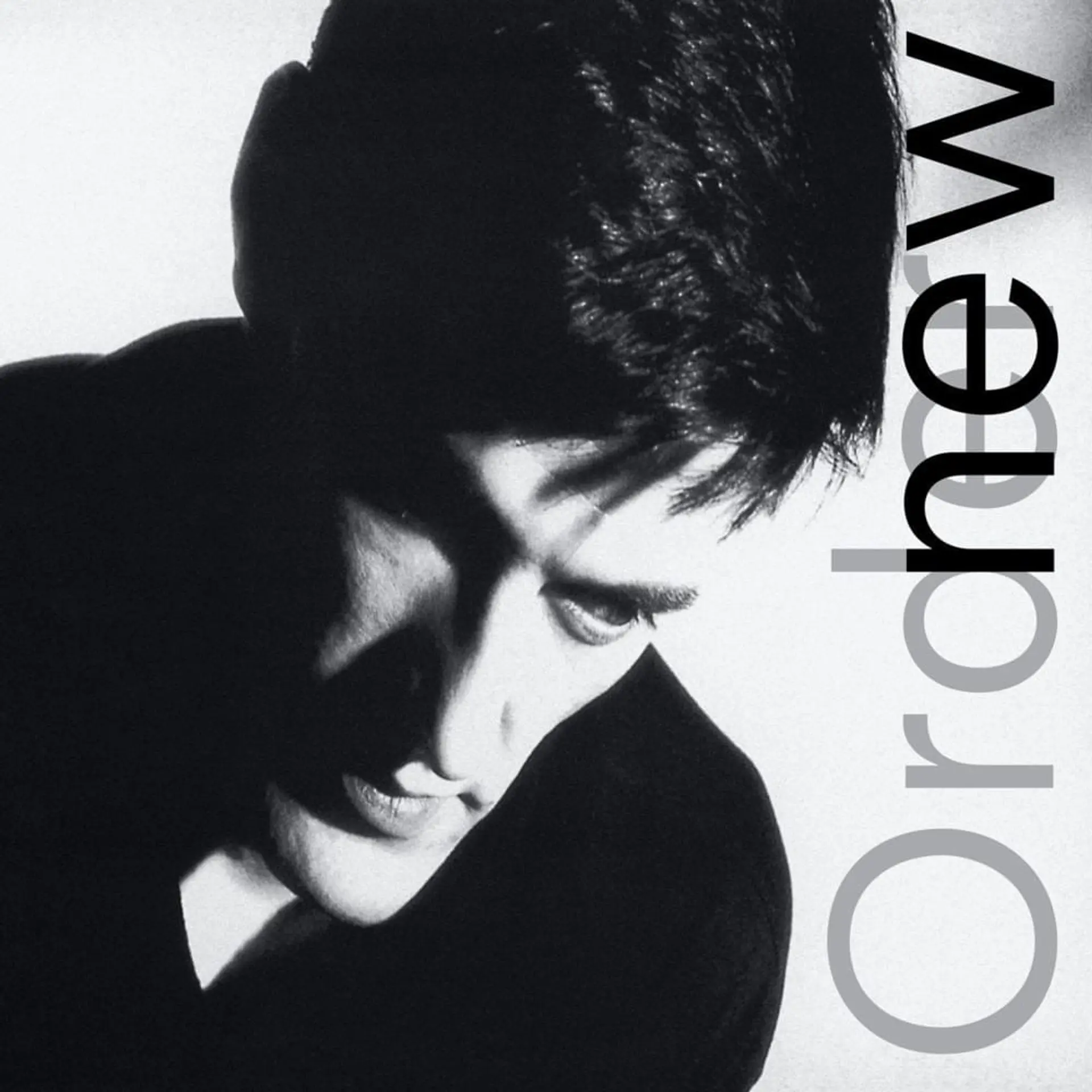
New Order declined the commercial nicety of including the title on the album's cover, but succumbed to featuring portraits of the band's members and its name.
Factory's graphic designer, Peter Saville, arrived at novel ways of observing these conventions.
Hook[30] relates how Saville had the bandmates photographed individually, ‘using a completely new camera film called Polaroid roll.’ Saville stopped the photo session when he saw a shot suitable for the cover.
Next, the graphic designer processed the portraits using early imaging technology to render them with the square aspect ratio necessary for an LP sleeve.
He chose to use a picture of Morris on the front cover, but:
[…] felt very strongly that if he featured anyone’s picture too much, either by putting it on the front or putting the title or song credits on it, it would be going against his feeling that everyone in the band was equal, i.e. there was no band leader.[31]
Morris[32] points out that the order in which the portraits appear is the ‘complete reverse’ of ‘the way you would expect.’
The drummer, usually the embodiment of a band's back line, is upfront; keyboardist Gillian Gilbert is on the back, and customary front-liners, singer and bassist, Sumner and Hook, feature on either side of the inner sleeve.
Saville shrouded the sleeve in translucent paper bearing the band's name and track listing, removably superimposing the text on the images.
Hook[33] writes that Saville ‘loved’:
[…] the idea of you having to destroy the tracing-paper cover to get to the record. Another bonus was many fans buying two copies, one to play and one to save unopened.[34]
My copy, an eBay acquisition, has the translucent paper intact. It wraps the sleeve much like a hardback book's dust jacket, with flaps that fold into the cover's opening. You may need to tear the translucent cover to fully reveal the pictures on the sleeve, but it doesn't seem that the LP's original owner broke the wrapper to remove the record.
Inescapably destructive artwork or not, Saville's designs made the look of New Order's releases highly distinctive.
A retrospective future
The band's next single, following those torn reluctantly from Low-life, was Shellshock,[35] which was its contribution to the soundtrack of Pretty in Pink.[36]
The film is another slice of eighties popular culture that, although I'm familiar with it now, I don't remember from the time.
1001 Albums You Must Hear Before You Die[37] insists on a retrospective return to Low-life by including the album on its ten-ton-plus-one bucket list.
In his compendium entry for the LP, Chris Shade[38] finds that it:
[…] encompassed techno pop (“Subculture”), dark gothic rock (“Sunrise”), and the first recorded incidence of country 'n' techno (“Love Vigilantes”).[39]
New Order's music is often labelled ‘alternative’ because it stood apart from the mainstream chart sounds of the time. For me, it has also become part of an alternative soundtrack to the 1980s — one that now frequently replaces the music I chose back then.
Notes and references