
This essay examines the influence of emerging media technologies on the way in which writers structure their work. It firstly explores the role of texts as artefacts building on some of the conclusions drawn within the previous essay. Through a consideration of contemporary approaches to the structuring of texts, looking particularly at works for film and television, it surmises how the possibility of audience interaction might influence this process in the future.
In the broader sense of the word, ‘interactive’ requires both cognitive and responsive participation in an activity. Reading a book, listening to a play on the radio, watching a television programme or cinema film seem, at a superficial level, to be entirely passive activities. The flow of information is unidirectional and the reader or viewer consumes the text without communication with the author. This suggests a ‘hypodermic’ relationship between author and audience — the writer creates the text and the audience passively receives it. The activity of reading is, however, far more complex and proactive.
In the previous essay I noted that, according to Freund and Poulet[1], ‘A book [television programme or cinema film] requires a reading consciousness for its realisation as a work.’ This reading consciousness is not merely that of passive repository, but one which engages with the text, creating a cognitive performance which realises it as a work. Performances exist at two cognitive levels — during its creation in the mind of its author, and during its recreation in the reader’s mind. As Wolfgang Iser puts it:
[…] the literary work has two poles, which we might call the artistic and the aesthetic: the artistic refers to the text created by the author, and the aesthetic to the realisation accomplished by the reader. From this polarity it follows that the literary work cannot be completely identical with the text, or with the realisation of the text, but in fact must lie halfway between the two.[2]
According to Freund, the text as an artefact is dissolved within the reading consciousness at the aesthetic pole and exists in ‘mute materiality’ as an ‘inert object’ until said reading consciousness is applied to it.[3]
Although it is undoubtedly true that an author requires a reader to realise his or her work, it is also significant that this work can be stored as an artefact, albeit in ‘mute materiality’. As shown in the previous essay, media facilitate the projection of ideas both temporally and spatially. Through writing, an author is able to project his or her work forward in time and outwards in space — we are able to read Dickens’ novels over a hundred years after his death and wherever we wish because they have been recorded and reproduced in a permanent and portable form.
The existence of texts as artefacts is also significant at a far less self-evident level. If narratives could only be conducted through the medium of speech, they could be delivered only in linear real-time form with little opportunity for back reference and rereading. A storyteller can be asked to repeat sections of his or her story, or indeed the whole thing, but it is unlikely that this person could be detained indefinitely for constant reference.
Once a text is recorded in a book it assumes a permanent existence independent of its author and can give itself up temporally at different levels than the amount of time taken to deliver the text orally. It can also be accessed at random and sections may be reread and reviewed at the reader’s will without testing the patience of the author. In short, once a text is recorded as an artefact it is liberated, to varying extents according to the chosen medium, from its linearity.
This point is significant and central to this essay. Once narratives and their constituent parts are available to be accessed at random, readers are able to interact editorially and, I will argue, more creatively with them.
To better understand this, let us consider the various media for recorded music. An audiotape is almost entirely sequential, music tracks recorded onto it must be played one after the other in the order in which they are recorded on the tape. It is possible to play individual tracks separately, but the intervening ones must be wound through before the desired music can be heard. The possibility for editorial interaction is low because of the unwieldy nature of a purely sequential, linear order.
Conversely, the bands on an LP record can be accessed at random, and individual tracks accessed relatively quickly according to desire. The benefits of random access here are however limited because of the difficulties of positioning and repositioning the stylus accurately in the desired place on the LP.
The advantages of random access do not become really evident with music carriers until compact disc technology is employed. Music on a compact disc can be immediately accessed at will and played in any order the listener desires. The restrictions of sequence are broken and, at a limited level, editorial control can be exerted.
Although this phenomenon is again self-evident, its significance is that texts are broken down into smaller discrete elements. Instead of being a complete sequence of music as with an audio tape, a CD is both a complete sequence and a randomly available set of tracks — the larger, hitherto rigid, arrangement now gives itself up in parts.
Marshall McLuhan[4] explains the technological breaking down of linear sequence thus:
mechanisation is achieved by fragmentation of any process and by putting the fragmented parts in a series. Yet […] there is no principle of causality in a mere sequence. That one thing follows another accounts for nothing. Nothing follows from following, except change. So the greatest of all reversals occurred with electricity, that ended sequence by making things instant. With instant speed the causes of things began to emerge to awareness again, as they had not done with things in sequence and concatenation accordingly. Instead of asking which came first, the chicken or the egg, it suddenly seemed that a chicken was an egg’s idea for getting more eggs.[5]
In order for processes to be mechanised, McLuhan argues, they first had to be broken down into separate repetitive parts which could then be performed by individual machines. A linear routine resulted which could not be escaped or deviated from without destroying the process. Until this process could be broken by the instantaneous effects of electricity, it could not be recognised that processes were a means by which to introduce more machines rather than to produce products. By putting this slant on this particular ‘chicken and egg’ question, McLuhan aims to demonstrate his hypothesis that the ‘medium is the message’.
McLuhan posits that the process of mechanisation absorbed individuals and cultures within its structure, blunting awareness. As observed in the previous essay, he believed that, ‘The serious artist is the only person able to encounter technology with impunity, just because he is an expert aware of the changes in sense perception.’ This is a modernist approach to media, allowing room for little faith in an audience’s levels of perception at what Iser dubbed the ‘aesthetic pole’ of a text. Roger Fowler[6] gives the following definition of the artist’s relationship with audience under modernism:
[Modernism’s] notion of the artist is of a futurist, not the conserver of a culture but its onward creator; its notion of the audience is that it is foolish if potentially redeemable: ‘Artists are the antennae of the race, but the bullet-headed many will never learn to trust their great artists’ is Ezra Pound’s definition. Beyond art’s specialised enclave, conditions of crisis are evident: language awry, cultural cohesion lost, perception pluralised.[7]
McLuhan’s modernist view, therefore, posits that audience perception becomes decreasingly acute with existing media technologies and it is for the artist to lead the way. If, however, audiences have the facility not only to interpret texts but to manipulate them, we might hypothesise that their role is increasingly dynamic.
It is important to remember before we do so that although a rigidly prescribed structure might prevent what McLuhan terms ‘awareness’, this is not to say that structures can be disposed of. The writer requires structure in order to be able to tell a story effectively. As William Goldman[8] comments on film scriptwriting:
SCREENPLAYS ARE STRUCTURE
Yes, nifty dialogue helps one hell of a lot; sure, it’s nice if you can bring your characters to life. But you can have terrific characters spouting just swell talk to each other, and if the structure is unsound, forget it.
Writing a screenplay is in many ways similar to executing a piece of carpentry. If you take some wood and nails and glue and make a bookcase, only to find when you’re done that it topples over when you try and stand it upright, you may have created something but it won’t work as a bookcase.[9]
Although structure is central to the success of screenplays, this does not imply that they should be rigidly linearly delineated — to coin a phrase, ‘there is more than one way to build a bookcase’. Hitherto this has mainly been a consideration in terms of a script working aesthetically for an audience, but I aim to demonstrate that emerging technology will preclude linearity.
The linear approach is evident in conventional wisdom on the way in which drama ‘should’ be constructed. In his book on film and television scriptwriting Wells Root[10] gives cinematic auteur George M Cohan’s definition of the three-act narrative structure:
“In the First Act get your man up a tree.” By “your man” [Cohan] meant the central character, your hero. By “up a tree” he meant confront him with a dramatic problem or crisis.
“In the Second Act throw stones at him.” By “throwing stones” he meant intensify your man’s problem: almost stone him off his perch.
“In the Third Act get him down out of the tree.” By which Cohan meant, resolve your man’s crisis or problem.[11]
To say that a play, film or television programme has a ‘three-act structure’ is no more than saying that a story has a ‘beginning, middle and an end’ — a linear, three-step progression, each step following directly and inevitably from the previous one.
When taking IQ tests in junior school, I was given a task in which a series of images were placed before me and I was asked to arrange these in the ‘right order’. One of these consisted of drawings of a boxing match — the first picture showed the boxers wearing their dressing gowns in the ring before the contest, the second the contestants during the fight, and the third the referee lifting the winner’s arm aloft. Obviously the exercise was designed to test ability to order a simple narrative.
As implied above, even a simple structure such as this need not be organised in strict consecutive order. A television news report on a boxing match might begin with an image of the victor’s arm being lifted by the referee, cutting back to highlights of the match and completely omitting the opening moments — effectively telling the story backwards with no beginning. It might even be argued that the entire story is conveyed by the final image since this contains all of its essential elements. As McLuhan indicates, however, ‘That one thing follows another accounts for nothing. Nothing follows from following, except change,’ so a referee lifting the arm of a boxer does not indicate that a fight has necessarily preceded this. By starting at such an event a writer might, for example, break with linearity in order to speculate how this came about, possibly using his or her audience’s assumptions to deliberately mislead them.
If sections of a story are interchangeable, our approach to structure must differ from the purely linear. Maintaining the ‘three-act’ model, a linear structure may be represented figuratively as follows:
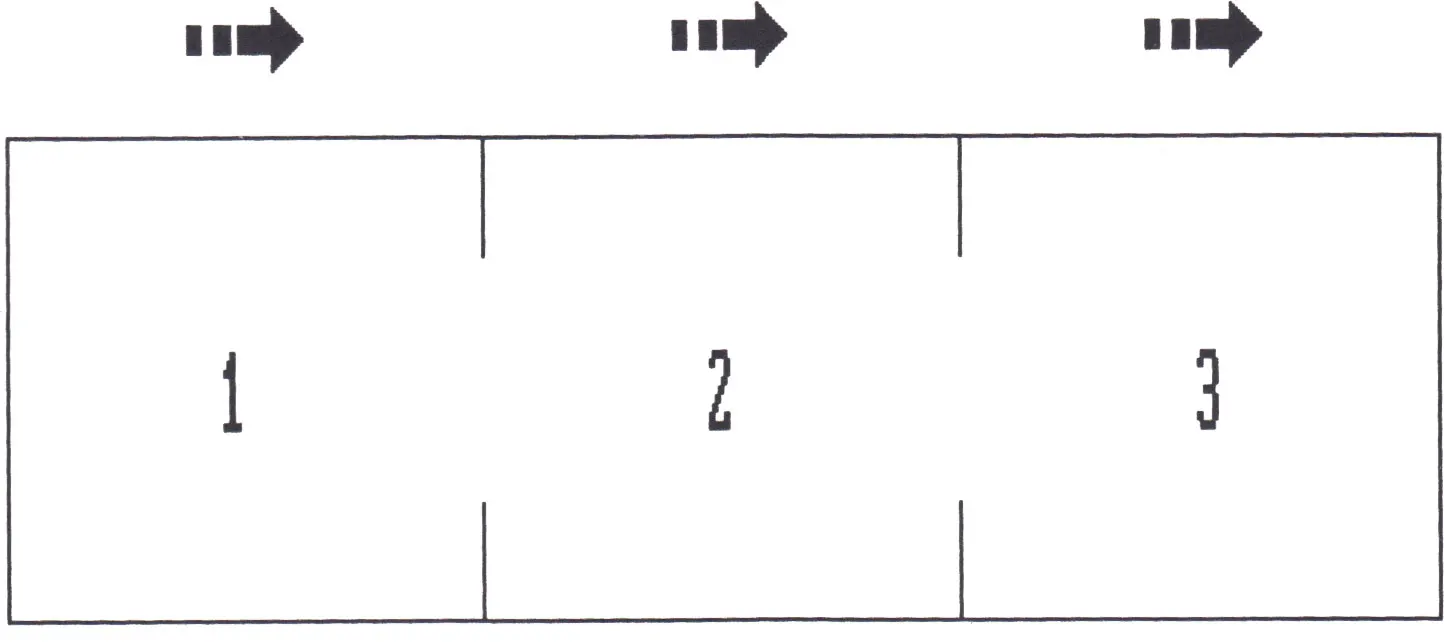
Each box represents a single act and with this model each act is accessible via the numerically preceding one alone, the narrative progressing only in the direction of the arrows. There is no opportunity for interchange of discrete parts of the narrative since it is imagined that the audience can only grasp this if they are informed of events in rigid sequence. However, as we have seen, it is unnecessary to narrate a storyline in such a strongly delineated fashion and thus a more complex and flexible model must be found:
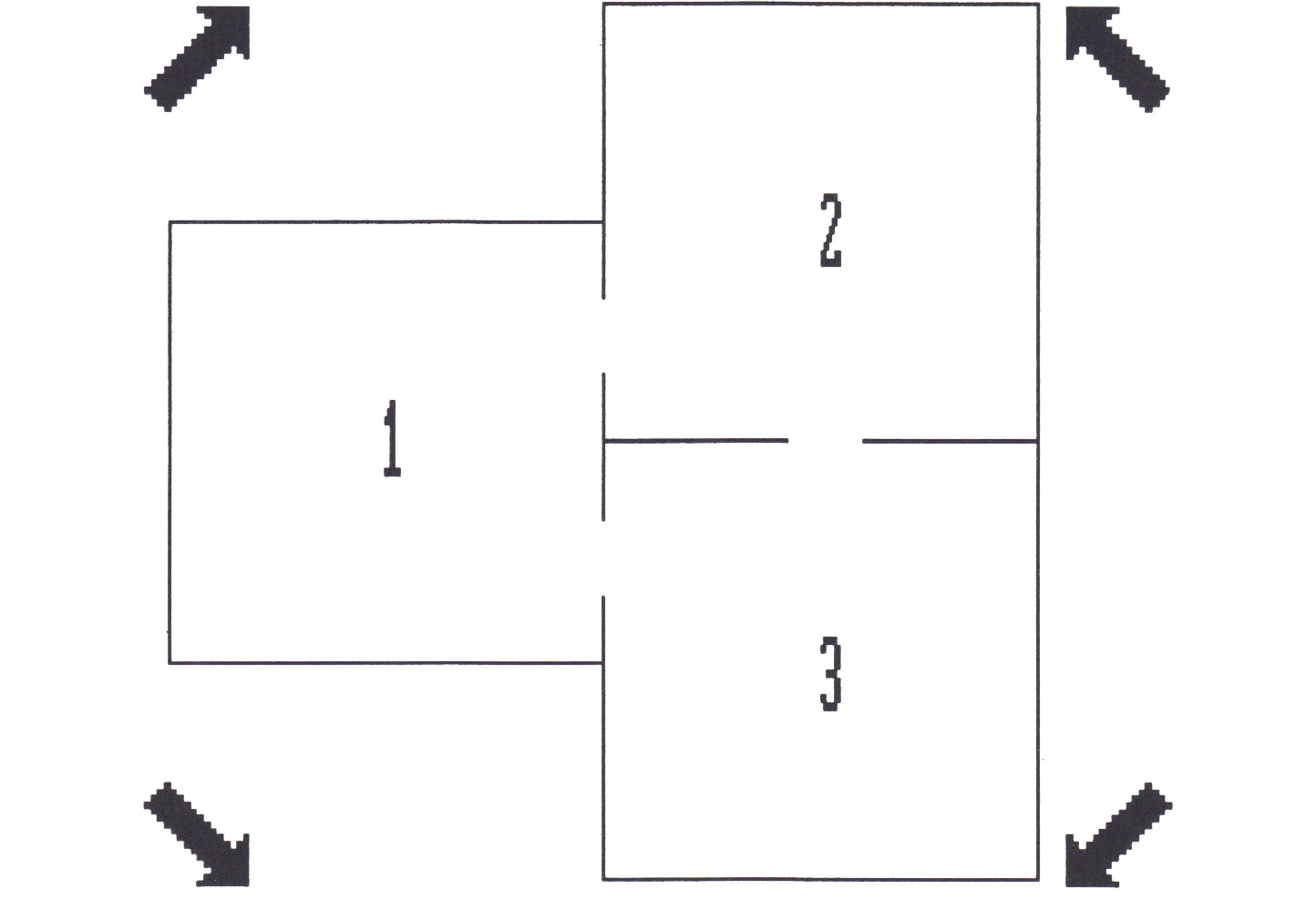
With this model each act can be accessed from either of the others and, as the arrows indicate, no particular direction through the narrative is prescribed.
Within these models I have used the three act structure as a convenient way in which to break down a more complex narrative, but there is no reason why individual events or scenes within such a narrative should not be similarly interchangeable.
Pulp Fiction, a screenplay by Quentin Tarantino[12], divides up a linear storyline and retells this in non-consecutive order, creating a sometimes disorientating but aesthetically more engaging structure than if events had been related in strict sequence. The film interweaves three stories (four, if the Prologue and Epilogue tale is counted), also meshing the lives of its protagonists. So effective is the rearrangement of the linear storyline that it takes some thought to establish its consecutive order. Empire magazine[13] offered the following linear précis, which I have annotated to show how the action is divided within the script:
Day One
Hitmen Vincent and Jules arrive at a Hollywood apartment intent on retrieving something expensive belonging to their boss Marsellus Wallace.[14] On their way back their informant Marvin’s head becomes detached from his body and redecorates Jules’ car’s back seat. The pair hightail it to Jimmy’s house and call in Winston Wolf to sort out the mess.[15] Later that morning, Jules and Vincent go for breakfast to the diner that Pumpkin and Honey Bunny have decided to hold up.[16] When Vincent and Jules return to Marsellus Wallace’s club they find him in conversation with Butch…
Day Two
The following evening Vincent takes Mia Wallace out to Jack Rabbit Slim’s for dinner. Later that evening, back at Mia’s house, she overdoses on Vincent’s heroin and he rushes her round to Lance’s house for an adrenalin shot…[17]
Day Three
The night of the fight Butch kills his opponent and Marsellus sends Vincent after him…
Day Four
Preparing to skip town, Butch discovers his girlfriend Fabienne has left his gold watch at their apartment and goes back to find it. There he kills Vincent and, on the way back to his motel, runs into and then over Marsellus. After the incident at the pawn shop involving the hillbillies and anal sex, Butch and Fabienne peel off on Zed’s chopper into the distance…[18][19]
As may be deduced from the page numbers given in the footnotes for the above, the stories of Pulp Fiction are twisted sequentially back on themselves. The ‘Prologue’ and ‘Epilogue’ which occur consecutively before any of the other escapades are placed around these, ‘Vincent Vega and Marsellus Wallace’s Wife’, the second story, is shown first, ‘The Gold Watch’, which is the concluding part of the film, is placed in the middle, and the opening tale, ‘The Bonnie Situation’, immediately precedes ‘The Epilogue’. This temporal shuffling is made possible by references in each of the individual stories to the narrative which follows it so that the film maintains integrity within its parts.
Of course temporal rearrangement is not a new cinematic technique. Orson Welles’ Citizen Kane[20] opens at the end of its story with the death of Kane. His story is then told in flashbacks as a group of newsreel journalists attempt to discover the identity of the elusive ‘Rosebud’ — Kane’s dying word. The search for ‘Rosebud’ is the narrative ‘glue’ which binds a number of disparate impressions of Kane given by his wives, friends and acquaintances. The film is linear in as much as Kane’s associates are interviewed in ascending order — his earliest connections first — but this need not have prevented Welles choosing a different order — the story gives itself up in parts because each section is complete in and of itself.
The point that a narrative structure can work both as a single entity and in parts is worth remaking since, as suggested earlier, new media technology will make it possible for ‘readers’ to redefine and reconstruct the way in which they consume texts.
Much of these two essays has been concerned with the singular ‘medium’, but emerging technology allows an audience simultaneous access to a number of media. Stuart Maconie[21] gives the following definition:
Multi-media refers to a blending of media types. The newest technology offers a disc that carries any kind of information that can be encoded digitally. So the CD of the future, or to be more accurate, of the present, since the stuff is in the high streets now, will be able to offer music or text or speech or visuals or computer games. Or, and this is where it gets interesting, some kind of combination of all the above.[22]
Maconie continues that electronics manufacturer ‘Philips believes that with the advent of multi-media “the effects will be as dramatic as the emergence of sound and picture recording themselves”.’ As suggested above, the introduction of this technology will also influence the way writers approach their work. Maconie describes the contents of a CD-ROM featuring the 1964 Beatles’ film A Hard Day’s Night[23]:
The package includes the whole 90-minute feature film in reasonable quality digitised form plus the original Alun Owen script, a lengthy critical commentary, interviews with [the film’s director] Richard Lester and a host of supplementary features such as song lyrics and background, the ability to instantly access various scenes as you would a CD track and in-depth profiles on all the main cast members.[24]
Two main implications of such a medium for the writer initially strike me. Firstly, as explored at length above, the film itself becomes non-sequential since individual scenes are immediately accessible by the viewer. The viewer can therefore exert limited editorial control over the film as is correspondingly possible with tracks on a music CD. If Pulp Fiction or Citizen Kane were available on CD-ROM, editorial choices could be made by the viewer, perhaps reconstructing Pulp Fiction in sequential order to discover how a linear storyline might work.
This facility should not be underestimated since, as we have seen, editorial choices concerning the positioning of individual scenes in a cinematic text essentially influence the reader’s aesthetic experience. The linear and random models of plot construction given above are thus repositioned within the realm of the reader at the aesthetic pole and allow said reader some creative control.
As Maconie also describes, the availability of works on CD-ROM is not restricted to video images and graphics. Literary texts can be made available and the complete works of Shakespeare and Dickens can now be purchased on CD-ROM. Rendering these texts in digital form has similar effects to those of thus rendering film and music — the text becomes randomly available to the reader and is increasingly fluid and malleable.
This essay, for example, is written to be read sequentially, conforming entirely with the first of the two models given above (although, of course, it is not accurate to consider this in terms of ‘acts’, but the linear sequence still applies). There has been no attempt to enable the reader to access parts of this text at random through the use of subheadings or other content ‘flags’. Since, however, it has been written using a word processor, this essay is available to its author in digitised form and may be accessed randomly via this. Using the word processor, for example, it would be possible to instantaneously trace all references to Marshall McLuhan simply by entering the keyword ‘McLuhan’. If a subsequent essay were to be written in which McLuhan’s work was relevant it is also possible to ‘paste’ the appropriate sections into the future work.
The digitised version of this particular text can therefore be seen as a significant by-product of its production for the printed page. Likewise, a screenplay is a significant by-product of the production of a film — it is essential to the production of the film, but (in the most part) is not the artefact intended for presentation to an audience. Likewise, an orchestral score or a song’s printed lyric are not normally intended as the final musical ‘product’.
With multimedia technology such creative by-products are available to the reader, this availability enabling him or her to penetrate the work at a far more fundamental level than mere consumption of a ‘finished’ text. Texts become a part of a continuing chain of reference resources which allow subsequent readers to create further, more complex texts from these.
An example of this phenomenon lies again within recorded music. Computerised musical synthesisers known as ‘samplers’ are widely used in the creation of both popular and avant-garde ‘classical’ music recordings. Samplers digitally record segments of sound from other recordings — from short musical phrases to the ‘sound’ of a musical instrument — which can then be used in further recordings. For example, the African drum sound at the opening of Britain’s biggest ever selling recording — Do They Know It’s Christmas? performed by Band Aid[25] — is taken from another recording — The Hurting performed by Tears for Fears.[26]
In a recent interview,[27] Quentin Tarantino comments on the plundering of other work in filmmaking:
‘I steal from every movie ever made. I love it — if my work has anything it’s that I’m taking this from this and that from that and mixing them together. If people don’t like that, then tough titty, don’t go and see it, all right? I steal from everything. Great artist steal, they don’t do homages.’[28]
The opportunity for ‘stealing’ from other texts is enhanced by such texts’ availability through multimedia technology. Michael White[29] foresees that this will eventually bring about juvenile genius writers producing literary hybrids as a matter of course:
Like everything else, education will be revolutionised by virtual reality and computer advances; the wealthy, highly educated minority will get their basic education over with more quickly and become artists, writers and musicians far sooner. Eight-year-olds will be veterans on their third novel. A popular genre will be the “sample novel”: perhaps a splice of Defoe and Brontë, in which the lesbian Heathcliffe is stranded on Moonbase Zero-Six.[30]
The concept I have been judiciously skirting here is that of postmodernism. If the modernist writer, as Fowler puts it, is ‘a futurist, not the conserver of a culture but its onward creator’, then the postmodernist writer is the opposite — endlessly drawing on what has gone before, producing texts which are a part of a cyclical, self-referential canon. The author of multimedia texts is both cultural conserver and onward creator since he or she is involved in bringing existing work to a new medium and creating new texts with this.
A recurring theme within these two essays has been the concept of the ‘serious artist’ occupying a uniquely insightful position above the ‘bullet-headed many’ who, for example, are unaware that ‘the medium is the message’. Iser would argue that texts and authors are esteemed because they are communally and mutually valued by what he terms a ‘readership community’. A ‘serious artist’ therefore can only occupy such a position with the mutual and mass consent of his or her readers. If multimedia has any possibilities, they lie in the drawing together of the aesthetic and artistic poles of a text allowing maximum communication and thus greater opportunity for author and reader to ‘only connect’.
Notes and references