
This work approaches writing manuals through a consideration of the ways in which they might instruct and influence the inexperienced writer. Using a number of ‘how to’ books as illustrations, the essay divides the writing process into the technical and the creative, looking particularly at how these divisions interact. The work concludes with a consideration of the relationship between books on creative writing and proactive experience in the form.
And thus the native hue of resolution
Is sicklied o’er with the pale cast of thought,
And enterprises of great pitch and moment
With this regard their currents turn awry
And lose the name of action.
In her foreword to William Ash’s The Way to Write Radio Drama[1], Fay Weldon compares learning to write with learning to ride a bicycle:
Wonderfully simple, if only you knew how, but impossible if you didn’t: and the learning process better left somewhere way back in the past, with its vague memories of blood, sweat, tears, scrapes, bruises and parental reproaches. Until suddenly there you are, as if by magic, in the heady company of those you most admire and respect, actually doing it! Riding a bike! Writing a play![2][3]
This metaphor is regularly applied to any process which requires a period of practise before it is mastered and which, once competence is achieved, is unlikely to be unlearned or forgotten. Learning to swim, climb a rope or drive a car are all skills which eventually become second nature, but are initially difficult to acquire.
A further similarity between these is that they combine technical or mechanical expertise with a more abstract experience. As Weldon continues, ‘a book on “How to Ride a Bicycle” has to be about more than just how to put your foot on the pedals, but about freedom, power, speed, wind, self-determination, life, death, sheer exhilaration.'[4]
Leaving aside the superlative qualities of cycling, we might divide the learning process into mastery of the mechanical — steering, turning of the pedals, operation of brakes and gears — and the abstract — balance. The ability to balance on a two-wheel bicycle is a phenomenon governed both by the momentum of the vehicle and the confidence of the rider. It is this confidence which allows cyclists to make the mechanical processes second nature.
Similarly, when learning to swim, individuals are taught to use their natural buoyancy in order to keep afloat. Buoyancy exists for everyone as a physical property of water whether or not they have the confidence to use it, and it is this confidence that a swimming instructor must instil in his or her students.
Clearly it is of little use instructing students only in mechanical processes if they do not have the ability to put these into effect. Someone learning to swim might be perfectly able to execute the leg and arm motions of the breast stroke or crawl on the poolside but sink like a stone once in the water. Knowledge of technique without the ability to put it into practice is redundant.
Just as a swimming instructor will encourage learners to gain confidence in the water by experiencing it in the safety of a shallow depth or by using buoyancy aids, a teacher of creative writing should encourage his or her students to gain confidence in their writing ability before immersing them in technique and theory. In this sense individuals learn to be swimmers before they learn to swim, to become writers before they learn to write.
Dorothea Brande (1983) suggests the following for ‘The Difficulty of Writing at All’:
It may be that the root of the trouble is youth and humility. Sometimes it is self-consciousness that stems the flow. Often it is the result of misapprehensions about writing, or it arises from an embarrassment of scruples: the beginner may be waiting for the divine fire of which he has heard to glow unmistakably, and may believe that it can only be lighted by a fortuitous spark from above. The particular point to be noted here is that this difficulty is anterior to any problems about story structure or plot building, and that unless the writer can be helped past it there is very likely to be no need for technical instruction at all.[5]
‘How to’ books may therefore focus too much on the mechanics and techniques of writing and not enough on building an individual’s confidence as a writer. Just as water has an innate buoyancy which can support anyone with the will to swim, so too, Brande contends, can individuals with the will to write be encouraged to do so. The welter of information on character and plot development, dialogue, narrative and so on found in many ‘how to’ books might prove daunting, discouraging and ultimately unnecessary if aspiring authors do not have the confidence to write in the first place.
Brande argues that what newcomers see as a writer’s ‘magic’ acts as a barrier to their own writing. They see themselves as hopelessly subordinate to those who have achieved publication success and literary fame, lacking the mystical muse required to write. Colin Evans (1993) discovered this phenomenon amongst university lecturers who ‘see their position as being humbly in the service of creative writers: “I’m not creative. I study literature because I admire it. So I want to be as close to it as I can.”‘[6]
Lack of self-confidence in one’s own writing abilities is reinforced by the approach of others. ‘You are likely to hear that your desire to write is only an infantile exhibitionism,’ comments Brande, ‘or to be warned that because your friends think you a good writer (as if they ever did!) the world cannot be expected to share that fond opinion.'[7]
William Goldman’s (1984) experience bears this out:
I don’t think most people realise — and there’s no reason they should — the amount of demeaning garbage you have to take if you want a career in the arts. I mean, going off to med school is something you can say with your head high. Or being a banker or going into insurance or the family business — no problem.
But the conversations I had with grown-ups after college…
“So you’re done with school now, Bill.”
“That’s right.”
“So what’s next on the agenda?”
Pause. Finally I would say it: “I want to be a writer.”
And then they would pause. “A writer.”
“I’d like to try.”
Third and final pause. And then one of two inevitable replies: either “What are you going to do next?” or “What are you really going to do?”[8]
Robert Fritz (1994) asserts that this phenomenon is experienced by creators in general. He explains the relationship between creators and their work and others’ resistance to it thus:
The reason I create is simple: I want the creation to exist. In fact, I love the creation enough that I will take whatever actions are necessary to bring the creation into the world. This is how it is for all creators, although we have been taught not to admit it, for when we talk like that, we can be accused of being elitists, mystics or fools.
‘What about the real world? You can’t live your life doing what you want. You must be realistic; you need to come down to earth!’ This is the type of thing our kids hear at school. This is the type of thing you and I have heard many times during our lives.[9]
Fritz describes how love of a creation is essential to its realisation. This love seems onanistically self-indulgent to others who, as shown above, saddle potential creators with a sense of guilt about their desire to bring something into being. Describing the workshop contributions of three male colleagues on her MA Creative Writing course at the University of East Anglia, Kathy Page relates:
[Something Page’s colleagues] had in common was that they all wrote short stories featuring masturbation. There were minor differences in detail and setting, but the similarity was very striking. Someone had pointed it out in a seminar only to be told that it was not surprising since, all writing was, after all, essentially, masturbatory.[10]
Evans discovered that students at Oxford University exhibited a ‘masturbatory’ coyness about their creative writing:
‘I used to write books. It was knocked out of me well before university. I feel sad about that. I write occasionally now, but I’m very reluctant to share it with anybody.’ So the writing is abandoned or becomes purely private, shown to no one.[11]
The student’s comment here further reveals that writing is seen as a frivolous aberration, something to be ‘knocked out’ of individuals, bludgeoned by the cynicism of others and their own self-doubt.
Gerald Kelsey (1995) in Writing for Television draws together the threads of what we have discussed so far in a single paragraph:
You can learn, very easily, to lay out a script on the page. You can master all the technical terms. But if you can never feel the bitterness of a woman who has lost her child; the anger of a man wrongfully accused; the despair of a young person unable to get a proper job or the terror of someone facing a madman with a knife, perhaps you should ask yourself whether writing drama really is for you.[12]
Kelsey points out the dichotomy between the technical and the creative, noting earlier that a properly set out television script will not succeed on its presentation alone. He notes that a writer must be able to strongly empathise with characters in the situations he or she chooses to place them, but seems to offer no route by which an aspiring author may arrive at this — throwing a further brickbat in the direction of fledgling dramatists by suggesting that they should consider giving up if they don’t feel that empathy.
What Kelsey seems to suggest here is that successful writers have a special ability to identify with their characters which is unavailable to many others. If this were the case, drama would only work for people with the capability to become writers since only this select minority would have the intellectual and emotional resources to properly identify with the characters portrayed.
The fact that millions of people constantly identify with and relate to fictional characters — watching soap operas, attending films and theatre, reading novels — suggests that those who write have no monopoly on empathy. In fact, it would take a peculiarly emotionally barren person not to ‘feel the bitterness of a woman who has lost her child; the anger of a man wrongfully accused,’ and so on.
Kelsey’s comment is especially redundant because it appears in a volume on drama writing. Assuming that his book’s potential audience wish to create television scripts as a result of enjoying the output of the medium, it is likely that they will have been caught up emotionally by the texts which have inspired them. Although it is possible that the motivation for writing is purely financial, anyone with the degree of inability to identify with dramatic situations that Kelsey suggests should be seeking psychiatric help.
William Smethurst (1992) suspects just that of many aspiring television dramatists:
The urge to write television drama is at its strongest amongst the socially maladjusted; people who cannot cope very well with real life seek to live through a fantasy world of their own making. People of low intelligence often aspire to write television drama. Semi-literates send in scripts — and all too often, the cynic might say, they are accepted.[13]
By planting the suspicion that a complete lack of empathic imagination is a possibility, or that, if it exists, it may be a sign of social maladjustment or low intelligence, Kelsey and Smethurst risk blunting a new writer’s confidence by encumbering him or her with negative psychological baggage.
Andrew Davies (1995) describes how his confidence was boosted by the drama producer, Rosemary Hill:
I was still very precariously established as a writer then, and a bit in awe of Rosie. I think I was trying to get her to let me write her next project, when she suddenly turned to me and said very grandly: ‘Andrew, you must never beg. Only job lots beg. I am interested in prima donnas not job lots. […] If I thought for one moment you were a job lot I wouldn’t be bothering with you.’
I think what she was saying — well what I took from it was — that prima donnas originate and job lots do hack work, and that it’s our duty as writers — and producers — to have confidence in our vision and try to do things that haven’t been done before.[14]
Fritz offers a model which incorporates vision as an essential part of the creative process:
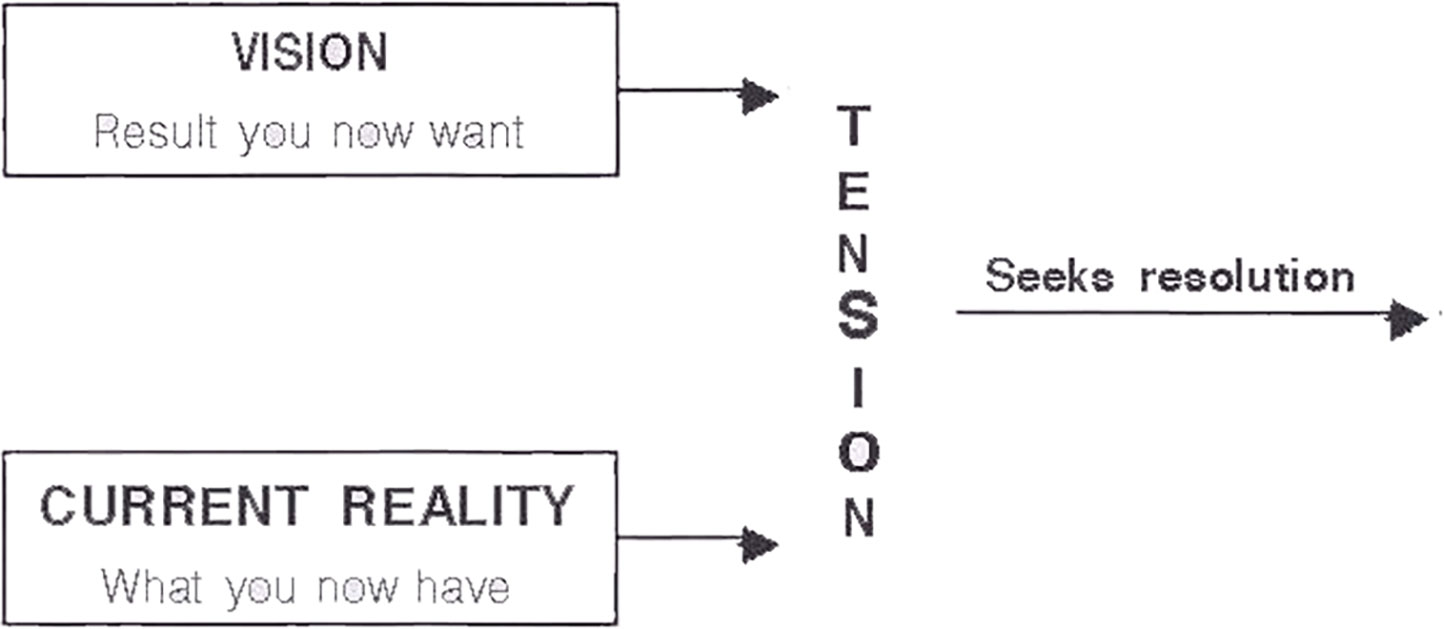
Fritz’s model shows that the creative process is motivated by a tension caused by a discrepancy between the present position of the creator relative to his or her vision of what is to be created. If one is setting out on a journey, he posits, it is necessary to know both where one is going and where one is at present. Likewise, within the creative process, it is essential to have both a firm vision of what is to be created and a realistic assessment of the position relative to the realisation of that creation.
So far we have discovered that an accurate assessment of one’s current position can be clouded by self-doubt and others’ cynicism. Fritz suggests that external factors such as this should be cast aside as far as possible in order to correctly establish progress within the creative process. It is also important to establish a clear, demanding vision to fuel creative tension throughout this process.
Kelsey states that a writer for television should take the best quality broadcast programme as his or her standard. He describes the experience of a new writer who, after seeing a very poor television drama, declared that she could write a script as good as the one she had seen. Upon doing so, she was surprised when her mediocre script was not accepted for broadcast[16]. Aim for the best, Kelsey sanctions, if by so doing an acceptable but not outstanding script is written, this is better than if sights have been set on mediocrity and this has not been achieved.
When Davies describes the ‘prima donna’ as the superior writer, he does not mean that writers should be temperamental or frivolous but, as suggested, maintain a strong belief in their work. Brande concurs, describing ‘What Writers Are Like’:
The picture of the artist as a monster made up of one part vain child, one part suffering martyr, and one part boulevardier is a legacy to us from the last century, and a remarkably embarrassing inheritance. There is an earlier and healthier idea of the artist than that, the idea of the genius as a man more versatile, more sympathetic, more studious than his fellows, more catholic in his tastes, less at the mercy of the ideas of the crowd.[17]
Both Brande and Fritz consider the creative process in terms of a state of mind, as a meta-process. Fritz believes that it is impossible to render such processes in formulaic terms:
If we were to approach the creative process by describing formulas, we would be working against ourselves, because there are no formulas that can lead to real creating, in the same way there are no formulas that can tell you how to ski, play the oboe, make love, raise children, or drive a car.[18]
Since writing goes on within the mind, instruction in it must differ from learning a process such as swimming or riding a bicycle. The difference lies within what Marshall McLuhan[19] describes as ‘content’. The ‘content’ of swimming or cycling is forward motion, but that of writing is the concepts, concerns, emotions, and messages the author wishes to convey. Whereas the raw materials of swimming or cycling are water or a bicycle, the raw materials of writing are not only pen, paper and ink, but also ideas.
Again the writing process is divided into the technical and the creative. Whereas the technical is concerned with marshalling and shaping ideas, the creative relates to having ideas initially. The latter is often shrouded in ambiguity, as Margret Geraghty (1995) relates:
Ask successful fiction writers where they get their ideas and the answer is often singularly unhelpful. A vague wave of the hand accompanied by the assertion that ideas are everywhere, is a common response. Or, as playwright and novelist, Robertson Davies once put it; ‘If I knew, do you suppose I would tell you?'[20]
Geraghty goes on to comment that this approach is unacceptable in other spheres. An airline pilot, she offers, could not greet passengers with uncertainty about how he or she is able to fly the aircraft. Again, though, the physical conditions of aviation are more accessible to description than arriving at an idea for a piece of fiction.
Geraghty concurs with Fritz on rendering the creative process as a formulaic set of instructions:
The notion that the creative element of our work can be learned in the same way as, say, maths or woodwork, is responsible for much disappointment. Writing fiction is not the same as assembling a flat-pack wardrobe: Just follow the instructions and success is guaranteed. Writing fiction is an art, and like all creative subjects, certain aspects defy analysis.[21]
Though the creative aspect of writing might defy analysis, Geraghty continues, it is possible to locate its source within unconscious thought processes. Brande divides the mind into two parts — the conscious and the unconscious — characterising each as follows:
The unconscious is shy, elusive, and unwieldy, but it is possible to learn to tap it at will, and even to direct it. The conscious mind is meddlesome, opinionated, and arrogant, but it can be made subservient to the inborn talent through training. By isolating as far as possible the functions of these two sides of the mind, even by considering them not merely as aspects of the same mind but as separate personalities, we can arrive at a kind of working metaphor, impossible to confuse with reality, but infinitely helpful in self-education.[22]
The conscious or left-brain, Brande argues, continually interposes in the writing process, subjugating input from the unconscious. The conscious is predominantly concerned with technical aspects of writing such as word choice, spelling and grammar, attaching greatest importance to these at the expense of the unconscious.
Brande believes that it is possible to control left-brain dominance, stimulating a greater creative flow. She suggests that this can be achieved by inducing a creative reverie in which the unconscious is in the ascendant. Geraghty notes that the psychologist Anthony Storr confirms that ‘the state most conducive to creativity is one of reverie’, relating how ‘R L Stevenson, for example, said that the plot of Dr Jekyll and Mr Hyde came to him after a dream.'[23][24]
Creative individuals — particularly poets and musicians — are renown for artificially stimulating reverie using drugs. The poet Samuel Taylor Coleridge wrote Kubla Khan after an opium dream. He had intended to write much more than the published fifty-four lines, but his creative reverie was broken:
It came to him while he was staying at a lonely Exmoor farmhouse, recuperating from an illness. He had taken two grains of opium for medicinal purposes (he was in fact an addict). On awaking he began to put down the poem in an ecstasy of inspiration.
When he got to: For he on honey dew has fed, And drunk the milk of Paradise he was interrupted by an insurance salesman from the nearby town of Porlock. Desperately he tried to get rid of the man, but somehow he was detained for an hour, talking mundane finance.[25]
The visitor broke the effects of the opium dream completely and Coleridge was never able to recapture his vision.
The Kubla Khan example bears out Brande’s hypothesis that the conscious and unconscious exist in opposition. The activities of an insurance salesperson are very much left-brain orientated and not conducive to creative reverie. Given this, it seems unremarkable that Coleridge was unable to complete his poem after immersion in such an unimaginative discussion.
Brande’s techniques for inducing creative reverie do not involve the use of drugs. She recommends an exercise in which the aspiring author rises half an hour before his or her accustomed time and begins writing immediately. The conscious mind should be excluded as far as possible from the writing process, with no allowances made for anything other than the immediate choice of words, spelling and punctuation. If this exercise is practised regularly, Brande contends, a writer will develop the ability to slip into creative reverie at will.
Similar techniques have been employed with some success:
Albert Einstein used to go to sleep at night holding a heavy object in his hand. His hand would rest over the edge of the bed and beneath the hand was a half-filled bucket of water. When he fell asleep his hand would relax, the heavy object would hit the water and the splash would awaken him. He would sit up and straightaway write in his notebook the thoughts that were in his head at that precise moment! That was Einstein’s method of connecting into his subconscious. And he’s the guy who gave us the shape of time and space as we know it today![26]
Given that conscious, left-brain activities can destroy creative reverie, it is reasonable to conclude that the technical information described in many ‘how to’ books — lying within the conscious sphere — might actually preclude such creativity — just as the insurance salesman ended Coleridge’s opium-induced daydream. This is the ‘pale cast of thought’ which ‘sicklies o’er’ the ‘native hue of resolution’ — or, to use one of our metaphors, it may be that instruction might focus the ‘cyclist’s’ attention so much on the mechanical processes of ‘bike riding’ that he or she forgets to balance.
My own experience of writing manuals has come in the ‘post-balancing’ or ‘post-floating’ stage of learning to write. I had written, for example, five radio dramas before reading Ash’s book. It had been necessary to learn the accepted script format by looking at sample documents, but otherwise I deduced many of the techniques, conventions and forms of radio drama from listening to plays and writing my own dramas. Ash’s book confirmed many of my deductions and helped improve on some technical points. However, had I used the book as a starting point, I feel that I would have been too concerned with adhering to given precepts to engage in creating an imaginative work.
‘How to’ books should not therefore be relied upon to provide step-by-step instructions on successful writing. At best they act as a guide for aspiring writers and should not be allowed to trammel work into such rigidly delineated forms that students are either unable to fully realise their creative potential or begin writing at all.
Lew Hunter (1994) relates: ‘I once asked John Steinbeck how I could best learn to write. Steinbeck glowered through his bushy eyebrows and over his imposing facial foliage growled one simple word. “Write.”‘[27] Writing is both the only way to gain experience and the best way to learn — as Fritz puts it:
The best way to learn to create is by creating. Practice is always more important than theory. When asked his opinion of music theory, the great composer Igor Stravinsky said, ‘Hindsight.’ Most good theories are developed after the fact of practice. The theories that are not based on practice are merely speculations. We could sit around all day and talk about the creative process, but it is only when we start creating that we begin to have real knowledge, experience and command of the subject.[28]
To gain confidence in writing’s metaphorical waters one can only plunge into them. Once immersed, ‘how to’ books must be used with discretion in order to avoid losing ‘the name of action’.
Notes and references