
‘Discovering’ Oasis
I lost touch with the charts sometime in 1986. The last I remember knowing or caring what was at number one, it was Pet Shop Boys’ debut hit West End Girls[1] in January that year. This didn’t mean, of course, that I’d lost interest in music, just that this was when an adolescent obsession with what was where in (what we never called) the ‘hit parade’ came to an end. No coincidence then that 1986 was also the year in which, as Colin MacInnes[2] puts it, ‘the teenage label [was] torn off the arse pockets of my drip-dry sky-blue jeans.’
I suppose I must have had some inkling of what was à la mode in record sales after West End Girls as I remained a regular listener to the poptastic BBC Radio 1 for a while after January 1986, but by the time The Pogues released If I Should Fall from Grace with God[3] in January 1988, I’d moved the dial permanently because I first heard about that album on an arts programme on the speech-centric BBC Radio 4.
All of which is a roundabout way of explaining how I came to miss the rise of Britpop in general and Oasis in particular. While I’ve met those who remember seeing the band at The Fleece in Bristol in 1994,[4] I even missed the now famous BBC TV coverage of the battle between Oasis’s Roll with It[5] and Blur’s Country House[6] for number one in August 1995 — but, as I say, the toppermost of the poppermost ceased to be of real interest to me almost a decade earlier.
I ‘discovered’ Oasis during a late-night cable TV channel-hop on 3 June 1996, writing in an abortive diarying effort, ‘Saw Oasis performing a song called Champagne Supernova on VH1 — very much like The Beatles, lead singer even looks like Lennon.’[8] I borrowed a copy of (What’s the Story) Morning Glory?,[9] finding on first listen that, ‘There are a lot of influences in there including The Beatles, The Stones and The Kinks — it’s good to hear a halfway decent contemporary pop band — my favourite song is still Champagne Supernova.’[10] Had it not been Champagne Supernova[11] that waylaid me on my after-hours remote-control ramble but any of the five previous single releases — Some Might Say,[12] Roll with It,[13] Morning Glory,[14] Wonderwall,[15] and Don’t Look Back in Anger[16] — I might well have zapped right on. The strong echoes of the past in the song drew me, ironically, to the music of the moment.
‘Wild excitement tinged with fear’
Even if I’d skipped the Oasis video on VH1 in June 1996, it’s unlikely I’d have missed the upcoming release of the band’s third album in August 1997. Although I believe Radio 4 was strangely silent on this prospect, elsewhere the media was full of it.
Radio Times marked the release of Be Here Now[19] with a cover feature in which John Peel found his way From Elvis to Oasis.[20] Also marking the twentieth anniversary of Presley’s death on 16 August 1997, Peel’s article recalls the ‘wild excitement tinged with fear’ he experienced on first hearing Heartbreak Hotel[21] on Two-Way Family Favourites[22] aged 16 in 1956. Peel interviewed his then 16-year-old daughter, Flossie, to learn if she was feeling a similar frisson of anticipation at the upcoming Oasis release. He found Flossie:
[…] prepared, it seems, to commit herself to the extent of admitting that she and most of her friends are looking forward to hearing it. Remembering edging my way into Crane’s in Liverpool to buy Heartbreak Hotel feeling very much as I did when I bought Health and Efficiency, I ask Floss whether she and/or any of her friends would be likely to queue all night outside a record shop to be the first on their block to own Be Here Now. She gives me that look of mingled scorn and pity with which I am so familiar. It doesn’t matter when I buy it, she replies, going, as usual, to the heart of the matter, it’ll be exactly the same record.[23]
My recollection is that Flossie and her contemporaries would not have needed to go anywhere as esoteric as a record shop to buy Be Here Now. The CD was deemed such a must-have item that my local Safeway fielded a large rack of them, usually only found in town-centre HMVs or Virgin Megastores. And the bragging rights gleaned from being first in the neighbourhood to own the album would have been so fleeting a thing as to be barely worth rising early, let alone staying up all night (although there were those who did both).
‘Umberto Eco’ on Oasis
Fresh-faced future Libertines co-frontman Pete Doherty[24] found himself in the queue for the album outside HMV at central London’s Trocadero Centre. Startling an MTV interviewer with wit and erudition to the point that the presenter fumbled collecting his soundbite, the 18-year-old quipped, ‘I subscribe to the Umberto Eco view that Noel Gallagher’s a poet and Liam’s a town crier and that, to me, seems like the perfect combination.’[25]
Doherty made clear in 2019 that his motive in joining the HMV queue on 21 August 1997 was not to pick up a copy of the latest Oasis CD but to get himself on TV or in the papers.[27]
Asked about Doherty’s attribution in 2015,[28] Umberto Eco[29] answered (unsurprisingly) that he had not expressed a view on Oasis. The late Italian philosopher and novelist added that he was a ‘dinosaur’ in musical taste who ‘remained stuck on The Beatles’. Eco had the latter at least in common with Oasis.
Home taping didn’t kill music
Housesitting that summer with a Walkman as my sound system, I had the album taped within a day or two of its release. This was not so much a matter of illegal frugality as of quality. The recent enthusiasm for prerecorded cassettes — such as that for Hounds of Love by Kate Bush[30] as seen in the fourth series of Stranger Things[31] — seems to me a triumph of nostalgia over listenability. Not that the Walkman or its clones sounded too shabby, it’s just that they were at their best when playing home-taped content. If you owned or had access to a fair-quality hi-fi, you could more than equal the standard of a ‘professionally-produced’ cassette by buying the record or CD along with a good blank tape and recording your own. This left you with a durable ‘master’ copy (provided you took care of your records or CDs) and a cassette that was likely to sound better than its commercial equivalent off the blocks and would probably continue to do so after repeated listens. And if your tape did get chewed during hard rotation, you could make another without coughing up the whole price of the album again. I now have Be Here Now on CD and vinyl and can access it as part of my streaming subscription. The cassette from which I first heard it a quarter of a century ago is long gone — well, it might be in a drawer somewhere… But it seems that all that mewling and puking the music industry did about ‘Home Taping Is Killing Music’[32] reckoned without its subsequent ability to repackage and resell the same recordings repeatedly — as this post attests.
‘The hubris before the fall’
There was a determination in August 1997 that Be Here Now should live up to its hype. John Peel[33] observed in advance of its release that, ‘The Oasis reviews will be — are already being — not far short of fawning. No major publication will want to risk alienating the Oasis fans among its readers by printing a hostile review.’ Hepworth[34] agrees that the media had an interest in this critical collusion because Oasis not only sold records but newspapers and magazines, drove TV and radio ratings and record shop footfall, won votes, and it ‘was even argued that they contributed to a renewed sense of national self-confidence.’ It was almost in the national interest, then, that Oasis continued what Nick Duerden[35] defines as its ‘imperial phase’:
This part of a career, for those lucky enough to achieve it, is the time in which an artist’s sales keep rising and rising, when everything they touch is certified gold by the audience that buys it. (The Beatles’ entire career, truncated as it was, was an imperial phase, while The Rolling Stones’ lasted, approximately, from 1965 until 1972, before solo projects, successive divorces, and general ennui fatally disrupted their flow, relegating them to heritage status, in which they could continue to play the world’s stadiums as long as they focused on those hits made between 1965 to 1972.)[36]
Oasis’s imperial phase ought to have extended to Be Here Now, but the album suffered from the above over-expectation to the extent that it could only succeed or fail spectacularly, as Dorian Lynskey[37] describes:
If it couldn’t be Britpop’s zenith, then it must be the nadir. It can’t be just a collection of songs — some good, some bad, most too long, all insanely overproduced — but an emblem of the hubris before the fall, like a dictator’s statue pulled to the ground by a vengeful mob.[38]
Of course it need be neither zenith nor nadir, and I remembered the album with enough enthusiasm to think it worth revisiting on vinyl when Big Brother Recordings issued a 25th-anniversary edition this August.[39]
The unique selling point of the anniversary release is that it’s pressed on silver vinyl. The pressing itself is a reissue of the 2016 remastered edition. I decided I could live without the coloured vinyl and save a tenner on the platters (it’s a double album on vinyl) by buying the 2016 version.[40] (The 25th-anniversary release is, of course, a limited edition, but for serious collectability, the essential item is an original 1997 Creation Records pressing.[41] The CD format was at the height of its imperial phase in 1997 and, at the time, vinyl would have seemed an eccentric or rearguard choice. A 1997 vinyl copy isn’t too much of a rarity, though, with Discogs showing previous sales of the original record in its marketplace from £76.56 to £160.00 at this writing.[42] The more comprehensive Popsike, a database archiving vinyl record auctions — drawing mostly on eBay — from 2004, has the original LP (based on a search for the album’s initial catalogue number, CRELP 219, and excluding the Fan Club box set) fetching from £18 to £234 between 2012 and 2021.[43] I found copies on sale and in auctions starting at £80.)
LP-sized ambitions
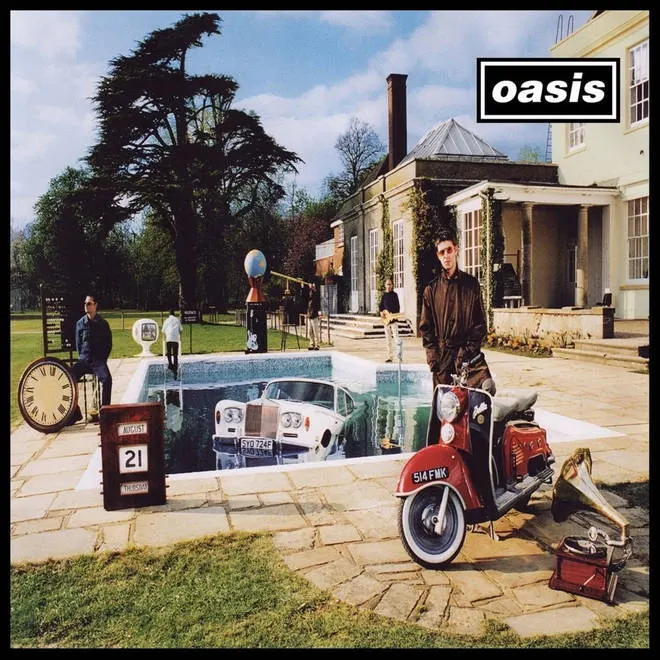
The record (in whatever edition) shows off the cover image to its best advantage. Hepworth[44] notes that, on the CD where ‘the cover was less than five inches across’, the cost of creating its picture ‘appeared to have been expended in pursuit of a significance the format could no longer sustain.’ The artwork certainly had LP-sized ambitions with an eventual cost that its graphic designer, Brian Cannon,[45] puts at about £75000.[46]
Cannon[47] recalls that the original idea for the cover was to produce a composite image featuring band members in locations of their choice:
Noel wanted to go to the mountain from Close Encounters of the Third Kind, [bassist Paul] Guigs [McGuigan] wanted to go to Jamaica, but we changed our minds in the end — nothing to do with the budget, mind, we could’ve done anything we wanted. [Rhythm guitarist Paul] Bonehead [Arthurs] wanted to be shot next to a pool with a Rolls-Royce in it to hark back to the Keith Moon story, which never actually happened, so that was that…[48]
The cover picture’s most decadent feature and centrepiece turns out to have been a relatively inexpensive item. Joe Breeze[49] reveals in a 2013 interview with photographer Michael Spencer Jones[50] that the crew hired the 1972 Rolls-Royce Silver Shadow for £1000, while Rhys Maunder[51] expands in a post on its supplier’s website (Flying Spares in Market Bosworth, Leicestershire) that the company had bought it for spares in 1996, pulling the car from the scrap heap when approached by Cannon’s Microdot graphic design company, which:
[…] confirmed that the car did not need to run, it just needed to look complete. So the engine and the hydraulic units were removed. As the bodywork was in poor condition we sent it to local bodyshop, Dixons of Barwell, who added large amounts of filler and repainted the front half of the car. It was then transported to Stocks House in Hertfordshire for the photoshoot.[52]
Spencer Jones selected Stocks House[53] as his location for the purely pragmatic reason that, ‘It had a swimming pool directly in front of the house, and from a photographic point of view it was ideal,’[54] but also because the Georgian mansion was the 1970s UK Playboy headquarters at which company executive Victor Lownes[55] entertained guests including rock luminaries Mick Jagger, Bryan Ferry, Ringo Starr and Keith Moon,[56] who spun his Lincoln Continental-dunking yarn in a 1972 Rolling Stone interview.[57]
The motor may have been inspired by Moon’s possibly apocryphal antics, but Spencer Jones had it adapted to channel The Beatles, replacing its original licence plate, MDH 119K, with one reading SYO 724F to match that of the Black Mariah police van parked on the right of the iconic cover of the Fabs’ swansong, Abbey Road.[58] He rejected the original idea of using the plate number of the white VW Beetle on the left of The Beatles’ album, LMW 281F — which ‘Paul is dead’[59] conspiracists took to stand for ‘Linda McCartney Weeps/Widow, 28 if (1F) he’d lived’ — as ‘too obvious’.[60]
Spencer Jones[61] pointed out that interpretations of the Be Here Now cover were as groundless as those for Abbey Road: ‘Most of the meanings attributed to the props were read in afterwards, though the globe is a nod to the Definitely Maybe sleeve.’ Brian Cannon robustly rejected any dubious readings of the other objects on the cover, explaining that ‘all the props around the pool have no meaning whatsoever, I just took Liam and Noel down to a BBC props warehouse in White City and they picked loads of random stuff, it was total nonsense.’[62][63]
In relation to the Rolls-Royce, Cannon was keen to stress that, ‘Despite what people think that wasn’t done digitally, that car is in that pool,’[64] but the incongruity of the random assortment of objects in and around the water creates a photomontage[65] effect. This is compounded by Spencer Jones’ use of a wide-angle lens to both encompass the whole scene and provide enough depth of focus to keep everything sharp, but which also compresses perspective so that band members and objects appear quite ‘flat’. The production team also arranged the Rolls artfully to display its mascot, radiator grill and number plate — location shots show it propped up on a pile of crates and tyres[66] — so it seems to be sinking at an unnatural angle. All of which contrive to make the image appear as if it’s been cut and pasted together rather than photographed directly.
Given the evolution of the cover concept from multi-location composite to poolside poses with props, it’s likely that my impression that the sleeve design was also influenced by that of The Beatles’ Sgt Pepper’s Lonely Hearts Club Band[67] is wrong. While the Be Here Now frontispiece lacks an overarching approach like that Peter Blake[68] adopted for Sgt Pepper — ‘Paul and John said I should imagine that the band had just finished the concert, perhaps in a park,’ Blake wrote in the booklet accompanying Pepper‘s first CD issue.[69] ‘I then thought that we could have a crowd standing behind them, and this developed into the collage idea.’ — the apparent montage effect of the artefacts on the Oasis cover put me in mind of The Beatles’ sleeve. Sgt Pepper‘s cutout crowd scene also features its share of random props — including (again according to the 1987 CD booklet) a Mexican candlestick, a television set, a trophy, a four-armed Indian doll, a hookah (water tobacco-pipe), and a velvet snake — making for more conceptual common ground with Be Here Now. Whether or not these connections are real, making them is a lot easier with the benefit of the Oasis artwork at LP size.
‘Air guitar gone mental’
The sonic advantages of having Be Here Now on vinyl are less apparent. The album isn’t exactly an audiophile experience and, although I don’t have audiophile hearing (what with the tinnitus), I can tell when the sound isn’t quite right. Listening to the records made me wonder constantly if the stylus either wanted some dusting off or if I needed to replace it. But no, the distortion’s there on the my original CD too and also (You bounder! You cheat!) on streaming.
Alan McGee[70] puts the album’s auditory shortcomings down to:
[…] the production and having too many drugs in the studio. You could hear the coke in the production, all top-end and no bass. It seemed to me that more than anyone else Owen Morris lost the plot producing that record. Noel was adding guitar part after guitar part and all I could think when I went down to the studio was, This is loud. Owen had taken all those overdubs off the first album, but now he’d lost control. I remember hearing ‘It’s Gettin’ Better (Man!!)’ and hearing Liam singing those words for the forty-seventh time in a chorus — and I knew it was too long. But the band were a runaway train by then. It was hard to say who was in control. I had to hope I was wrong.[71]
Owen Morris[72] didn’t exactly dash to his own defence over the album, describing its final mix as ‘an utter disgrace’.[73] Noel Gallagher also joined the condemnation, damning Be Here Now in John Dower’s 2003 documentary Live Forever: The Rise and Fall of Brit Pop[74] as:
[…] the sound of a bunch of guys, on coke, in the studio, not giving a fuck. There’s no bass to it at all — I don’t know what happened to that. It’s all… [makes a crackling sound] And all the songs are really long and all the lyrics are shit. And for every milisecond Liam is not saying a word, there’s a fucking guitar riff in there in a Wayne’s World stylee, you know… Fucking air guitar gone mental.[75]
In a 2016 interview with Keith Cameron marking the twentieth anniversary edition,[76] Gallagher describes an abortive effort to address the album’s generally agreed ‘too loud and too long’ issues:
At some point down the years in Oasis, someone had said, “Why don’t you edit the songs, then, if you don’t like ’cause they’re that long?” So I thought, “Oh, yeah… Try that.” So I went into the studio to… And started with My Big Mouth and it… You couldn’t… I couldn’t… When I got there and I put it up, I was like, “I can’t… This is what it is.” It’s like fucking Let It Be… Naked, you know what I mean? It’s like it’s really taking the piss a little bit.[77]
The merits of The Beatles’ 2003 minimalist makeover[78] aside, Gallagher did opt to overhaul Be Here Now‘s opener:
I loved the track D’You Know What I Mean?. And I was like, you know, “We never really… That mix is fucking awful.” And so I got the master tape and threw it up on this desk. And honestly, I was staggered at the amount of nonsense that was on tape. We had a full orchestra coming out of a fucking tiny Vox amp or a Marshall amp this big. That’s what’s on the record. And when we separated all a hundred guitars, all doing the same thing, and got the key elements and then did that remix, it sounds amazing. You know, you can actually hear the strings and the bass guitar — you can actually hear everything.[79]
D’You Know What I Mean? (NG’s 2016 Rethink) issued as part of Be Here Now (Deluxe Remastered Edition)[80] is a revelation following familiarity with the original release. Gallagher’s excavation of the track from beneath its skreed of guitar overdubs means, as he comments above, that its other components are now audible. Most striking of these are the strings, which rise to meet the first chorus and now feature throughout the remainder of the song. I wasn’t really aware that the recording included strings until hearing the rethought version, but, listening back to the 1997 mix… Ye-es… Yes, there they are…
As the remainder of the album didn’t get the ‘NG Rethink’ treatment, it’s more or less a matter of listening around the overblown production on the other songs. The Deluxe Remastered Edition (on CD and streams) includes the Mustique demos, recorded during Gallagher’s holiday/songwriting retreat on the private Caribbean island in June 1996. Gallagher made the demos with Owen Morris on an eight-track portastudio, limiting the opportunity for overdubbing compared to the kit on offer at Abbey Road,[82] Ridge Farm,[83] and AIR[84] studios where they recorded the eventual album.[85] The Deluxe Edition also features a live runout of My Big Mouth from the 10 August date of the band’s peak Knebworth 1996[86] gigs, so you can hear unembellished versions of all the songs if the eventual overproduction is offputting.
Sound quality aside, I don’t find that the songs on Be Here Now detain me overmuch, despite their longer than usual durations. The lone Oasis track that I find difficult to bear is Mucky Fingers from the band’s 2005 offering Don’t Believe the Truth[87] with its piano-key stabbing, headache-inducing rhythm, but there’s nothing on Be Here Now that I find similarly jarring. My feeling about the 1997 album fits with Gallagher’s above observation that it ‘is what it is’, and choosing to listen to it is also a choice of hearing a set of longer tracks.
Lynch on lyrics
Interviewed on a recent edition of The Political Party podcast,[88] RMT[89] General Secretary and newly-minted British folk hero Mick Lynch[90] dismisses Britpop as ‘derivative’, inviting host Matt Forde[91] to, ‘Name me a good Oasis lyric that can stand up on its own as a piece of… prose. Or a piece of poetry or whatever you want to call it.’ Forde returns with, ‘There’s four and twenty million doors / On life’s endless corridor’, from The Masterplan.[92] ‘What does that mean?‘ asks Lynch, whose tastes revolve around The Clash and 2 Tone bands with their straightforward, political lyrics. ‘It doesn’t matter what it means,’ Forde answers, ‘it’s about what it makes you feel.’
The meaning of lyrics in popular music isn’t a particularly useful or interesting rabbit hole to go down as they’re often composed as much to serve the song as to convey meaning. Gallagher has turned in more than his share of ear-catching lyrics despite Lynch’s low opinion of Oasis’s output. An example that snagged my attention (and raised a laugh) on an early listen is, ‘She’s got a cousin / In fact she’s got ’bout a dozen / She’s got one in the oven / But it’s nothing to do with me’, from She’s Electric.[93] An ‘A’ Level English Lit student might spot Gallagher’s use of assonance with ‘cousin’, ‘dozen’, and ‘oven’ here. Elsewhere, the Oasis songbook has some strong opening lines, not least those of its two best-known tracks — ‘Today is gonna be the day that they’re gonna throw it back to you / And by now, you should’ve somehow realised what you gotta do,’[94] and, ‘Slip inside the eye of your mind / Don’t you know you might find / A better place to play’[95] — neither overburdened with meaning but both kickstarting their respective songs.
On Be Here Now, the opening lines of Stand by Me — ‘Made a meal and threw it up on Sunday / I’ve got a lot of things to learn’ — and All Around the World</cite > — ‘It’s a bit early in the midnight hour for me / To go through all of the things that I want to be’ — work well as lyrical hooks — I’d agree that those for Stand by Me aren’t quite the equal of Ben E King’s in his song of the same name (‘When the night has come / And the land is dark / And the moon is the only light we’ll see’[96]) but Gallagher makes a brave choice in writing a song with the same title as the 1961 soul classic.
The album’s lyrics are on familiar Oasis territory when name-checking Beatles song titles: D’You Know What I Mean? marks The Fool on the Hill and I Feel Fine; My Big Mouth has The Long and Winding Road; Fade In-Out‘s allusion to Helter Skelter might or might not be a Beatles reference; the title track makes unequivocal mention of Let It Be[97] (the album, not the song); and It’s Gettin’ Better (Man!!) is titularly close to The Beatles’ Getting Better but seems to have been involved in a creational collision with Sex Pistols’ God Save the Queen — ‘God save the queen / We mean it man’.[98]
Choice cuts
If All Around the World lacks a lyrical nod to the Fabs, its video more than makes up for this omission. Co-directed by husband and wife team Jonathan Dayton and Valerie Faris[99] — later behind the 2006 black comedy Little Miss Sunshine[100] — the music video draws heavily on George Dunning’s[101] 1968 Beatles-based animated feature, Yellow Submarine.[102] Its animation style also owes much to Terry Gilliam’s[103] Monty Python montage movies but is inventive enough to entertain throughout its seven minutes and two seconds — unsurprising that it took 24 computer animators six months to complete.[104]
I agree with Alan McGee[106] that the song is one of the album’s stand-out tracks, although wouldn’t wax quite so superlatively: ‘“All Around the World” is an amazing song […] That will stand the test of time.’ I agree about its enduring appeal.
My other choice cuts from the record are Stand by Me and Don’t Go Away in which I find common ground with Ian Harrison’s tenth-anniversay Be Here Now reevaluation:
It’s not as if Noel Gallagher’s way with a song was absent […] My Big Mouth and Stand By Me are Oasis songs as football chants, and stand alongside the best moments in their canon. Similarly directed at the hooligan with a heart, Don’t Go Away relates to a cancer scare involving the Gallaghers’ mother and features one of Liam Gallagher’s most affecting vocals.[107]
‘To dwell on past or future is to be dead to the present’
‘Be here now’ is an expression often attributed to John Lennon — the default for Beatles-related bons mots — but Ian MacDonald[108] sources the phrase more generally. In an exploration of the evolution and recording of the final track on The Beatles’ August 1966 album Revolver,[109] MacDonald finds that Tomorrow Never Knows takes its title from one of Ringo Starr’s malapropisms, which is ‘analogous to the hippie maxim “Be here now”.’ He elaborates in a footnote that:
Be Here Now was later the title of a book by [US psychologist Dr Timothy] Leary’s partner Richard Alpert (Baba Ram Dass). The slogan paraphrases the Vedic teaching that to dwell on past or future is to be dead to the present. Enlightenment consists of living continuously in the present — a philosophical paradox in that to do so requires will, yet will is time-bound, depending on memory and anticipation (consciousness of the past and the future).[110]
The present impinged to the third Oasis album’s detriment soon after its release. McGee notes that, ‘Be Here Now seemed to signal the end of Britpop, the end of the success guitar bands could have making pop music.’[111] I most recall listening to the album in the ten days from its issue to the death of Diana, Princess of Wales, on 31 August 1997. While Be Here Now‘s swagger and bombast didn’t fit generally with the mawkish mass histrionics following the unfortunate royal’s fatal accident, one of its tracks was approved for BBC Radio 1’s evolving obituary playlist. Jeff Smith, then Head of Radio 1 Music Policy, recalled the station having:
[…] a set of three emergency CDs in a little cupboard in each studio. CD(a) [had] sombre-ish mainly instrumental music, CD(b) [was] a mellower vocal-driven selection, and CD(c) [was] a let’s-come-out-of-it scenario and move on. […] For Diana, the obituary CDs that we had didn’t really seem good enough, and I was already working on newer ones, based on more contemporary ambient music, and with some string-driven and operatic elements. […] Gradually we introduced George Michael — ‘You Have Been Loved’ and Massive Attack’s ‘Unfinished Sympathy’ and ‘Missing You’ by Puff Daddy, ‘Everybody Hurts’ by REM and ‘Don’t Go Away’ by Oasis.[112]
‘Do not listen to this after 48 hours’
Despite this minor chime with August 1997’s mournful aftermath, the music-buying public who had proved so keen to get their hands on Be Here Now that month were as ready to discard it. Making the case against the album in Q‘s 2007 retrospective, Garry Mulholland finds it:
[…] a loud, lumbering noise signifying nothing; a sonic disaster area that would have killed off anv band that was led by less endurine icons than Liam and Noel Gallagher. Be Here Now sucks. And the thousands of copies that fill the racks of charity shops and used record stores make that a matter of fact, rather than opinion.[114]
David Hepworth charts Be Here Now‘s fast track from essential acquisition to pre-unloved castoff as follows:
In years to come somebody would suggest that an alternative title for Be Here Now should be Played Just Once. In years to come people would even argue that Be Here Now was the record most likely to be found in second-hand bins.[115]
In his 2016 interview with Keith Cameron, Noel Gallagher embraces the idea of the album’s single-hearing disposability, saying that a couple of his friends from Manchester have:
[…] always said, “It was just meant to be played once. On that day. High as a fucking kite. Preferrably in the park. (Or pissed.) Then never to be listened to again.“ I was like, “Why didn’t I fucking think of that? That would’ve been the best press release.“ [Cameron suggests that the album could have had a hype sticker about this.] Totally, yeah — “Do not listen to this after 48 hours.”[116]
Vinyl verdict
Returning to the album a quarter of a century after this use-by date, I find that — apart from the benefit of a better view of its cover artwork — the Be Here Now experience isn’t especially enhanced by hearing it on vinyl. Hepworth[117] observes that:
Records are made for and by the technology available at the time and it’s impossible to reimagine them for anything that comes later. A Fats Domino 78 from the fifties didn’t sound quite right on the Dansette of the sixties. Play a Motown 45 from the sixties, at its best on a jukebox with a lead weight for a tone arm, on a seventies music centre and it seemed strangely reduced.[118]
Even after decades of listening to Sgt Pepper’s Lonely Hearts Club Band[119] digitally, it still feels odd that Within You Without You plays immediately after Being for the Benefit of Mr Kite without the side-break interval, and returning to that record on vinyl restores the natural order. All the disc-flipping, dusting and needle-dropping involved in listening to the vinyl version of Be Here Now, on the other hand, is an imposition — it just wasn’t made to be played that way. And it’s not as if the Oasis offering sounds any better on vinyl — it really doesn’t; its sonic shortcomings just cause the concerns I’ve described above about stylus condition.
It’s likely that I’ll get back to Be Here Now from time to time in the future as I’ve done in the years since its release. When I do, though, I’ll leave my vinyl copy on the shelf.
Notes and references