
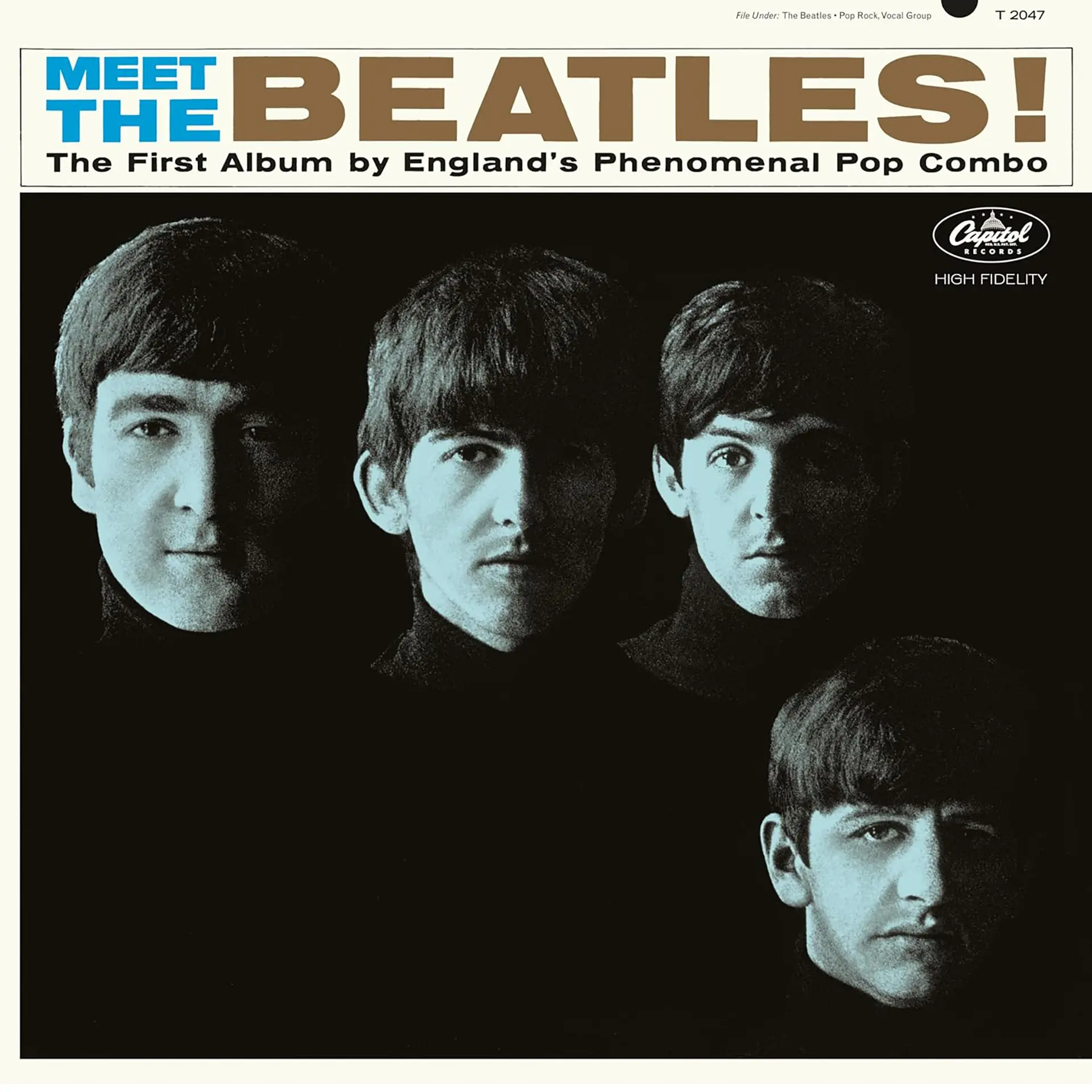
| Released | 22 November 2024 |
| Label | Capitol / Apple / UMR |
| Genre | Rock and roll, pop, Merseybeat, R&B |
| Duration | 26:43 |
Drooling Pavlov dog that I am, I'm usually straining at the leash for an annual acquisition of music that, let's face it, I have multiple times already.
And yet, something in the latest pricy package makes it not quite what I've got on my shelf (or racked up on the floor), and I part with another hefty chunk of change for the new shiny Beatles box.
Autumn 2024's offering was almost resistible — a properly overpriced box set of the band's five 1964 US albums plus The Beatles Story, a duo of interview discs.
Apple also reissued the albums individually at a price that put a substantial premium on The Beatles Story — exclusive to the box set — and the storage box itself.
As much as I like to hear Beatles interviews, albums of them are in one-play territory, and I wasn't about to shell out a significant additional amount for that — oh, and a glossy cardboard box.
And then there are the Capitol albums themselves…
Already repackaging material from their canonical British counterparts in 1964, the Stateside releases don't exactly scream ‘value’.
As Andrew Milton explains in his vlog about the early Capitol albums,[1] mechanical music licensing in the US created a commercial imperative to include only 12 tracks on the US LPs, while the British versions have 14.
To add a ‘terrible food’ insult to the ‘such small portions’ injury, Capitol's Dave Dexter Jr ‘sweetened’ the recordings for the American market by feeding them through an echo chamber and adding compression.
The lily thus gilded was The Beatles' sound for first-generation US fans.
The difference recalls the European experience of Hershey chocolate, which dominates the market for the confectionery in the US.
As Courtney Iseman explains,[2] Hershey's proprietary processes mean that butyric acid from the milk used in its chocolate bars ‘can create notes of sourness and tang — which […] some sensitive tasters, or those used to European chocolate, could feel is reminiscent of vomit — where butyric acid also hangs out.’
Capitol's processing of EMI's master tapes produced a ‘Hershey’ Beatles sound, cherished by its native market, but less appealing to those of us used to the homespun source.
The track listings are also jarring for Beatles natives and to the manner born.
If Capitol shortchanged US fans by including fewer songs on each LP, it compounded the exploitation by adding singles to the album line-ups — Beatles producer George Martin had a ‘long-standing tradition — his personal ethic, really — about not duplicating Beatles singles on long-players, a plan that he and [Brian] Epstein had devised in order to ensure that Beatles fans enjoyed greater value for their money.’[3]
Meet the Beatles! opens with I Want to Hold Your Hand, the band's first US number one. It's not my favourite Beatles song, but it makes for a dynamic start to the album.
Next up is I Saw Her Standing There, the flip side of the first track's single version in the States.[4] It makes logical sense to sequence the seven-inch's A and B sides in this order on the LP, but McCartney's ebullient, ‘One, two, three, four!’ that launches the number makes a false start of I Want to Hold Your Hand.
This Boy, released in the UK initially only as the single companion to I Want to Hold Your Hand,[5] is Meet the Beatles!' third track. A slower number, it conveys a sense of the album ‘settling in’, but a third big entrance disrupts this.
It Won't Be Long is the UK second album, With The Beatles'[6] big opener, and cuts an odd dash halfway through Side One of Meet the Beatles!
The record then relaxes into familiar British territory with a filleted version of With The Beatles.
The UK album's standout covers, The Marvelettes' Please Mr Postman,[7] Chuck Berry's Roll Over Beethoven,[8] The Miracles' You've Really Got a Hold on Me[9] and Barrett Strong's Money (That's What I Want),[10] are casualties here — saved for the perfunctorily titled Beatles' Second Album[11] in the US.
All My Loving works well as Side One's conclusion, but the above omissions rob the album of a rip-roaring closer — a role amply fulfilled by Money on With The Beatles.
The commercially expedient track listing on Meet The Beatles! is evidence of the underappreciated art of sequencing on albums. It might seem like the way things were meant to be for first-generation US fans, but next to the UK originals, it comes across as a cobbled-together collection of tracks — not all the right songs, and not necessarily in the right order.
An upside of this reissue is that it's in mono. Stereo versions of early Beatles recordings make for uncomfortable listening on headphones because of their hard left-right panning of instrumentation and vocals.
George Martin applied this stark separation not to pursue a newfangled stereo sound but a better mono mix. Having ‘all the rhythm on one track and all the voices on the other’ meant he ‘could concentrate on getting a really loud rhythm sound, knowing [he] could bring it up or down afterwards to make sure the voices were coming through.’[12]
The recording technique that maintained the balance between vocals and instrumentation in mono mixes had the opposite effect when applied to stereo. With only two tracks available on the master tapes, there was little choice but to allocate one for the left and one for the right channel in stereo playback, separating voices and rhythm, making it difficult to reconcile them, particularly when listening on headphones.
The 2024 US discs are ‘cut from the original master tapes using a completely analogue signal path.’[13] Such fidelity to the source is typically regarded as a quality mark in audiophile circles (not that I possess audiophile hearing). However, this set comes with the caveat that the ‘original’ tapes are second-generation dubs from EMI's masters, which were subject to Dave Dexter Jr's ‘improvements’ described above.
Capitol also fell significantly short of enhancing The Beatles' UK album sleeve designs. All the canonical British releases are wrapped in covers that can rightly be called ‘iconic’. The US artwork, meanwhile, aspires to ‘generic’.
Meet The Beatles! at least retains Robert Freeman's low-key band portrait, taken at the Palace Court Hotel in Bournemouth on 22 August 1963,[14] as its cover shot.
Capitol chose hyperbole over continuing to take With The Beatles' understated lead above the photo. In addition to imitating the band's then-adolescent audience by making a screamer of the title, it rendered ‘Meet The Beatles!’ in blue and gold above a superfluous strapline proclaiming it to be ‘The First Album by England's Phenomenal Pop Combo’. For Capitol, nothing went unsaid, it seems.
Concluding that Meet the Beatles! is an object lesson in the folly of trying to improve on perfection is to wield 20/20 hindsight.
In 1964, Dave Dexter Jr and his Capitol colleagues were unaware that Parlophone had already produced the optimal and enduring long-playing statements of The Beatles' recording career.
The idea that the records would amount to more than adolescent ephemera was inconceivable to the Capitol executives, who could reasonably conclude that they were better placed to market the music of this transient teenage trend in the US than its British originators.
The Capitol albums remain more of their time than the British originals because they bear the scars of the US company's market exploitation (not that EMI ran a charitable organisation in the UK!).
Apple's autumn 2024 reissues of The Beatles' 1964 US LP output offer contemporary fans a glimpse into the original Stateside experience of the band's music, fully embracing the era's aesthetics, sound, and capitalisation.
Meet The Beatles! streams in mono and in stereo on Apple Music as tracks one to 24 of a 2014 issue of The U.S. Albums[15]
Notes and references