
‘What was the first record you bought?’
In his 1995 memoir, Lost in Music: A Pop Odyssey, Giles Smith[1] calculates that ‘within a normally active social life’ the question, ‘What was the first record you bought?’, is ‘likely to come up three or four times annually’.
It’s not a question I’m often asked. Perhaps because the concept of a ‘first record’ is redundant in the brave new world of music streaming.
Or it could be that I don’t enjoy a ‘normally active social life’…
Smith observes, ‘When you talk about your first record, you’re saying something about how quick you were off the mark: you’re indicating the place where you and pop music first really hit it off.’
Pop music and I first ‘hit it off’ in April 1978. That was when I first tuned in to BBC Radio 1’s Sunday evening Top 20 chart show, and Brian and Michael’s Matchstalk Men and Matchstalk Cats and Dogs (Lowry’s Song)[2] was number one.
The three charts topped by that ditty[4][5] feature several hits that became life companions — Blondie’s Denis,[6] She’s So Modern by The Boomtown Rats,[7] Elvis Costello and the Attractions’ (I Don’t Want to Go to) Chelsea,[8] and Take Me I’m Yours by Squeeze[9] all found a place in my perennial playlist.
It wasn’t the individual tunes that sparked my enduring interest but finding myself amidst the music of the moment — tuning in to the zeitgeist.
Beguiled by a K-tel compilation
When I got around to taking my pick of the pops in my local record shop, I did so from the cassette racks — so my ‘first record’ was a tape.
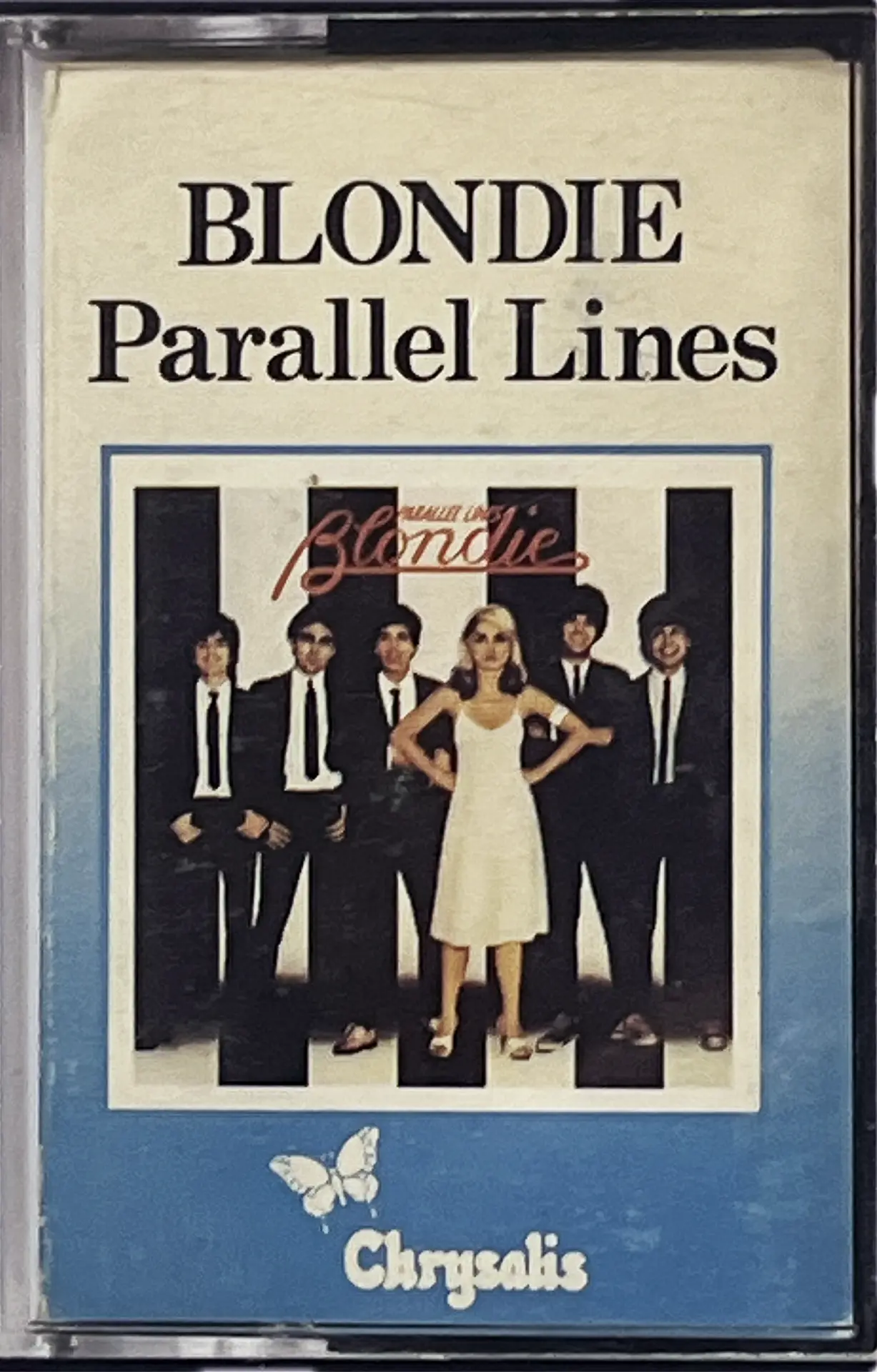
I planned to buy a copy of Blondie’s Parallel Lines.[10]
When browsing the titles, though, I was seduced by the TV-advertised gloss of K-tel’s Disco Fever: 20 Original Disco Hits.[11]
The compilation combines disco, sub-ABBA pop, and chart stuff from 1977. It’s somewhat B-list from a contemporary perspective, and more so in hindsight.
It includes, for example, Silver Lady by David Soul[12] (Hutch out of Starsky and Hutch), the actor’s follow-up to his 1976 smash, Don’t Give Up On Us.[13]
Showaddywaddy’s You Got What It Takes[14] is also a successor to 1976’s chart-topping Under the Moon of Love.[15]
If these offerings are from pop’s more frivolous side, the compilation delves into novelty with Meri Wilson’s Telephone Man[16] and Joy Sarney’s Naughty Naughty Naughty,[17] the latter featuring the swazzle vocals of Mr Punch.
The genuine disco inclusions have some buttock-clenching moments in The Floaters’ Float On,[19] in which the bandmates introduce themselves with their star signs and descriptions of their ideal women like a succession of cheesy dating profiles.
Beneath Disco Fever‘s track listing, K-tel makes the mealy-mouthed admission that: ‘To ensure the highest quality reproduction, the running times of some of the titles as originally released have been changed.’
So the compilation achieved its cornucopian appearance in part by giving short measures.
I made the right choice of Parallel Lines when I next saved enough for a tape.
Subsequent expansions of my cassette collection stayed solid with titles including Blondie’s next album, Eat to the Beat,[20] Gary Numan’s The Pleasure Principle[21] and David Bowie’s stone-cold classic The Rise and Fall of Ziggy Stardust and the Spiders from Mars.[22]
Vinyl: the best of both worlds
Despite K-tel’s less-is-more protestations about the quality of their cassettes’ reproduction, costly prerecorded tapes weren’t all that when it came to the soundness of their sound.
The best results were achieved by buying a quality blank tape, finding a well-kept copy of the desired music on vinyl, and taping it.
Twigging that I could have the best of both worlds by buying LPs, I bought… my first record — Meat Loaf’s Bat Out of Hell.[23]
This showed that cassettes left a lot to be desired in terms of packaging too.
Bat Out of Hell‘s famous frontispiece featuring a musclebound motorcyclist thrust backwards by the g-force of his steed as it bursts from the bowels of hell is best viewed on a 12-inch sleeve. The diminutive canvas of a cassette insert doesn’t do it justice.
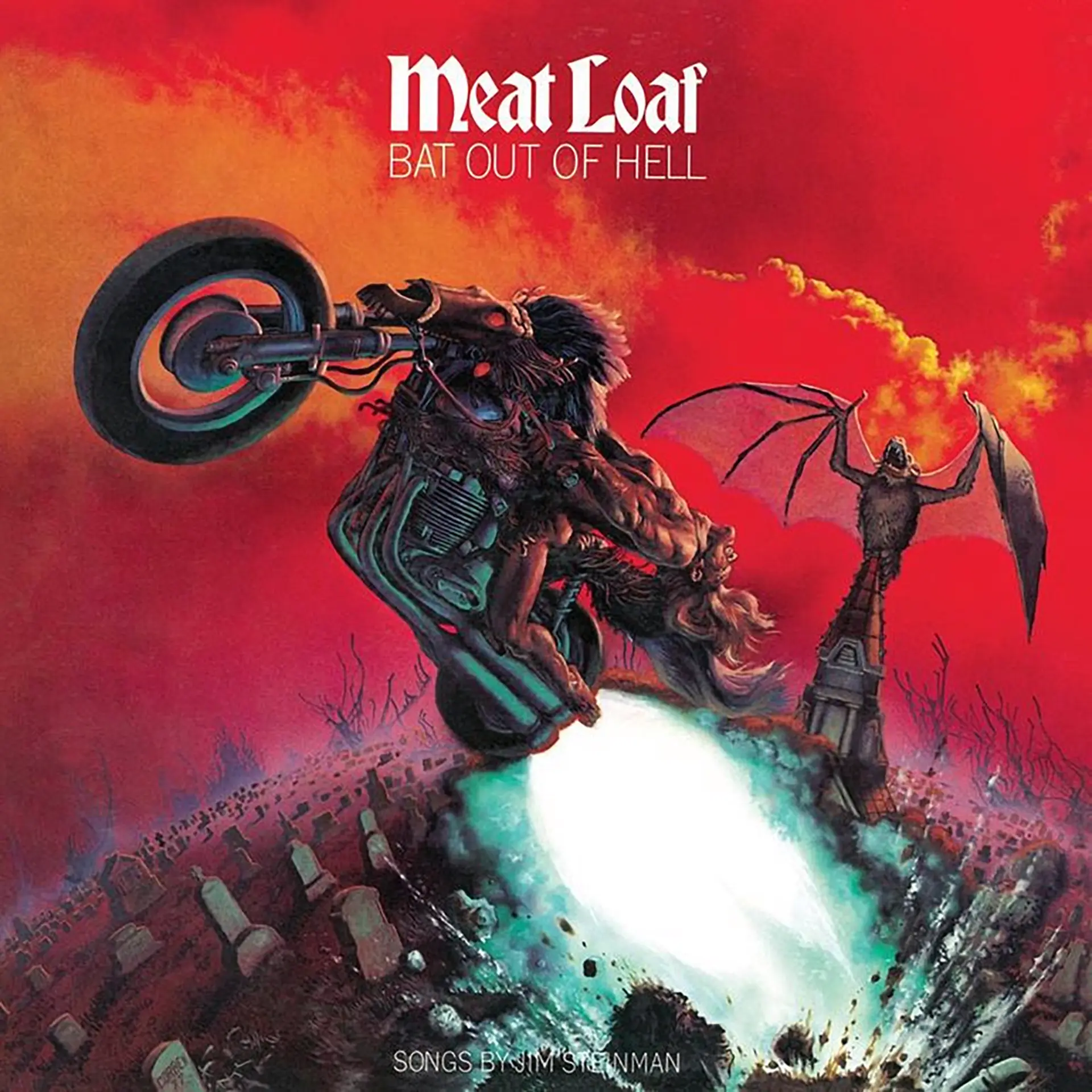
Meat Loaf is among the artists included in a CD collection that Rob Fleming, the record shop-owning central character of Nick Hornby’s[25] 1995 novel High Fidelity, finds ‘so poisonously awful that it should be put in a steel case and shipped off to some Third World waste dump.’
High Fidelity is a redemption story, but while the above is the view of Fleming on his way to being redeemed, Bat Out of Hell is an album that is susceptible to cynicism.
What even an enlightened Rob Fleming might point to as the record’s ‘poisonous awfulness’ — its overblown bombast — is much of its appeal.
The songs play out in mawkish melodramas from the eponymous opener to For Crying Out Loud.
The cod romantic dialogue at the start of the LP’s second track, You Took the Words Right Out of My Mouth (Hot Summer Night), typifies how the songs undercut their over-the-top sentiment — ‘I bet you say that to all of the boys…’
To treat a work that parodies its exaggerated emotions too solemnly is to miss the point. But the reason the fictional Rob Fleming deems it (amongst others) ‘poisonously awful’ has less to do with its content than with its popularity.
As David Hepworth[26] points out, Fleming in Hornby’s novel runs a record shop that seems to pride itself ‘on not selling anything that might conceivably be requested by the customer who had just rolled in off the street.’
Wikipedia[27] has Bat Out of Hell as the sixth all-time best-selling album. With sales of 43 million copies and 530 weeks on the UK album chart,[28] it’s a prime candidate for request by casual record shop customers.
To join the cognoscenti, though, is to exercise discernment. If you like what everybody else likes, your taste is undistinguished.
This makes Bat Out of Hell somewhat unsatisfactory as a first record. Buying something numerous others have bought isn’t much of a personal statement. And it’s not as though I can claim to have been ahead of other Bat Out of Hell buyers. I got my copy in 1980 — three years after its release.
Childhood hinterland: an incidental introduction to record-buying
If the above options are unsatisfactory, I can only fall back on my childhood hinterland for my first album choice.
A highlight of my family holidays in the early 1970s was rounding off the week with a slap-up meal in a Haverfordwest Wimpy Bar — then a sit-down affair with Wimpy-branded china and stainless-steel cutlery — followed by a rare cinema visit to take in the latest Bond movie.
My first James Bond film was Diamonds Are Forever,[29] which featured Sean Connery’s return as 007 after George Lazenby’s sole outing as Bond in On Her Majesty’s Secret Service.[30]
I remember this as an annual event, encompassing Diamonds Are Forever and the first couple of Roger Moore Bond flicks. Eon Productions wasn’t quite that prolific, though, releasing Live and Let Die[31] in December 1974.
A biennial treat or not, I was hooked. Enamoured especially with the gun barrel and title sequences, I coveted a piece of the cinematic action to take home and keep forever.
This was around half a decade before the VHS and Betamax battle for home entertainment supremacy.
If I couldn’t have a full audiovisual 007 encounter at home, I could at least get halfway there with audio extracts.
I discovered a disc promisingly titled The Best of Bond[32] in what must have been one of the earliest of my decades-long explorations of the album racks in city-centre record shops.
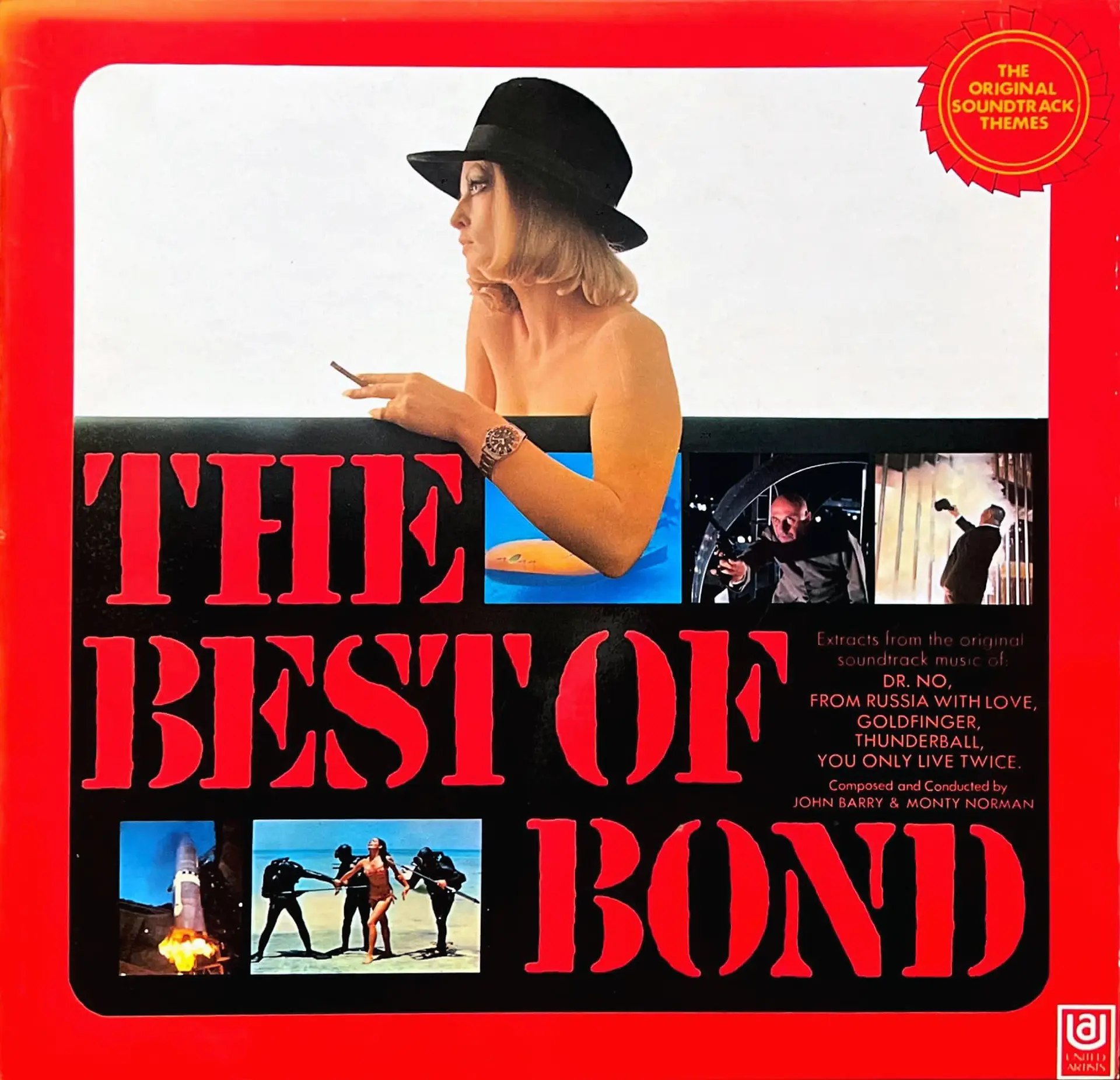
A 1969 United Artists issue, it covers the first five Bond movies — Dr. No,[34] From Russia with Love,[35] Goldfinger,[36] Thunderball,[37]
A fair expectation of this album is that it includes the theme tune from each film. The John Barry Seven and Orchestra’s famous James Bond Theme,[38] Matt Monro’s crooning From Russia with Love,[39] Shirley Bassey’s lung-imploding Goldfinger,[40] Tom Jones’ ballsy Thunderball,[41] and Nancy Sinatra’s whimsical You Only Live Twice[42] are obligatory.
Of these, only the first appears, which should have offered me ample early evidence of the likelihood of getting short-changed by a compilation album — it wasn’t until the first Now That’s What I Call Music[43] double in 1983 that one of these apparent sonic smorgasbords seemed genuinely worth its asking price.
I’d seen none of the films The Best of Bond encompassed when I bought the LP, and it wasn’t until I caught Goldfinger for the first time on television that I realised my record was mostly incidental music.
This accounts for the functional nature of the track listing. The opening selection from Dr. No, James Bond Theme, is robustly literal, but seems lyrical compared to Bond Back in Action Again, which starts Side Two.
The latter accompanies Goldfinger‘s pre-credit sequence, in which Bond explosively confounds a South American drugs cartel and then thwarts a would-be assassin with a lethal bathtub-electric fire coincidence.
‘Shocking. Positively shocking.’
Film scores are illustrative and make little sense shorn of the images for which they were composed. For example, the idiophonic stings in Golden Girl ratchet up the tension in Goldfinger‘s Miami Beach hotel sequence in which Oddjob makes his deadly debut.
Bond regains consciousness in the kitchenette of his hotel suite having been felled by a blow from the Korean villain. He goes to the bedroom and turns on the light, revealing the body of his latest lover, Jill Masterson (Shirley Eaton), covered in gold paint. The score’s eight metallic chimes heighten the shock of the discovery and convey something of the corpse’s sepulchral glow.
The J.B. connection
Two selections from Dr. No, Kingston Calypso and Under the Mango Tree, are songs, not ambient orchestration. Island Records founder Chris Blackwell,[45] who worked on Dr. No, notes that Under the Mango Tree is Monty Norman’s arrangement of an old Jamaican folk song.
Blackwell adds that Ian Fleming wrote the Bond books at his Jamaican home, GoldenEye, in six-week bursts every winter from 1952 until he died in 1964. Three 007 novels, Dr. No,[46] Live and Let Die,[47] and The Man with the Golden Gun,[48] as well as the short story Octopussy,[49] feature Jamaican locations.
Fleming’s surroundings naturally influenced his work, following the inveterate writerly advice to ‘write what you know’. However, Bond’s impact on Jamaican subculture seems less likely.
Blackwell finds, though, that ‘the rebellious sound-system ruffians and shanty-town gangsters known as rude boys who were dealing with the pressures of down-town Kingston in the early ’60s’ admired 007 for his sharp style, independence, and determination to enjoy himself.
The Caribbean fondness for Bond found musical expression in Desmond Dekker’s 1967 rocksteady recording 007 (Shanty Town).[50]
And when, as Blackwell puts it, ska ‘crossbred with the English punk scene and mutated into two-tone’, The Specials took up the 007 baton with the closing track on the first side of their 1980 second album, More Specials.[51]
Sock It to ‘Em J.B. is a cover of a 1966 single by Rex Garvin & The Mighty Cravers.[52] It name-checks Bond film titles and quotes their themes musically.
More Specials was an album I heard a lot around its release, although teenage factionalism meant that I pretended not to like it. I bought it on CD and recently got vinyl copies on eBay. I still play it regularly.
Blackwell points out that Dr. No had its UK release on 5 October 1962, ‘the same day that the Beatles put out their first single, “Love Me Do.”’
In Love and Let Die, John Higgs[53] takes the simultaneous launch of these enduring British popular cultural phenomena as his premise. He suggests that they represent the poles of Freud’s life and death instincts — Eros and Thanatos — with The Beatles on the side of love/life and Bond on that of death.
It’s a fascinating conjoining of my earliest movie and musical tastes. I came much later to The Beatles than Bond — John Lennon’s death on 8 December 1980 first drew my attention to the Fabs, and I’ve returned to their music constantly since then.
Accounting for taste
Two years before pop music and I first hit it off, I learned that my musical tastes would be scrutinised and I’d later be held accountable for them.
In the 1970s, my parents helped run a Methodist youth club with activities including weekends at Fedw, a 16th-century hunting lodge in Llandrindod Wells, Powys.
Now a bed and breakfast boastful of its inglenook fireplaces, Fedw Farm was then an outward-bound youth centre.
The club members preferred smoking, snogging, and playing records to outdoor activities. They brought the club’s white Formica-covered record player and speakers for the music.
For my weekend entertainment in 1976, I packed my Best of Bond LP, Laurel and Hardy’s The Trail of the Lonesome Pine[54] 45, and my Action Man.
The Trail of the Lonesome Pine, from the classic comedy duo’s 1937 movie Way Out West,[55] peaked at number two in the UK singles chart on 14 December 1975,[56] behind Queen’s Bohemian Rhapsody,[57] which held the top spot for nine weeks.
1976’s Fedw stay was on the weekend of 3 April. That Saturday night, the grown-ups and children annexed the lounge from the teenagers and gathered around the log fire to listen to the Eurovision Song Contest from The Hague.
I took up residence in the inglenook fireplace and breathed life into the dying embers as the radio results came in.
It was one of those rare occasions on which the UK won something, and we listened in wonder as Brotherhood of Man came out on top.
Unlike fellow Eurovision winners ABBA, the passage of time has done little to burnish Brotherhood of Man’s reputation.
The truth that those of us who, as teenagers, deemed the Swedes deeply uncool were overlooking is that the songs were often great. But while I’d happily give Waterloo,[59] SOS,[60] or Dancing Queen[61] a whirl these days, the same is not true of Save Your Kisses for Me.[62]
In 1976, we were pleased to take the win no matter how twee things had to get.
Out of the inglenook in the daytime, I was preoccupied with getting the teenagers to play my records.
The LP was JAMES BOND and had a nudie lady on the front, so why wouldn’t they want to hear it?
Also, Trail of the Lonesome Pine had been in the charts (as far as I knew), so I had a proper hit!
I had yet to learn the word ‘irony’ but thought the youth club members might play my records as a joke. This idea was quickly scotched by one of the girls who, spotting me loitering with my discs, warned the youth at the turntable, ‘Don’t put any rubbish on.’
Atomic Rooster’s Death Walks Behind You[63] was one of the alternatives to my ‘rubbish’.
They must have brought other records, but I remember the Atomic Rooster one because of its striking cover.
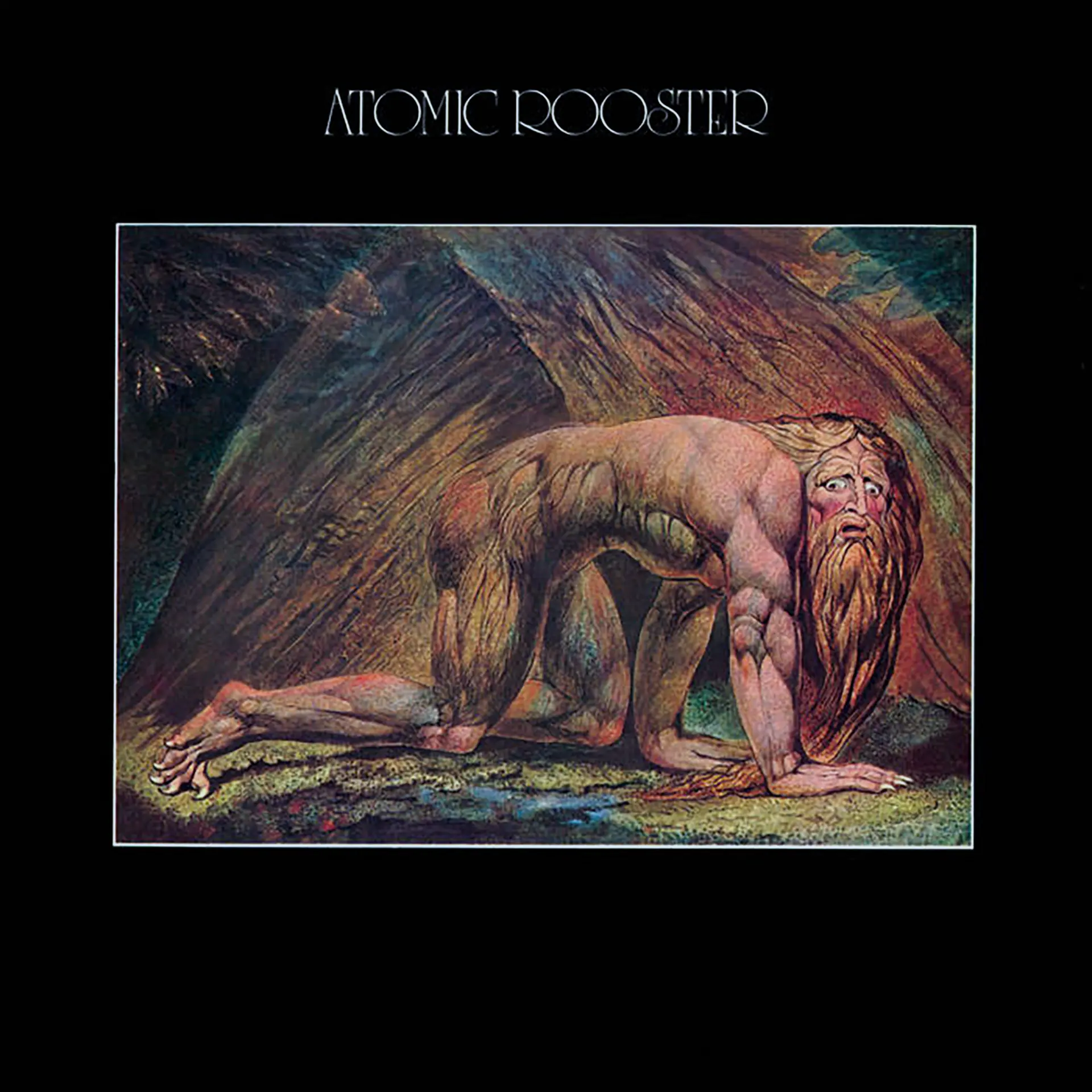
I now know the picture beneath the band’s name is William Blake’s print Nebuchadnezzar, which shows the unhinged Old Testament king naked and crawling on all fours in a cave.
A half-man, half-beast, his long beard trails the ground, his face a haunting countenance of horror, fear, and dismay.
The music is less memorable.
I was intrigued to hear what I made of the album with years of eclectic listening behind me — although this included no Atomic Rooster.
The band, especially its guitar and keyboard combination, resembles Deep Purple, but lacks Richie Blackmore’s riffmanship, Jon Lord’s organ hooks, or either Ian Gillan or David Coverdale’s power vocals.
I’d rather stream Death Walks Behind You again than listen to Save Your Kisses for Me, but The Best of Bond still edges it when it comes to my preference for the music I remember from that weekend in Wales.
If the youth club were unimpressed by my musical taste, they were bigger fans of my Action Man.
It had ‘gripping hands’ into the rubbery grasp of which you could press miniaturised military hardware.
One of the teenagers asked if he could ‘look at’ the doll and stuck a smouldering cigarette end in its hand.
He posed the figure with both hands on the butt at its groin and stood it on top of a dresser so that it appeared to be urinating smoke into the room.
How the youth club laughed!
When I reached my teens a few years later, I was friends with one of my erstwhile tormentors who’d obligingly tape albums from his extensive collection for me.
‘You were into Laurel and Hardy when I first knew you,’ he used to like to remind me.
It was inadmissible to point out that I was also still in junior school and had an Action Man: these were my musical choices, and I was responsible for them!
Too important for the truth
Giles Smith[65] concludes that ‘the affiliation between oneself and one’s first record [is] too important to rest on something so insubstantial and arbitrary as the truth.’
Having been candid about the muddled provenance of my record-buying, I’m claiming Blondie’s Parallel Lines as my first.
This requires only minor dissembling because it was the first full-on pop album I bought that showed a proper commitment to a particular band — compilations don’t count as they hedge bets over fandom.
The fact that I first owned it on cassette is a question of medium over matter. It was my first album, if not my first record.
Notes and references