
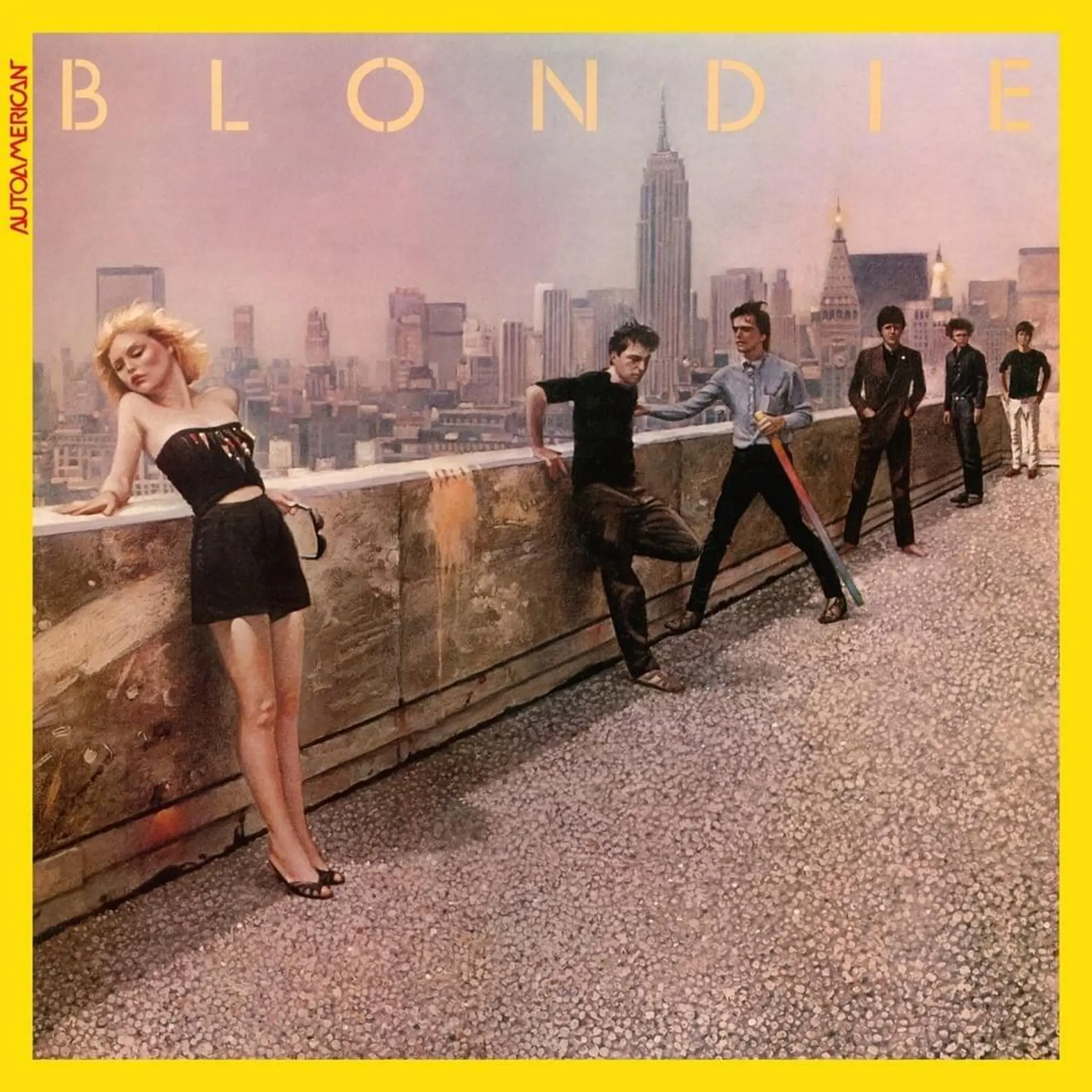
| Released | 26 November 1980 |
| Label | Chrysalis Records |
| Genre | Art rock |
| Duration | 46:39 |
Blondie's fifth album came out just 14 months after its predecessor, but while I was keen enough to clap my ears on Eat to the Beat [1] to brave my great-aunt's censure, my musical tastes had moved on apace by the time Autoamerican[2] hit the racks, so that its release was of little more than passing interest to me.
My mate who had the prescience to spot Atomic as a sure-fire hit a year earlier was, by autumn 1980, immersed in the 2 Tone movement. Blondie's cover of The Paragons' 1967 rocksteady number, Tide Is High,[3] was close enough to ska to meet his approval, and, with this seal upon it, the single became the band's fifth UK number one.[4]
Blondie was in the vanguard of musical styles with Autoamerican's second single. Building on the disco and New Wave fusion the band pioneered in Heart of Glass, Rapture adds the then-emerging hip-hop genre.
Debbie Harry recalls:
We loved rap. It was still very underground at that point, but “Rapture” went to the top of the charts [in the US]. I'm told it was the first rap song to make number one and the first with its own original music. All the rap songs up to that point were done using rhythm tracks and licks from existing songs.[5]
Rapture's video features early hip-hop artist Fab 5 Freddy who Harry credits with taking her and Chris Stein to their ‘first rap show in the Bronx.’
Harry continues by saying she ‘name-checked Freddy in the song and also Grandmaster Flash, another pioneer.’
The album embraces Blondie's home city culturally and iconically, its cover featuring the bandmates with the New York skyline.
While Rapture (the second track on Side Two) captures the cultural zeitgeist of the Big Apple in 1980, Europa, the album's opener, is reminiscent of Berlin-era Bowie — a Low-like[7] soundscape culminates with Harry intoning a dystopian micro-treatise on motor transport.
The album takes a more substantial step back in time with its third track, Here's Looking at You, although not as far back as 1942's Casablanca,[8] in which its titular phrase figures significantly. Instead, the jazzy number recalls those rendered by Marilyn Monroe in her 1950s film outings. In the role of chanteuse, Harry is nowhere near as breathy or cutesy as Monroe, but Harry describes Monroe as the ‘mother’ of her onstage persona, and Here's Looking at You reflects this genealogy.
Although Rapture includes the exhortation, ‘Don't stop, do punk rock’, there is little evidence of that kind of music on Autoamerican.
Of its 12 tracks, only the penultimate Walk Like Me recalls the up-tempo energy of the earlier albums.
Elsewhere, the pace is more moderate, and, revisiting the album, I've found that Angels on the Balcony, Go Through It, and T-Birds are mellow earworms.
The album makes a further venture into a jazz sound with Faces, and it wraps up with Follow Me, which, Wikipedia advises,[9] is ‘a cover of a torch song from Alan Jay Lerner and Frederick Loewe's 1960 musical Camelot.’
Autoamerican's Wikipedia entry also records mediocre ratings, including a 1985 one-star drubbing from Tom Carson in Rolling Stone .[10]
The thrust of Carson's invective is that Autoamerican is a betrayal of Blondie's rock'n'roll roots. Calling it an ‘anthology of intellectual onanism’, he adds ‘that it's almost the rock equivalent of a godawful Ken Russell movie.’
He has a particular disdain for Harry's narration at the end of Europa, which is not a highlight. Overall, Carson's review is a lengthy way of saying that Autoamerican is not as good as Parallel Lines [11] or Eat to the Beat ,[12] which is also undeniable.
I didn't get around to Autoamerican until its 2001 CD reissue.[13] It's more eclectic than its predecessors, and my tastes had also broadened by then. However, the 21 years between the album's release and its reissue seem to span less of a gulf than the original 14 months between it and its predecessor. Such is the relative velocity of change in teenage taste.
Notes and references