
| Released | 08 September 1978 |
| Label | Chrysalis Records |
| Genre | New wave, pop rock, power pop |
| Duration | 39:06 |
For me, Blondie's Parallel Lines[1] is in the latter category.
My caveated claim to the album as my first pop purchase is substantiated by my memory of being sufficiently committed to Blondie in 1979 to sport a badge bearing the band's name and a black-and-white photo of Debbie.
When I visited relatives in Canada that summer, the accessory caused a kerfuffle with a fairground ride operator.
Spotting my Blondie ‘button’ as I boarded the waltzers he was working, the youth felt the need to stress the superiority of the Stones over my then more contemporary musical choices.
To add heft to his opinion, he gave my waltzer a vicious spin as the ride started, adding vim to its rotation. He gleefully revisited my car several times during the ride to keep up the dizzying pace, but neither changed my musical taste nor proved that likings for Blondie and the Stones were incompatible.
Parallel Lines is the first of Blondie's two-album imperial phase, constituting the span of my initial fandom. Following its late 1970s peak, Blondie disbanded in 1982 for a 15-year hiatus,[2] after which I again became an avid listener.
This means that Parallel Lines hasn't quite been a constant companion since my first copy on cassette, but I had it on such hard rotation when it was one of my few albums in the late 1970s that it's never seemed a stranger.
It was amongst my earliest buys after I got my first turntable in over two decades in 2019. I bought it on heavyweight vinyl — a ‘fat record’ — and have since acquired a couple of slimmer early pressings.
Regardless of the format, playing Parallel Lines again is a reminder of the album's strength.
The ringing tone at the start of Hanging on the Telephone launches a dynamic triptych of tracks that would be the highlight of lesser albums.
Parallel Lines has two of its hits upfront, Hanging on the Telephone and Picture This sandwiching One Way or Another. Well-known enough not to count as a Blondie deep cut, the latter track was never a single release.
The album's biggest hits, the UK chart-topping Sunday Girl and Heart of Glass, find themselves in the relatively obscure sequencing of tracks three and four on Side Two.
Now inclined to be iconoclastic about standout album tracks, I still enjoy Heart of Glass.
The tumbling disco drum pattern from a Roland CR-78 drum machine that leads into the song[3] has always been beguiling. During one of my protracted teenage explorations of the stock at my local record shop, a fellow customer repeatedly made one of the staff members play the Roland opening. I'm unsure if he was trying to convince the indifferent employee that this was a faulty copy or if he just liked the sound of it. The intro was news to me as I'd not heard it when they played the song on the radio — it's cut from the seven-inch version — and it was an extra incentive to buy the album.
My pick of Parallel Lines excluding the obvious is the pacy Side Two opener, 11:59. As well as its energy rush, I like the wit of its lyrics: ‘Leaning in your corner like a candidate for wax / Sidewalk social scientists don't get no satisfaction from your cigarette…’
The same goes for the LP's closer, Just Go Away, with the customary faux pas metaphor rendered as: ‘You've got a big mouth and I'm happy to see / Your foot is firmly entrenched where a molar should be…’
Parallel Lines had long been a fixture in my sonic furniture before I learned that I'm Gonna Love You Too is a cover of a Buddy Holly song.[4]
Debbie Harry brings some punk attitude to Holly's staccato vocal style, assuming a masculine stance by not changing the lyrical point of view — ‘After all, another fella took ya / But I still can't overlook ya / I'm gonna do my best to hook ya…’
This complements Harry's levelling of the female gaze in Picture This — ‘I will give you my finest hour / The one I spent watching you shower…’
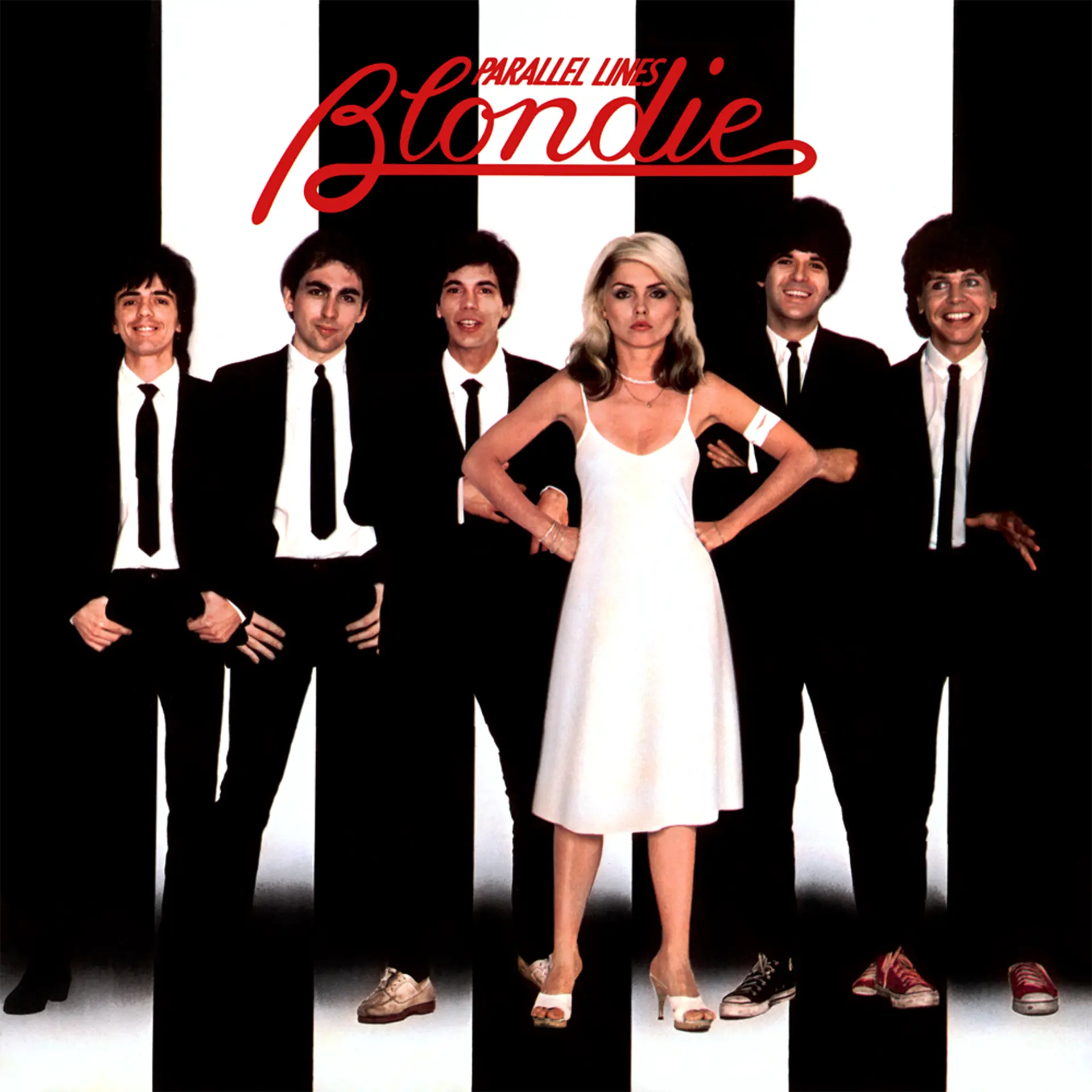
The album cover's timeless style matches the enduring appeal of the music. Little in the bandmates' appearance puts them firmly in 1978. The men's hair is a bit longer than it might be in other eras, but it wouldn't look out of place next to the mid-1960s Beatles or during Britpop. The black suits and skinny ties — as well as reflecting the parallel lines motif — are a classic look that notably resurfaced in 1992's Reservoir Dogs.[5]
I feel oddly disloyal to Blondie's other albums in awarding Parallel Lines first place. While the others have much to recommend them, none matches the pinnacle of Parallel Lines.
And it was my ‘first album’.
Notes and references