
‘Cultures of conspicuous consumption’
In Subculture: the meaning of style, Dick Hebdige[1] makes the point that the youth subcultures on which his study focuses:
[…] are cultures of conspicuous consumption — even when, as with the skinheads and the punks, certain types of consumption are conspicuously refused — and it is through the distinctive rituals of consumption, through style, that the subculture at once reveals its ‘secret’ identity and communicates its forbidden meanings. It is basically the way in which commodities are used in subculture which mark the subculture off from more orthodox cultural formations.[2]
Spectacular youth subcultures, then, apply conspicuous consumption in forging their identities. As Hebdige suggests, this manifests significantly in the form of distinctive clothing such as the Edwardian-style drape coats and drainpipe trousers worn by the Teddy Boys in the late 1950s or the tailor-made suits and fishtail parkas of the mods in the early 1960s. More recently adherents to hip hop subculture expressed their identity by accessorising with expensive brand-name trainers and extravagant gold jewellery.
It is difficult to conceive how identities might be constructed other than through modes of consumption. As Hebdige notes, ‘even where certain types of consumption are conspicuously refused’ the refusal results in identities resolving through consumption of different kinds — punks, for example, substituted bin-liners for dresses and T-shirts, exchanging conventional clothing for household consumables and, in so doing, making their consumption more conspicuous. The declaration of identity through musical taste also depends on the ability to show that taste through conspicuous consumption.
‘Envy, desire, touch, nostalgia, the whole nine yards’
In his article Nobody Ever Asked a Girl Back to Listen to Their iTunes, David Hepworth[3] draws the following distinction between vinyl records and music downloads:
You can't own a download. You merely pay for the legal right to access it. And if you don't own it you can never feel the sensations associated with ownership: envy, desire, touch, nostalgia, the whole nine yards.[4]
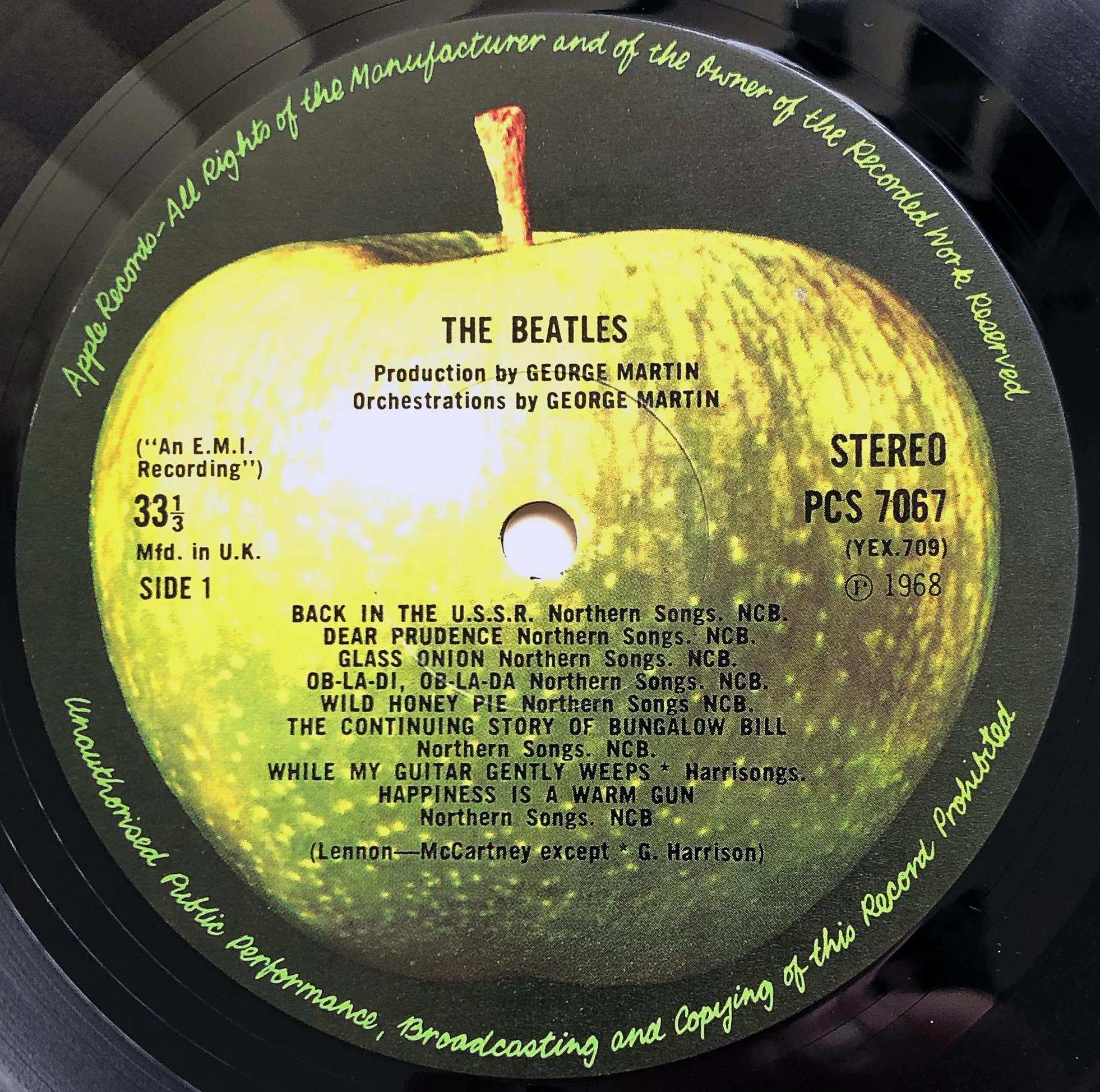
The experience of ‘ownership’ here is illusory. The ever-circling mantra ringing record labels cautioned, ‘All Rights of the Manufacturer and of the Owner of the Recorded Work Reserved. Unauthorised Public Performance, Broadcasting and Copying of this Record Prohibited’[5] — a rotary rights reminder revealing the real relationship between purchaser and recording regardless of its format. The ownership of commercial recordings has always remained firmly with record companies and the consumer has always paid for ‘the legal right to access’ them whether via records, audiotapes, CDs or over an internet connection. And, as the peripheral small print stressed, the companies sought (often with indifferent success) to restrict consumers' use of the recordings to their homes or other private spaces. The impression of ownership before digital music downloads was a factor of the former need to possess discs with recordings etched onto them or audiotapes magnetised with the premium content. While music fans owned the physical objects carrying the recordings and the packaging with copies of the associated artwork, they could claim no rights of ownership over the intellectual property other than the right to access it for personal use. Apart from being in possession of so much vinyl, paper and card or plastic, card, paper and metal, the ownership situation is identical with digital music downloads.
Hepworth's substantive point in his article, though, is about access more than ownership. He concludes by remembering:
[…] a time when the ownership of a few records was one of the few acceptable reasons a young man could provide which might encourage a young woman to visit his dwelling place. There was a time when you could say, “Come and hear my Van Morrison album” without risking pull-the-other-one derision. No matter how puny a young man's record collection it was also his life story, his diary and a treasure map showing the whereabouts of his often unspoken sensitivities. It was his heart, in fact. No longer.[7]
These observations show that the various means by which recorded music is accessed have a significant social impact. Record collections took time, effort and money to assemble — the more arcane the musical choices, the more effort they took to acquire — and this investment made it worthwhile for music fans to visit the homes of others (even without amorous intent) to access their collections. The static nature of listening to records also made it a sociable activity. Playing records requires turntables set on stable surfaces and this immobile playback method provides a natural focus for collective listening — this was true not only in homes but also at discos and clubs where record decks formed the centrepiece.
‘I don't need no album rack’
When cassette tapes allowed the development of highly portable players starting with Sony's Walkman in 1979[8] stereo systems became personal and were designed for individual listening through headphones. Cassettes also allowed consumers, by prohibited copying, to convert records into the more portable format. Bow Wow Wow's 1980 hit C30, C60, C90 Go[9] revels in the illegality of home taping, both rejecting and exploiting vinyl as a music source: ‘Now I've got a new way to move / It's shiny and black and don't need a groove / I don't need no album rack / I carry my collection over my back. […] If you're rich enough to have a record collection / I'll bring my bazooka round for an inspection.’
Cassettes combined portability with the flexibility to fillet record collections for choice cuts to add to personal mix tape compilations. The conspicuous consumption of recorded music shifted from a show of the media bearing the recordings to that of the devices used to play them. Hepworth[11] recalls that personal stereos were at first:
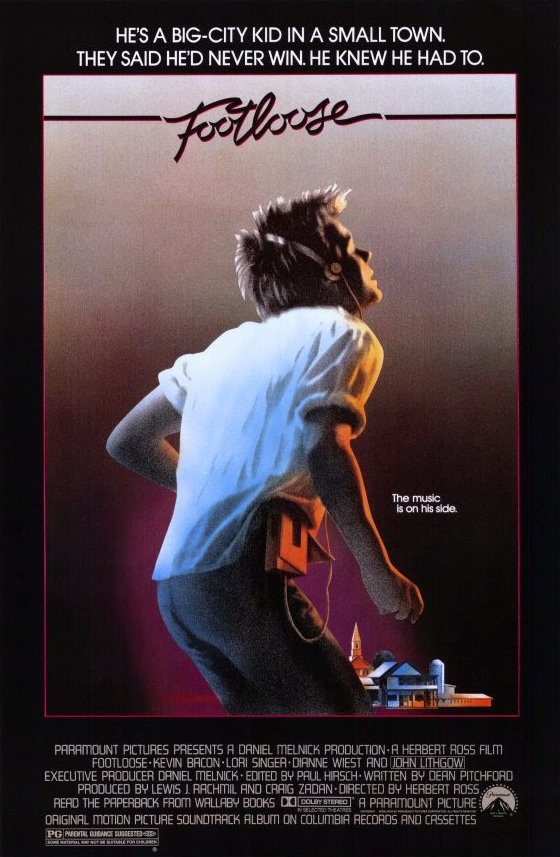
[…] something to show off about. In the 1984 movie Footloose Kevin Bacon uses his much-prized new toy to teach the teenagers of his sleepy old town in the puritan heartland how to dance to the rock music which the town's elders forbid. The poster for the film gave the equipment more prominence than the star. He is half turned away from the camera, thrusting the miraculous machine fastened to his belt loop towards the viewer.[12]
Hepworth adds that Michael J Fox also wields a Walkman prominently as Marty McFly in 1985's Back to the Future[14] when the accidental time traveler deploys some anachronistic Van Halen to convince his father-to-be that he is receiving an alien visitation. Hepworth also points to the video for Cliff Richard's Wired for Sound[15] — in which the singer rollerskates around Milton Keynes sporting lightweight headphones — as an earlier example of parading personal hi-fi equipment.
Subsequent technologies compounded the switch to individual listening and its more fragmented experience. Compact discs preserved albums with record companies releasing their back catalogues in the new format, but the greater ease of cuing and skipping tracks than with records or cassettes again disrupted the LP's integrity. Conspicuous consumption centred again on consumer music technology in place of its media in the wake of Philips' and Sony's introduction of compact disc players in 1982,[16] the expensive digital hi-fi equipment emblematic of affluent young urban professionals (yuppies[17]) until economies of scale reduced the cost of the machines and consumers grew accustomed to paying (in the mid to late 1980s) around twice the price of a vinyl album for a CD. CD players also quickly matched cassettes' portability with Sony launching the first in its line of personal stereos using the format — which became known as the ‘Discman’[18] — in 1984.
‘My way, what I want, when I want it, where I want it’
CDs not only consolidated the portability and individualisation that freed music fans from racks of records, they also supplied the source material for the next significant advance in consumer music technology. The MP3 digital audio file encoding format, first introduced in 1993,[19] offered a way in which to build music libraries inside personal computers by ‘ripping’ tracks from CDs. Ripping allowed consumers to convert the content already in their possession into a more malleable form without, as with previous evolutions, investing either in new equipment (if they owned PCs powerful enough to support digital music) or new prerecorded media. The impact of MP3 was similar to that of cassettes but with far greater disruptive force on the music industry. Not only was it now possible for consumers to make near-perfect copies of their CDs, they could also reproduce them in the original format with the flexibility (as with mix tapes) to create personal compilations ‘burned’ onto blank discs. In addition, global internet access allowed peer-to-peer sharing of music files so that individuals unknown to each other could explore and download their respective digital music libraries. Brent Schlender and Rick Tetzeli[20] recall that, in the summer of 1999. ‘a Massachusetts teenager named Shawn Fanning’ created a milestone in online music:
Napster was the software application that really blew the lid off things. […] It was one of the first truly “viral” Internet applications, a genuine killer app, that attracted tens of millions of users within months. It also was illegal. Napster facilitated the widespread piracy of recorded music, triggering a wholesale behavioral shift among music consumers that would eventually all but wreck the recording industry's traditional business model. The courts would shut down Napster in 2001, but not before it had become a cultural sensation, and Shawn Fanning a celebrity worthy of the cover of Time magazine.[21]
Shoshana Zuboff[22] sees Napster's ‘wholesale behavioral shift among music consumers’ as ‘a new quality of demand: consumption my way, what I want, when I want it, where I want it.’ This marked not only a move to acquiring content online but also a temporary diversion from conspicuous consumption. The illegality of music file-sharing made it undesirable to be conspicuously involved in the activity — Zuboff notes that the music industry's response was to ‘instill fear and crush […] demand by hunting down and prosecuting some of Napster's most-ardent users’ — but mass adoption of the practice meant that, as with home taping, there was ‘safety in numbers’ for smaller-scale MP3 file-sharers.
‘Rip. Mix. Burn.’
The music industry's inadequate response to the burgeoning MP3 revolution put tech companies in the position of being complicit in the illegal reproduction of copyright material. Apple's late co-founder and CEO Steve Jobs launched the company's iTunes music file management software or ‘jukebox’ at the MacWorld trade conference in San Francisco on 9 January 2001. He opened the iTunes section of his keynote presentation[23] with an explanation of the explosion in consumer adoption of MP3 files to store music on their computers and create playlists to write to recordable CDs. Giving an overview of the leading music management software available at the time — the most popular of which was RealNetworks' RealJukebox[24] — Jobs pointed out that this was complex to use and usually required premium upgrades to enable its full potential. Admitting that Apple was ‘late to this party’, Jobs demonstrated the original version of iTunes, which combined an uncomplicated interface with simple processes to copy CDs to computer hard drives, compile playlists and write them to recordable CDs. Apple made the full-featured software available free to its customers on the day of launch. The company marketed iTunes by summing up its tripartite workflow in the slogan ‘Rip. Mix. Burn.’ and ran a TV ad featuring a music fan seated in a theatre asking a gathering of well-known musicians (including Iggy Pop and Barry White) to feature in his latest playlist.
Schlender and Tetzeli[26] relate how Jobs was enraged in 2002 when Disney CEO Michael Eisner complained ‘in a hearing before the U.S. Senate Commerce Committee that Apple was openly touting illegal behavior. “They are selling the computer with the encouragement of the advertising that they can rip, mix and burn,” he said. “In other words, they can create a theft and distribute it to all their friends if they buy this particular computer.”’ Jobs' biographers continue that his temper may have been salved by a subsequent widespread ridiculing of Eisner's remarks. The legality of ‘Rip. Mix. Burn.’ remains, though, dependent on local legislation.[27] US copyright law, for example, allows that ripping CDs for personal consumption falls under ‘Fair Use’. UK regulations, though, prohibit the copying of recorded music for any purpose. As the BBC's Newsbeat website reported in 2015,[28] the High Court overturned a new law introduced by the British government in October 2014 legalising the copying of CDs, MP3s, DVDs, Blu-rays and e-books for private use following a legal challenge by the British Academy of Songwriters, Composers and Authors (BASCA), the Musicians' Union and UK Music. The BBC report points again to the perennial problem with this prohibition: ‘It's unclear how the change will be enforced.’
Notes and references