
I don't usually feel obliged to identify with characters who share my first name, but I do empathise with The Office‘s everyman, Tim Canterbury (Martin Freeman).
The series finds Tim in a dead-end sales job with the Slough paper merchant, Wernham Hogg. He took the job after dropping out of a psychology degree course and plans to leave it to resume his studies at university.
I thwarted my university ambitions by crashing and burning in my initial ‘A’ Levels in 1984. Not wanting to be left behind in Bristol while my peers went to university, I chose a Higher National Diploma (HND) to get back on track for a degree.
And so I moved to Slough.
‘Overrated’
Slough labours under a dour reputation, forged by poet Sir John Betjeman in his 1937 poem,[2] which advocates bombing the place.
In the end credits of the penultimate episode of the first series of The Office,[3] David Brent (Ricky Gervais) attempts a takedown of the late Poet Laureate:
This is the poem ‘Slough’ by Sir John Betjeman — probably never been there in his life.
Come friendly bombs and fall on Slough,
It isn't fit for humans now.
Right, I don't think you solve town-planning problems by dropping bombs all over the place — so he's embarrassed himself there.
[…]
And they made him a knight of the realm. Overrated.[4]
Gervais selected his reading of the poem as number 13 in a countdown of his 25 favourite Brent moments to celebrate this year's anniversary.[6] Introducing the clip, he comments:
Genuinely, John Betjeman's poem, Slough, was my favourite poem when I was at school. I thought it was incredible. I loved the social commentary. So, to be able to recite that, years later, as someone who took it as a diss, because that's where he lived, was a joy. Every line now was a dagger to Brent's heart.[7]
Retorts to Betjeman tend to focus, like Brent, on the ‘diss’ rather than the social commentary.
Punk poet Attila the Stockbroker (John Baine)[8] recalls in his 2015 autobiography, Arguments Yard,[9] being asked in 1988 ‘to rewrite Betjeman's thoroughly nasty poem’ as part of a publicity campaign for the opening of a new ten-screen cinema in Slough. The Slough Observer published Attila's pick of pro-Slough poetry submitted by townsfolk, along with his Betjeman rewrite, in a collection titled In Praise of Slough — The Quagmire Strikes Back.
Attila the Stockbroker's Slough takes on Betjeman as a patrician figure, a ‘poet of the teacup class’,[10] but then echoes rather than eschews him. Instead of the late laureate's ‘bogus Tudor bars’, he offers the contemporary ‘theme pubs, patronised by streams / Of tetchy men / with blow-dried hair and blow-dried brain’. The self-described socialist damns Slough with faint praise. Concluding that, as arch-monetarist ‘Milton Friedman[11] takes a bow / This town is fit for heroes now’, he subverts his apparently positive opening refrain, ‘Come tourists all, and flock to Slough’, in a poem that is backhandedly little more flattering than Betjeman's.
Slough History Online's Slough in Verse page[12] includes Attila the Stockbroker's Slough with Ian McMillan's[13] 2005 response to Betjeman under the title Spark Up Slough, usually cited as Slough Re-visited.[14] The poem was published by Volvic in May 2005 as part of its ‘Spark Up Your Day’ campaign, and its take on the ‘Come friendly bombs’ motif reflects the mineral water association: ‘Come friendly words and splash on Slough!’
Where Attila the Stockbroker disparages Betjeman's poetry while updating aspects of its social commentary, McMillan centres blandly on the possibility that Slough might not be such a bad place to live: ‘Slough is open, wide and green / With gorgeous buildings in between’. Like Brent, McMillan dismisses the prevailing poetic view as a ‘diss’, versifying that Slough is ‘a town / That people have tried to put down / By talking of it with a frown / And cruel sneers.’
Betjeman might be patrician and even patronising, but his intent, like that of The Office, does not seem to be to sneer. He instead raises the possibility of better ways to live, whether in Slough or elsewhere.
‘Lives of quiet desperation’
Slough's very name undercuts its potential appeal. Its borough council's website makes a brave effort to claim that this derives from a historic preponderance of sloe bushes in the area before admitting that:
Other writers have supposed the name to be derived from a ‘slough’, ‘mire’ or ‘morass’. These are usually places where the soil is soaked all the time and generally muddy. Indeed a number of references are made in local writings about a ‘miry place’ between the Crown Hotel […] and Salt Hill. During the 1880's building work in the area we now know as the High Street also recorded the need to dig out a ‘slough of black mire’ before being able to lay the foundations of buildings.[15]
The town's name makes it a metaphorically apt location for The Office. Tim is bogged down by his job and afraid to leave for university. Dawn Tinsley (Lucy Davis) has relinquished her ambitions as a children's illustrator at the coercion of her unsupportive fiancé, Lee (Joel Beckett). And Keith Bishop (the late Ewen MacIntosh[16]) from accounts finds that:
This job is just a stop-gap, really. […] Job's not difficult. I mean, I don't take my work home with me, it's pretty brainless. […] Ultimately I want to play music — write music and play in a band.[17]
David Brent's delusion is that he combines his work role with his celebrity aspirations:
This is what I do. Alright? You will never work in a place like this again. This is brilliant — fact! Yeah? And you'll never have another boss like me, someone who's basically a chilled-out entertainer, yeah?[18]
Brent's reality-denying narcissistic eagerness to be popular with his team, coupled with its members’ lack of fulfilment, supports Henry David Thoreau's[19] observation that:
The mass of men lead lives of quiet desperation. What is called resignation is confirmed desperation. […] A stereotyped but unconscious despair is concealed even under what are called the games and amusements of mankind. There is no play in them, for this comes after work. But it is a characteristic of wisdom not to do desperate things.[20]
Brent's efforts to prove that he is a ‘chilled-out entertainer’ by bringing ‘games and amusements’ to work show that he lacks the wisdom ‘not to do desperate things’, and his desperation is the source of his tragicomedy.
He confirms his desperation in a resignation that dismisses others’ ambitions in favour of the status quo. When Keith shares his musical aspirations, Brent hectors, ‘Good luck! Been there! Done that, bought the T-shirt! Next!’[21] And when Dawn outlines the abandonment of her career in children's illustration, Brent tells her:
[…] you'll always have the art, you know. Keep up the doodling, always, you know. Pipe dreams are good in a way. […] Keep the dream alive because otherwise one day you'll go, “Oh, could I have made it?” […] And if you keep trying, at least then when it doesn't happen, you can go, “At least I gave it a go”, you know …[22]
The other characters bear their desperation more quietly, but, unlike Brent, have not confirmed it through resignation. Dawn's thwarted artistic ambitions become a pivotal plot point in the Christmas specials that conclude the series, while Tim makes a desperate stab at escape at the end of the first series:
It's like an alarm clock's gone off and I've just got to get away. I think it was John Lennon who said, “Life is what happens when you're making other plans.” And that's how I feel, you know. Although, he also said, “I am the walrus, I am the eggman”, so I don't know what to believe.[24]
Quote Investigator[25] sources the quotation to a 1957 edition of Reader's Digest, where it is attributed to Allen Saunders. Correct attribution would have left Tim unable to land the I Am the Walrus[26][27] line. Lennon's lyrical use of the phrase (‘Life is what happens to you/While you're busy making other plans’[28]) tragically reflects how happenstance is impervious to personal intention — his life was cut short in the midst of his planned return to his recording and performing career. The extent to which our actions in life run counter to our intentions is a source of Thoreau's ‘quiet desperation’. Hemmed in by circumstances, we act accordingly, either accepting our situations or, like Tim in The Office, making desperate bids to escape the slough of stasis.
‘You got to take a light reading?’
Lacking the ‘wisdom not to do desperate things’, I went to study in Slough for want of a better idea. Although I had the dreary, dead hand of Business Studies on my shoulder — I passed the course without distinction, as it never really interested or inspired me (a necessary chore, like laundry) — other opportunities always appear.
I developed an enduring interest in photography in Slough, influenced and advised by fellow students. I soaked up enough knowledge of camera equipment through extracurricular study to get a job as a salesperson with the then-mighty Jessop of Leicester photographic retail chain when I returned to Bristol after my course.
My earliest photography project saw me going around Slough with my Pentax K1000[29] in June 1986, snapping townscapes to illustrate Betjeman's poem in grainy monochrome. I first read Slough in a student union newspaper soon after arriving in the town to start my studies. Two years on, it provided a foundation for a set of pictures recalling the familiar places from my time there.
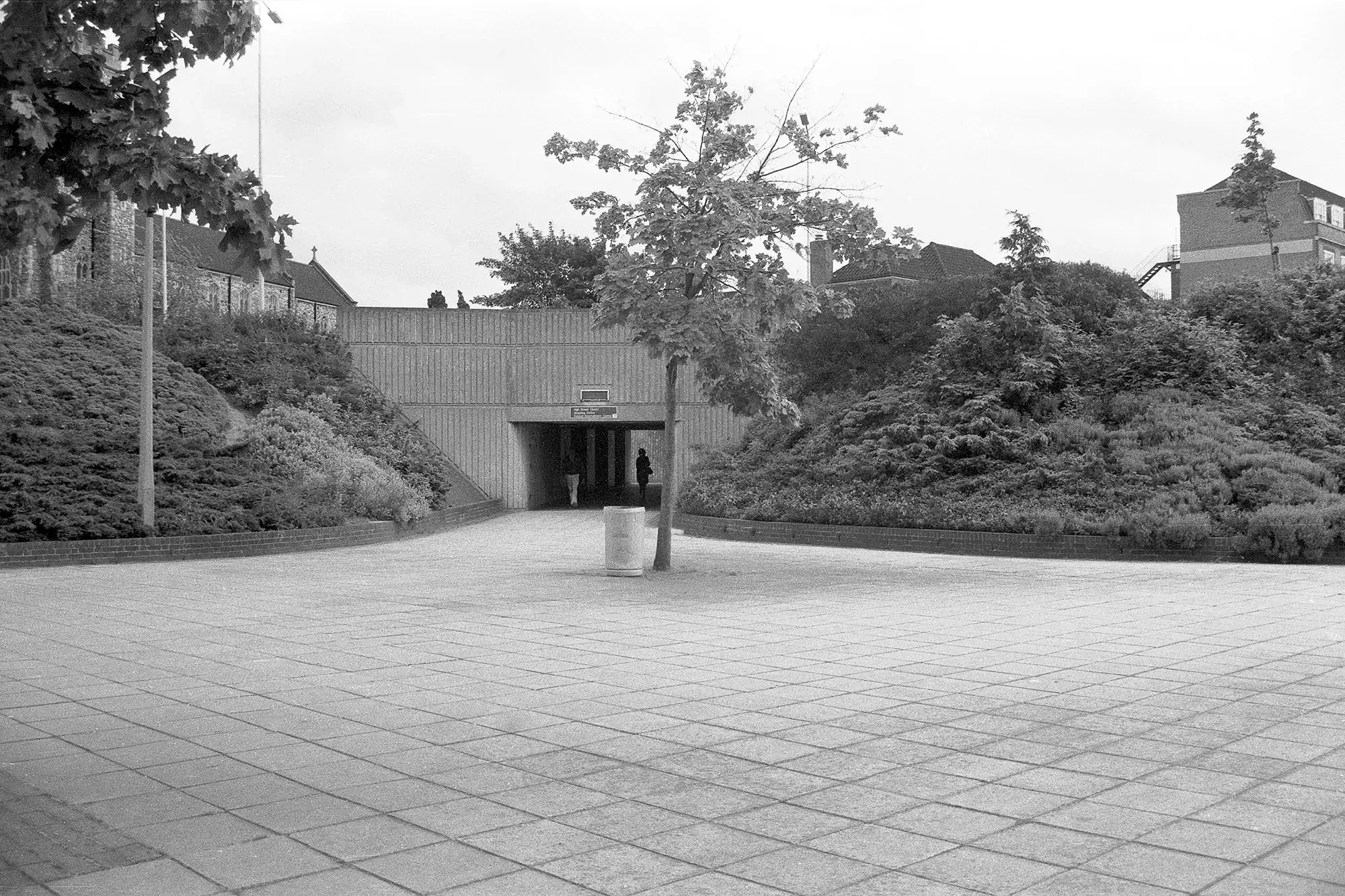
The Brunel roundabout, a centrepiece of The Office‘s title sequence, was one of those familiar places. The view from one of my classroom windows was also a daily thoroughfare to the railway station and shopping centre. I chose to photograph it both outside (this post's ‘featured image’ above) and inside, probably for much the same reason The Office film crew shot it around 15 years later: it made for an appropriately bleak urban scene.
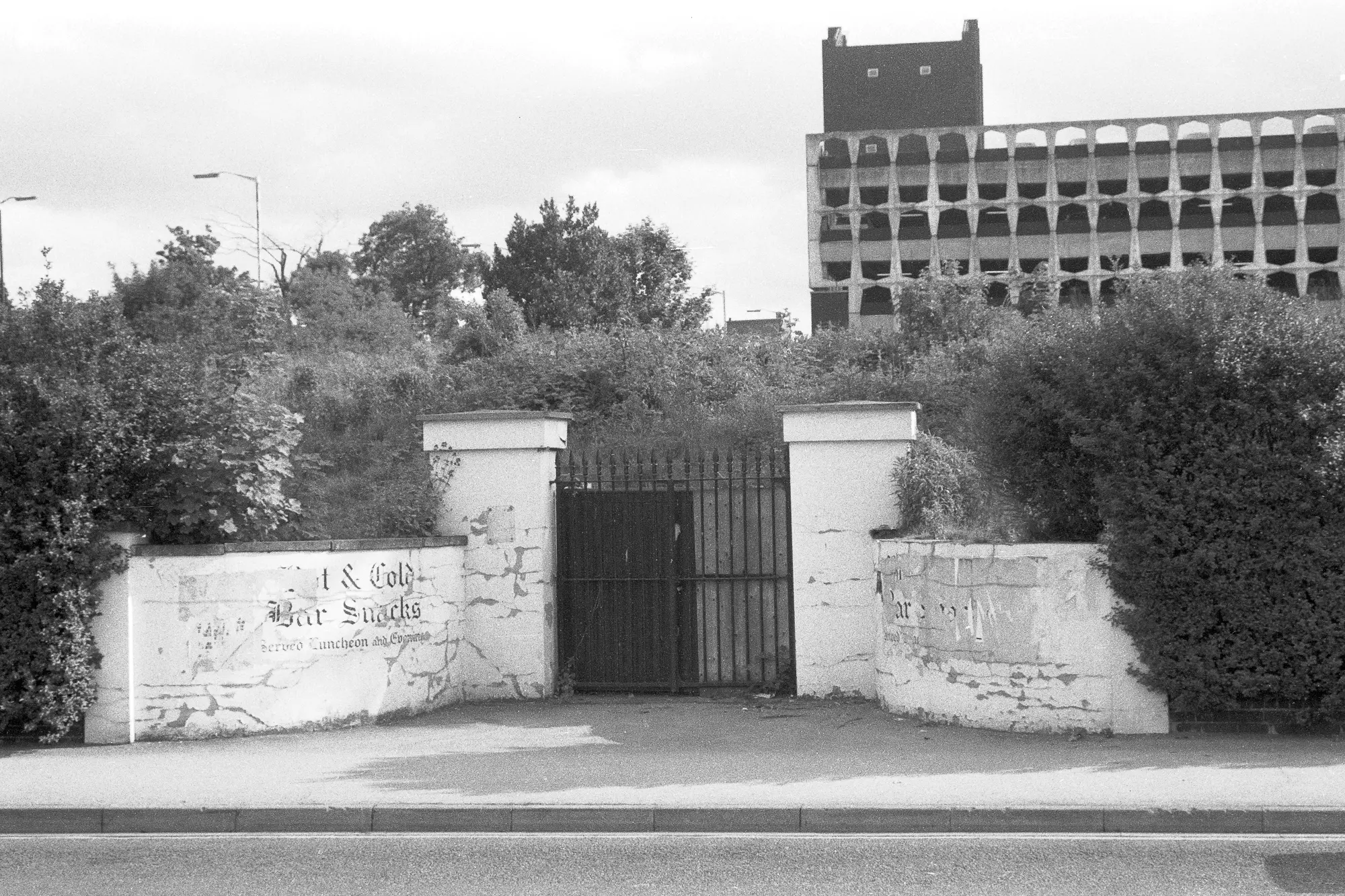
The Brunel Bus Station and Car Park's appearance in the sitcom's title sequence triggered memories, but I didn't pick it as a subject in 1986. I travelled to and from Slough by train, so I included the railway station in my Slough photo album instead. My search for a hostelry to represent Betjeman's ‘bogus Tudor bars’ yielded only an old gateway to some wasteland opposite the station bearing gothic lettering advertising ‘Hot & Cold Bar Snacks Served Luncheon and Evenings’. The archaic font and wording made me think this was at least the remains of one of the poet's faux-historical establishments, so I snapped it. The Brunel Bus Station and Car Park looms in the background.
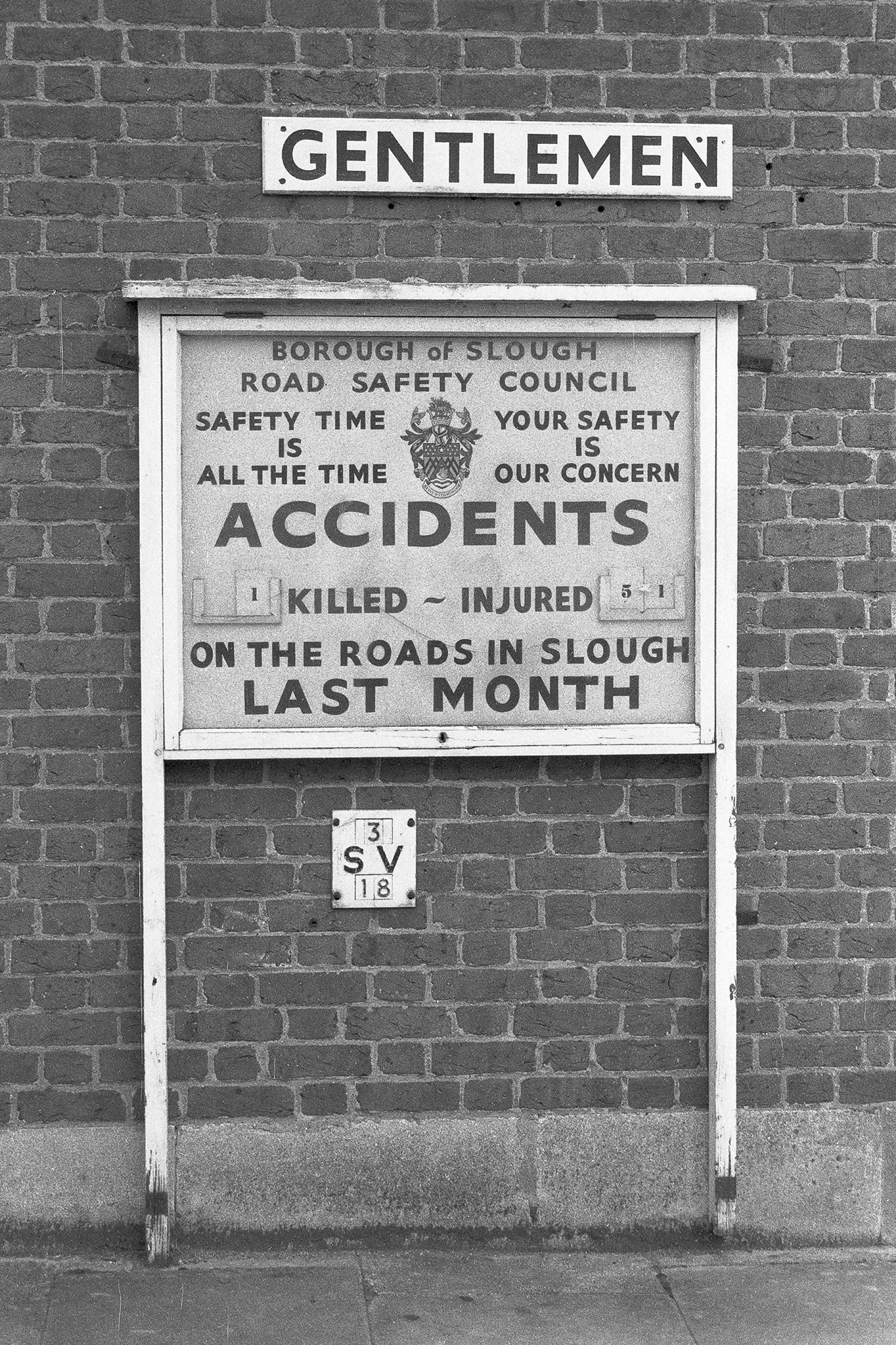
Slough's grim civic scorekeeping caught my dark comic eye early in my time in the town. I made sure to shoot the borough's Road Safety Council's accident scoreboard, which I passed regularly on my way from the Brunel roundabout underpass to Slough's High Street (East). I don't remember regular updates, and the one death and 51 injuries it recorded ‘ON THE ROADS IN SLOUGH LAST MONTH’ might well have been a permanent fixture throughout my two-year course.
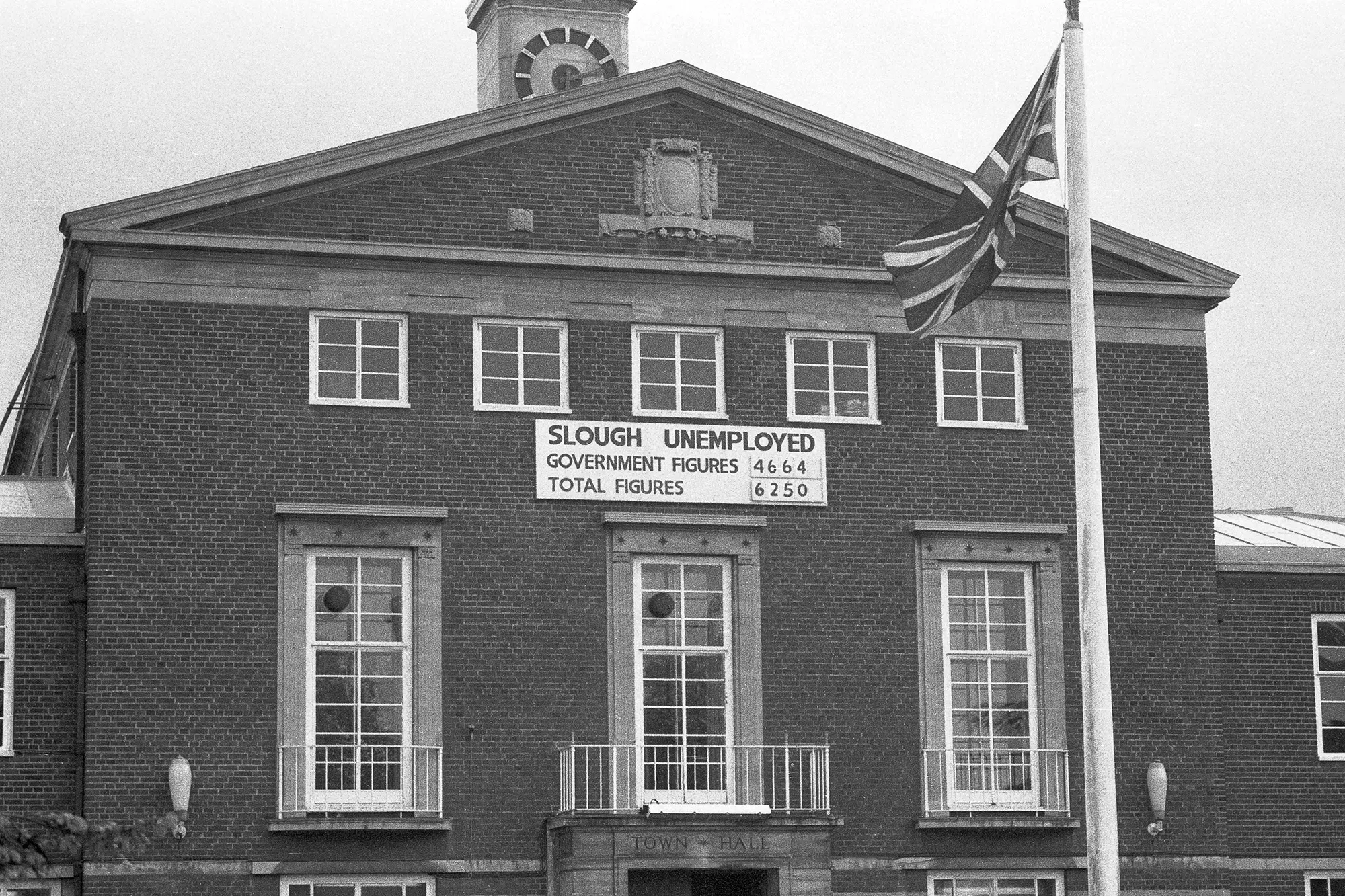
I also captured the unemployment readout atop Slough's old town hall, which disputed the government's claim that 4,664 people were unemployed in its jurisdiction in June 1986, with a counterstatistic of 6,250. The Labour-controlled council was clearly keen to highlight the Thatcher government's shortcomings with the prominent erratum.
My Slough photography project doesn't illustrate Betjeman's poem precisely, but is an unsophisticated attempt to capture something of its mood. I could just as easily have made the visual point by selectively shooting parts of Bristol.
‘…shiny new modern hellscape’
Betjeman's observations aren't specific to Slough any more than The Office depicts workplace conditions unique to the town. Slough is the setting of the poem and sitcom, but not their subject. Betjeman, Gervais, and Merchant chose Slough as a suitable setting for the issues they explore. But these issues are of modern life (even though Betjeman wrote his poem the best part of a century ago, it still resonates today) and don't belong to a particular place.
Instead of owning the backhanded compliment of its literary and comedic namechecks, Slough resists its dour characterisation. A BBC News report marking Betjeman's centenary concludes:
Slough council points out that — contrary to its grey image — the town has 42 parks and open spaces plus an ice skating arena where Jayne Torvill and Christopher Dean once trained.
Mars bars are made there, Thunderbirds was filmed there, and the Beatles began their British tour there in 1963.[30]
A Mars a day helped me work, rest, and play while I was in Slough. I found they went down well with black coffee, and imbibed them on the breeze, inhaling the warm, chocolaty air as I set out for college in the morning.
When I mentioned my regular consumption of the confectionery, a friend of my parents remarked that, in his day, he ‘would never have dreamt of eating a whole Mars bar.’ But he was more priggish than I was piggish.
Slough's association with the famous sweet counter staple is a more palatable one than the dismal ambience of The Office‘s title sequence. But where Slough Borough Council might have exhibited Thoreau's[31] ‘characteristic of wisdom not to do desperate things’, it has instead expunged all the landmarks shown in the programme's opening montage, starting with its £400m Heart of Slough development project, approved in 2008.[32]
In 2010, the redevelopment included demolishing the Brunel Car Park and Bus Station and starting construction of a new terminus, which opened in 2011.[33]
Slough Borough Council's final report on the Slough Regeneration Framework adds that:
The Brunel roundabout, a relict of 1970s highway planning, has gone, replaced with a more human scale signal controlled crossing.[34]
The roundabout became a crossroads in 2011.
Crossbow House, the last standing structure from The Office‘s title sequence, was bulldozed in 2014.[35] It provided the programme's exterior establishing shot and served as the Wernham Hogg building. Its location is now home to Premier Inn's Slough West (Slough Trading Estate) hotel.[36]
Chris Spargo's[37] YouTube video, Is Slough still miserable, 24 years after The Office?, compares the locations in the title sequence with their 2025 appearances, reconstructing the programme's intro with modern views. It shows the substantial changes to that part of the town since 2001 — and explains why I often got lost exploring the area for this post on Google Street View.
I agree with Spargo's ironic observation that the updated title sequence:
[…] ends on a Costa Coffee now. I feel like that just perfectly sums up the difference between the old sort of 1960s concrete hellscape and our shiny new modern hellscape.[39]
Adding an anonymising corporate sheen to an environment does not make it more relatable or encourage civic pride, and the redevelopment has met with indifferent success. Locals nicknamed the new bus station ‘The Slug’ due to its design, and found its accessibility and facilities inadequate before arsonists caused a substantial fire there, leading to its closure in October 2022.[40]
Despite its good intentions, Slough Borough Council's complete eradication of the landmarks from The Office‘s intro seems churlish — Spargo[41] finds that it has even removed the road sign from the sequence pointing to Slough Trading Estate.
In his take on Betjeman, Attila the Stockbroker[42] exhorts tourists to ‘flock to Slough’. By erasing the apparently unflattering locations from The Office‘s intro, Slough Borough Council has, ironically, made the town a less attractive tourist destination for fans of the sitcom. Both Betjeman's poem and The Office form parts of Slough's cultural heritage and, counterintuitively, make it a more interesting place to visit. As I've suggested, the town would do better to embrace these associations rather than downplay them.
‘Dress to impress’
I knew the Slough of The Office title sequence from studying there, but a location from the penultimate episode of series one[43] was much closer to home.
In a talking head from the episode, Tim comments:
Slough's nightlife is incredible. It's got two nightclubs. You've got Chasers. And New York, New York, “The club that never sleeps”. Umm, that closes at one. Mmm. There was, oh my God, a themed nightclub called ‘Henry the VIII's’. It had the Anne Boleyn Alley. Okay? This is true. As you went into the loo, there was a sign that said, “Mind Your Head”. Nice. And underneath someone had written, “Don't get your Hampton Court”. Hm…hmm… Yeah. It's not there any more. But there is not a day that goes by that I don't think about it.[44]
Gervais and Merchant channel Betjeman's ‘bogus Tudor bars’ with Slough's supposed former nightclub, Henry VIII's. And the gag about ‘The club that never sleeps’ closing at one is a nice setup for Tim's riff on the town's underwhelming fictional nightlife.
On first seeing The Office, I didn't know Stephen Merchant is from the same part of Bristol as me, which made me wonder if the local Chasers club was part of a chain.
The Bristol one was next to Kingswood's Kings Chase Shopping Centre (a complex that Slough's town planners would consider overripe for demolition). The club might well have derived its name from its neighbouring precinct, and it's likely Merchant lifted the Kingswood club's name for its fictional Slough equivalent.
The two late evenings I spent at Chasers before my time in Slough were not nearly as bawdy as The Office depicts. In the early 1980s, its proprietors resisted the sitcom's tacky characterisation of an establishment ‘full of loose women’[45] offering ‘Hooch for a pound and wonderbras-get-in-free’[46] nights, insisting that patrons ‘dress to impress’.
The required dressing was nowhere near the New Romantic flamboyance of London's Blitz club, but a provincial high-street variety. When I first hit the floor and hit the heights there, the girls wore ra-ra-skirt-and-legwarmer combos, while the boys sported their Top Man/Burton best, although I was more Man at C&A on my first visit.
By the second time, I'd upgraded my wardrobe with a collar-bar shirt and a skinny black tie with a piano-key design. My wardrobe revamp failed to impress the girl I asked to dance by proxy — perhaps she'd have preferred a more direct approach?
Chasers closed on Christmas Eve 2024. Its management explained that ‘Kingswood just does not have enough foot traffic that would pay to operate such a large property.’[47]
In The Office, Gareth (Mackenzie Crook) reports that he and the other characters go to the fictional Chasers ‘every Wednesday night’,[48] and a downturn in habitual clubbing seems a more likely reason for the demise of the venue's real-life equivalent than the lack of local ‘foot traffic’. In the early 1980s, it was a destination nightspot, a place where you needed the handbags and gladrags of The Office‘s theme tune to go.[49]
‘If you're wondering who this stranger is…’
Having inhabited the actual and inspirational locations of The Office, I have a lone connection with its cast.
In April 1998, I staged a rehearsed reading of my play Hurry Down Doomsday, an adaptation of Geoffrey Chaucer's The Miller's Tale, its title drawn from an Elvis Costello album track,[50] at the New Vic Studio in Bristol.[51] For this, I had the fillip of drawing on students from Bristol Old Vic Theatre School (BOVTS) to direct and cast.
The BOVTS student I recruited to direct the reading of Hurry Down Doomsday cast Sarah Colman, known as ‘Colly’, for the female lead.
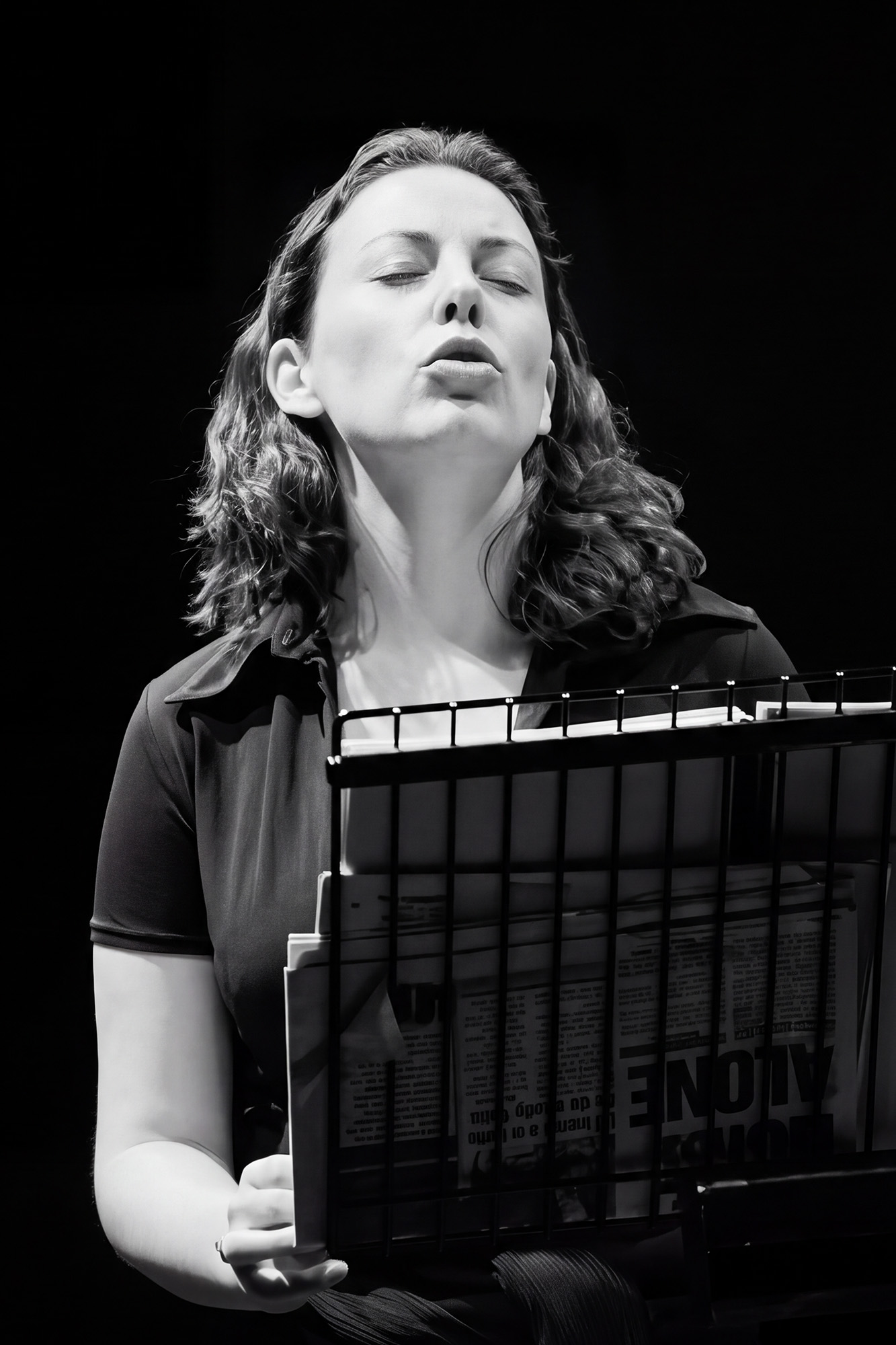
Four years later, Colly made an early cameo appearance in the final episode of the second series of The Office,[53] playing Helena Pidgeon, a reporter from trade magazine Inside Paper, who comes to Wernham Hogg to interview David Brent.[54]
I didn't recognise the actor when I first watched the episode. Following the reading, I saw her in a BOVTS production of Love's Labour's Lost at the New Vic Studio in 1999. By the time she appeared in the school's Shakespeare show, she'd adopted her stage name, Olivia Colman.[56]
Despite her minor role in The Office, Colman now has one of the cast's highest profiles, rivalled only by Gervais, although both Martin Freeman and Mackenzie Crook went on to Hollywood careers.
‘I'll be at training all day today…’
Fiction met reality for me again in the fourth episode of the first series in which Wernham Hogg's employees endure a training day.[57] The action reflects this kind of workplace instruction so closely that it's unsurprising that many viewers initially mistook The Office for a genuine documentary.
In my experience, such events bring together highly educated adults to impress ideas on them that wouldn't tax a 12-year-old.
In the episode, David Brent hijacks the vapid customer service exercises offered by Rowan (Vincent Franklin), an external training facilitator.
Following the aforementioned conversation in which Keith expresses his musical ambitions,[58] the morning's programme ends with an impromptu acoustic set from Brent, accompanying himself on a guitar that he goes home to fetch.
Brent's buttock-clenching soft-rock songwriting efforts are at least more entertaining than the official training, prompting limited engagement among the assembled coworkers. Unimpressed, the usurped Rowan calls lunch following a smattering of applause for Brent's concluding song Freelove Freeway.
Over lunch, increasingly inappropriate interventions in Dawn's turbulent relationship with her fiancé lead her to announce that she is considering leaving her job.
When training resumes, its vacuity, combined with Dawn's announcement, makes Tim's ennui so intense that he gives his notice and storms out. On a roll of carpe diem, he returns immediately to the training room to ask Dawn — whom he believes has split up with Lee — out for a drink. Dawn reveals that she and Lee have reconciled, meaning that Tim made his grand gesture on mistaken pretences.
The training, meant to improve its participants’ ability to do their jobs, largely serves as a catalyst that shows how dissatisfied they are with those jobs. Even Rowan, bludgeoned out of his cheerful presentation persona by Brent's egotistical marginalisation, storms out after Tim and declares the session a waste of time.
The episode highlights the characters’ ‘quiet desperation’ as they yearn for alternative lives while settling pragmatically for the lives they have.
‘Where've they sent him? Somewhere awful?’
The novelist Mick Herron invokes Slough to symbolise this liminal zone in his Slow Horses thriller series. The novels centre on a band of MI5 agents banished to the purgatory of a Security Service outpost known as ‘Slough House’ for misdemeanours that make them unworthy of being based at the Service's Regent's Park headquarters.
The exiles labour under the louche leadership of Jackson Lamb, whose ouster led to the coining of his station's name:
Lamb's been banished.
Where've they sent him? Somewhere awful?
Bad as it gets.
God, not Slough?
Might as well be.[60]
In the series’ fifth novel, London Rules,[61] Lamb sends one of his ‘joes’, River Cartwright, to ‘the actual Slough’. There, Cartwright reflects that:
Nothing exciting ever happened to the slow horses […] mostly it was just the daily grind. And that they were currently in the actual Slough only rubbed that in, somehow. The actual Slough wasn't somewhere he'd been before, and all he knew about it was that it had managed to crawl this near to London and then given up. No ambition. There was also a poem about bombs, but he wasn't reading too much into that.[62]
The perceived lack of ambition here could be metropolitan exceptionalism. Instead of ‘crawling […] near to London’, Slough might be heading in the opposite direction.
Slough's middling status persists, though, in Brent's paean to the place in the soundtrack of The Office spinoff movie,[63] David Brent: Life on the Road.[64] Brent sings that Slough is his kind of town, piling on the lyrical praise for its equidistance between London and Reading.
My two years in Slough were a middling period when I was unsure of my future direction. I shared the ennui of not knowing where I really wanted to be, along with the conviction that my current situation wasn't it, with the characters in The Office. The truth is that this isn't a condition particular to Slough, but one endemic to human experience, where Thoreau's[66] ‘lives of quiet desperation’ are, as he points out, commonplace. Betjeman's, Gervais and Merchant's, and Herron's ‘Sloughs’ are a state of mind, not ‘the actual Slough’.
‘…the same bit of carpet…’
What makes the ‘quiet desperation’ bearable is forming connections with others in the same situation. As Tim Canterbury observes in his final ‘talking head’ of The Office‘s second Christmas special:
The people you work with are people you were just thrown together with — you don't know them; it wasn't your choice. And yet you spend more time with them than you do with your friends or your family. But probably all you've got in common is the fact that you walk around on the same bit of carpet for eight hours a day. And so, obviously, when someone comes in who you have a connection with… Yeah. And Dawn was a ray of sunshine in my life, and it meant a lot.[67]
While Tim is right that employment compels us to spend more time with work colleagues than with family and friends, his observation is offset by the hoary truism that we choose our friends, but not our family. Dysfunctional families aside, the lack of choice of blood relatives is mitigated by the strength of genetic bonds, while we find friends through the random social interplay of everyday life. The workplace is no less likely a place for such discoveries than any other.
In The Office, Tim breaks the ‘fourth wall’ of the fictional documentary with looks to the camera that invite viewers to join him in his take on the situation he finds himself in. Martin Freeman[69] identifies these as a crib from Oliver Hardy's reactions to Stan Laurel's on-screen antics, but they also show Tim seeking connections beyond his personal dystopia. This is not to say that other characters in the sitcom disregard its unseen documentary film crew, but none of them attempts such direct contact with the audience. David Brent is acutely aware that he is being filmed, but he performs for viewers to be recognised as the ‘chilled-out entertainer’ he believes himself to be, rather than confronting the audience directly. Only Tim makes deliberate ‘eye contact’ with the camera — if those around him won't join him in recognising the absurdity of their behaviour, he'll seek this connection through the lens.
By allowing the character these non-verbal asides, Gervais and Merchant also anchor the audience's viewpoint. David Baddiel[70] observes that:
[David Brent's] self-image is, ‘I'm the boss, but because I'm really funny, and I'm a really funny bloke, I'm also immensely popular. I can have a joke and a laugh with the people who, you know, I'm supposed to have authority over, and they love me for it.’ And all that obviously is always wrong.
Tim is the one that you hope you are in The Office, even though he's depressed and thinks his life is being pissed away in this place. You love watching Brent, but you don't want to be Brent; you want to be Tim.[71]
Martin Freeman[72] adds:
That didn't happen by accident. It didn't happen because of my overwhelming charisma, do you know what I mean? It happened because they wanted Tim to be the, you know, the kind of, I suppose, the emotional focus, or at least… They wanted him to be the audience, yeah, and he, and he was, you know.[73]
Identifying with the characters in a sitcom or other work of fiction is like connecting with someone you share ‘the same bit of carpet’ with in reality. Identifying and empathising with the characters in a favourite novel or drama draws you back to it repeatedly. And when, as with my experience with The Office, there are points of connection beyond the fiction, the work endures as a hardy perennial, now spanning a quarter of a century since its first broadcast.
Notes and references