
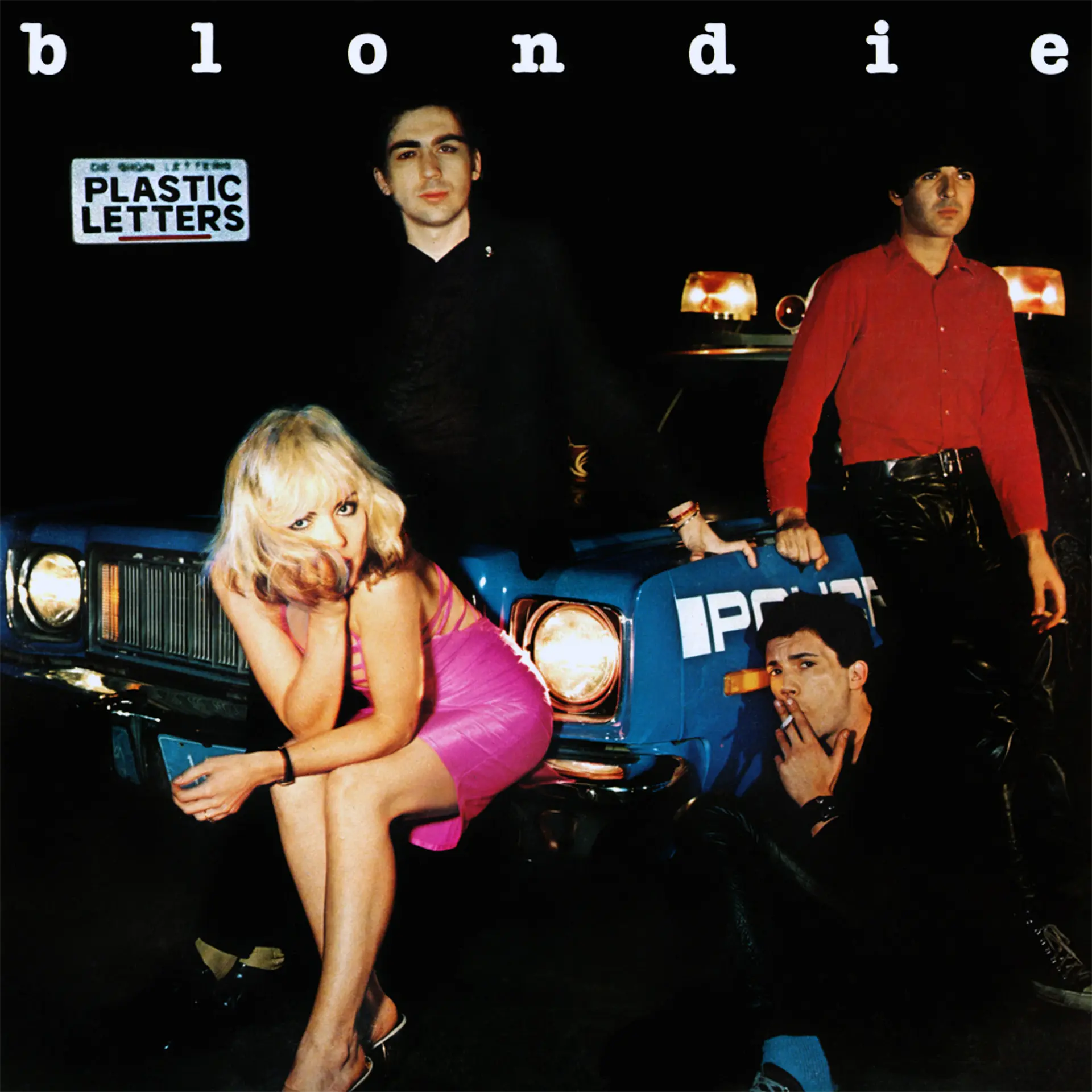
| Released | February 1978 |
| Label | Chrysalis Records |
| Genre | New wave, pop rock, punk rock |
| Duration | 34:46 |
One of the triumvirate of core Blondie members, along with Debbie Harry and Chris Stein, almost since the band's inception, Burke supplied its ‘heartbeat’ for all its albums.
Burke was one of fifty musicians who responded to a March 1975 ad in New York's Village Voice:
Freak energy Musical Experienced drummer needed female fronted estab. working NYC rock band. Excell oppty. money. Fun. Call NOW 925-0531[2]
Burke's ‘freak energy’ style eventually inspired a one-off academic study ‘to examine the physiological demands of playing “live”’.[3] This led to the foundation of the Clem Burke Drumming Project in 2008 for which the University of Gloucestershire awarded Burke an Honorary Doctorate of Music.
On Blondie's second album, Plastic Letters, Burke's boisterous beats are evident throughout Denis, the LP's debut single.[4]
A cover of a song first popularised in a 1963 doo-wop version by Randy and The Rainbows,[5] Blondie imbues it with a punk attitude that bursts the original's bubblegum bubble.
Denis and the album's other 45, (I'm Always Touched by Your) Presence, Dear,[6] first attracted me to the Blondie sound.
Despite this, Plastic Letters is Blondie's Cinderella album for me. It was a candidate for my cassette collection, which included its late-1970s successors, but it never qualified for my hard-saved pocket money.
The first time I heard any of it apart from the singles was when comedy performer and writer Jennifer Saunders made I Didn't Have the Nerve to Say No the pick of her pick of Desert Island Discs in December 1996.[7]
I finally caught up with the whole thing with 2001's CD reissue.[8]
It seems to be the rawest of the band's early albums. From Parallel Lines, producer Mike Chapman bludgeoned Blondie into a more polished approach to recording,[9] but Plastic Letters feels more direct from the New York club crucible of CBGB than the debut album, which, by rights, should carry the primal sound.
While only Rip Her to Shreds channels proper punk attitude on Blondie ,[10] it's more upfront on Plastic Letters.
In Saunders' favourite, I Didn't Have the Nerve to Say No, for example, Harry's dexterous lyric rails at a toxic lover, ‘You've got ants in your pants, I don't understand, I don't trust the flick of your eyes / You're a viper and love's a fever…'
Detroit 442, the LP's penultimate track, adopts the punk trope of resisting urban uniformity, contrasting the potential for speed and danger that the motor industry's products offer with their anonymising homogeneity — ‘One more to market, one more piggie, and they all, they all look just like me…’
Debbie Harry[11] attributes the album's aggression to circumstantial rather than cultural factors.
She recounts how Blondie's original bassist, Gary Valentine (later the author Gary Lachman), felt constrained by his role in the band and considered striking out for himself after playing on the second album.
Harry continues that Blondie's then-manager, Peter Leeds, pre-empted Valentine's amicable departure by acrimoniously firing him.
She concludes that this made for a bad atmosphere in the studio, and ‘You can definitely hear some of that anger and attitude on the album.’
Valentine may have been ejected before he could add bass guitar to the recording, but he substantially contributes to the album as the songwriter of (I'm Always Touched by Your) Presence, Dear.
The bassist's abrupt dismissal accounts for Blondie's manifestation as a four-piece on Plastic Letters — the perennial trio of Burke, Harry and Stein joined by keyboardist James Destri, a fixture of the band's early line-up.
Although only this quartet is pictured on the LP's cover, its sleeve notes show that Blondie's personnel included the rhythm guitarist and bassist credited as Frank ‘The Freak’ Infante, who shed semi-detached status for full band membership on later albums.
The emergent line-up matches Blondie's formative footing on Plastic Letters. The album has the first of the band's breakthrough songs, but is rooted in its early, under-polished sound.
Plastic Letters may not represent peak Blondie, but it shows some of the band's raw appeal as well as Clem Burke's high-energy drumming.
Notes and references