
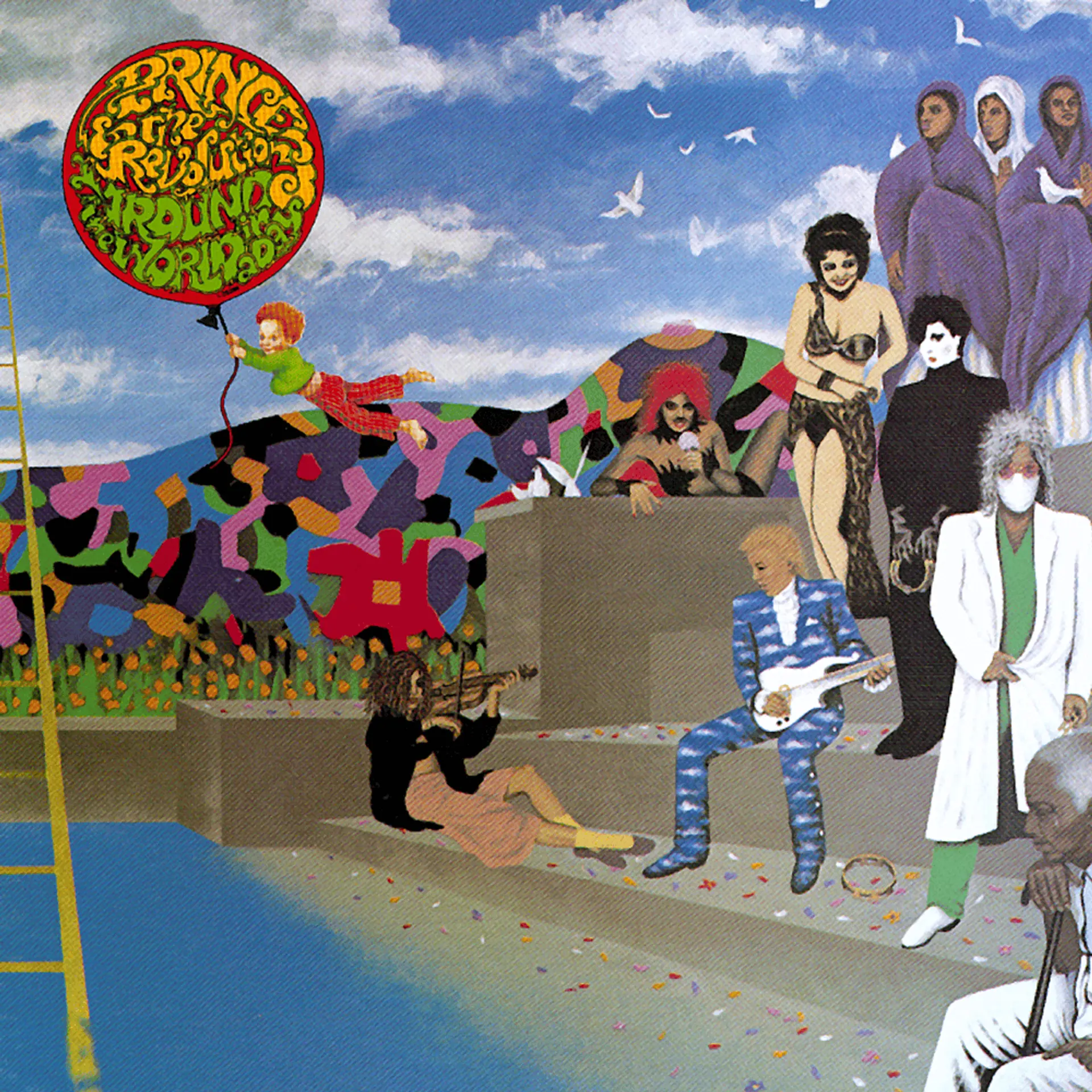
| Released | 22 April 1985 |
|---|---|
| Label | Paisley Park Records, Warner Bros Records |
| Genre | Psychedelic pop, pop rock, psychedelic soul, psychedelic funk |
| Duration | 42:33 |
In the 1980s, I was a big fan of the 1960s.
The decade before last shone as a far more vibrant time musically, historically, and politically than the one then underway.
By 1985, I was learning to accept that the halcyon days weren't coming back anytime soon. It seemed wiser to make do with the times in which I found myself.
I was pleased to seize any chance to capture a glimmer of the bygone era in the brave new world of big hair and shoulder pads.
Prince, the artist then known as Prince, was similarly minded.
Hovering musically and stylistically somewhere between Jimi Hendrix and Michael Jackson, he fused elements of the two decades.
‘The kind you find in a second-hand store…’
I bought a budget copy of Around the World in a Day on CD[1] when it was something you might ‘find in a second-hand store’, mostly because I wanted to revisit its first two singles.
Raspberry Beret[2] evokes The Beatles through its soft fruit connection to Strawberry Fields Forever[3] and musical nod to the Fabs' psychedelic era.
It's difficult to say exactly what in the music recalls the mind-bending milieu — the string sound, perhaps?
The song's video, on the other hand, has kaleidoscopic chromakey aplenty for full acid-drenched visual effect.
The lyrics put a witty spin on the theme of youthful indolence. Where Summertime Blues[5] has its feckless protagonist admitting, ‘Well, I didn't go to work / Told the boss I was sick’,[6] Raspberry Beret's idler gets ‘busy doing something close to nothing / But different than the day before’.[7]
Synthetic Sixties soupçon
Paisley Park,[9] the album's second single in the UK, appears more upfront about its 1960s antecedents.
The Prince Official Discography entry on the LP notes that it was:
Inspired in part by the Paisley Underground movement that was sweeping Los Angeles and the '70s rock records that shaped Prince in his youth […][11]
Paisley Underground was, says Creation Records' co-founder Alan McGee, ‘defiantly post-punk, neo-garage-revivalist, incestuous and psychedelic’.[12]
It took its name from the teardrop-shaped ancient Indo-Iranian pattern.[13][14]
Paisley patterns were also strongly associated with the hallucinogen-driven 1960s counterculture.
Unaware of the movement ‘sweeping Los Angeles’ in 1985, I found a couple of paisley grandad shirts at a boutique menswear shop in Slough, where I was a student.
The garments were made of viscose, which required careful attention with an iron, but they added a synthetic Sixties soupçon to my mid-1980s look.
‘Wimoweh’
Prince's paisley penchant was far more profound.
Paisley Park is his former home in Chanhassen, Minnesota, where he built a recording studio.[15] It is now a museum and concert venue.
The song celebrating the estate features a piping outro that elicits the intro of Strawberry Fields Forever,[16] with Prince replacing The Beatles' Mellotron with a Yamaha DX7 synthesiser.
Paisley Park also has a digital drum sound from a Linn LM-1 instead of the all-analogue Ringo.
The song's rhythm track includes a synthesiser part that reminds me more of The Tokens' 1961 hit, The Lion Sleeps Tonight (Wimoweh),[17] than anything by The Beatles.
Following the count-in, the Yamaha takes up a piping refrain with a similar rhythm to that of The Tokens' chorus of ‘wimoweh’ — a mishearing of the Zulu ‘Uimbube’ (‘You are a lion’).[18]
The synth ‘wimowehs’ away on the left for the rest of the track. But the chiming finger cymbals and surreal lyrics keep things far more psychedelic than doo-wop. (And the ‘wimoweh’ thing could just be me…)
After showing a borrowed copy of the 12-inch single version of Paisley Park[19] some serious turntable action in 1985, I turned off, tuned out, and dropped out of its follow-ups.
‘Say, can you see…’
I was vaguely aware of Pop Life,[20] the third single from Around the World in a Day, a funky yet downbeat assessment of the eponymous existence's ennui. However, I knew nothing of America,[21] the album's final single, until I bought it on CD.
The latter track opens Side Two with a stuttering start, which resolves into a guitar tune that reminds me of Hendrix's Star-Spangled Banner Woodstock encore.[22][23]
I may be making ‘wimoweh’-type connections again, but both musicians are reflecting on the contemporary state of their nation.
And the Prince record seems so steeped in the 1960s that it's tempting to make arbitrary comparisons with the decade's significant cultural moments.
While Hendrix lets his guitar do the talking, Prince gets lyrical in a song with an irony-heavy patriotic chorus, and verses warning of the dissolution of the political system into nuclear war.
Following the hippy trail
The title track follows the hippy trail eastward, alighting in the Middle East instead of joining The Beatles' course to India.
The Egyptian oud and darbuka on the track substitute for sitar and tabla on The Beatles' Indian-influenced recordings.
Side One's closer invites flower-power associations with The Byrds[24] (via Bob Dylan[25]), but Prince's more uptempo Tamborine [sic] brings ‘long days, lonely nights’ — not ‘jingle jangle’ mornings.
Both sides have extended soulful numbers. Side One's Condition of the Heart is unrequited love, while the elusive steps in The Ladder are the route to ‘salvation of the soul’.
Frank-N-Furter finale
Temptation, the album's closer, is the snake to The Ladder — a sexual psychodrama in the vein of Darling Nikki from Purple Rain.[26]
After repeated protestations of pure lust, Prince (the lyric name-checks its author and singer) is confronted by a god-like voice proclaiming, ‘Oh, silly man, that's not how it works. You have to want her for the right reasons.’
When Prince objects, ‘I do!’, the voice responds, ‘You don't; now die’.
The track concludes with contrition, Prince apologising, ‘I'm sorry / I'll be good / This time I promise / Love is more important than sex / Now I understand / I have to go now / I don't know when I'll return / Goodbye’.
The coda recalls the confrontation at the end of The Rocky Horror Picture Show[27] when Riff Raff (Richard O'Brien) and Magenta (Patricia Quinn) interrupt Frank-N-Furter's (Tim Curry) louche floor show to take command and return their extraterrestrial mission to its home planet.
Frank expresses humility and apparent enlightenment in his swansong, I'm Going Home, but it doesn't end as well for him as it does for Prince.
After Frank gets zapped by Riff Raff's ray gun, his musclebound monster, Rocky Horror (Peter Hinwood), tries to flee with the body of his late creator by scaling a theatrical recreation of RKO's radio mast logo.
The scene spoofs the end of King Kong[28] — an RKO Radio Pictures production — in which the outsized ape scales New York's Empire State Building, clutching Fay Wray.
The Rocky Horror set adopts the pop art trope of reproducing images from popular culture, as well as providing an unorthodox means of ascent, via RKO's logo.
The sleeve design of Around the World in a Day also draws inspiration from the pop art movement. It, however, has conventional climbing equipment at its centre, albeit with an equally ill-defined destination.
It's on the cover!
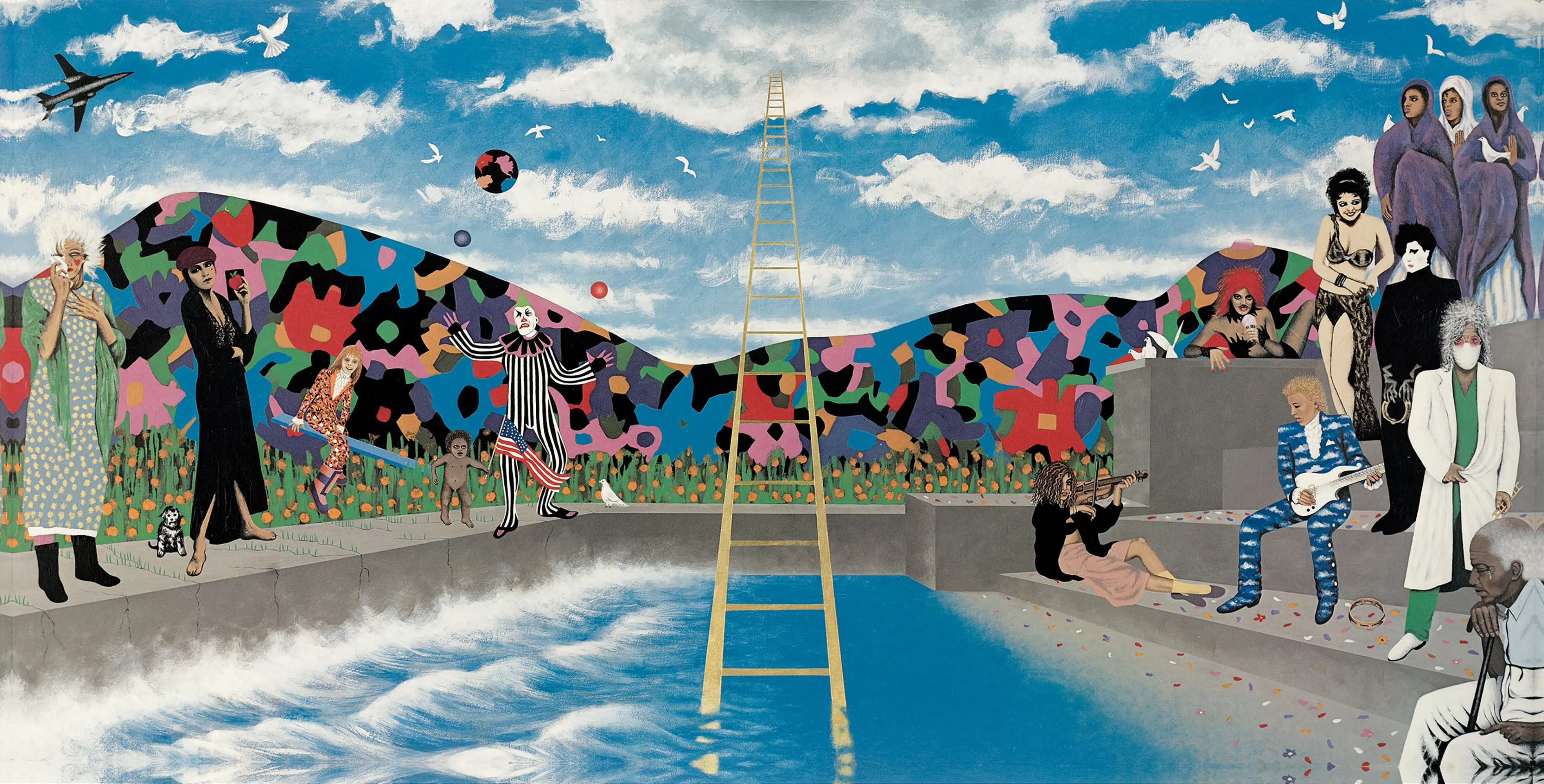
‘Everybody's looking for the ladder’ runs the refrain in the track named after the essential window-cleaning kit.
It's unnecessary to look further than the album's cover for a picture of one at least.
A skyward-bound ladder, its verticals converging precipitously, spans the gatefold sleeve's spine.
Doug Henders' cover painting is a compendium of images representing the album tracks. He has posted scans of Prince's handwritten brief for the painting on his website.[29]
Details the musician requested include:
Blue sky background with fluffy clouds.
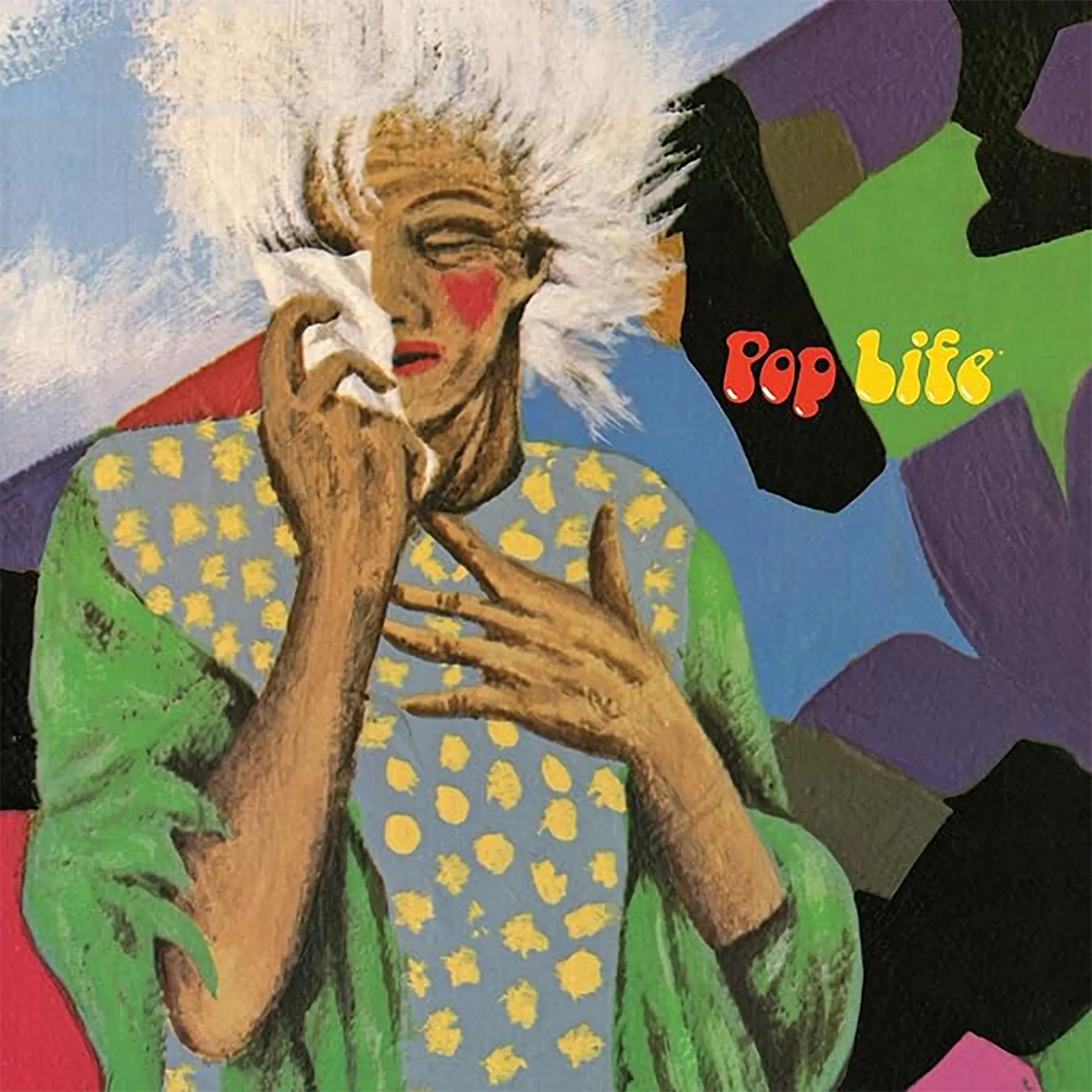
A small body of water in a pier. An old woman crying with a handkerchief over a love lost.
A ladder leading from the water into one of the clouds in the sky.[30]
The celestial ladder illustrates The Ladder, and, a little less on the nose, the old woman with the handkerchief turns up on the picture sleeve of the Pop Life single.
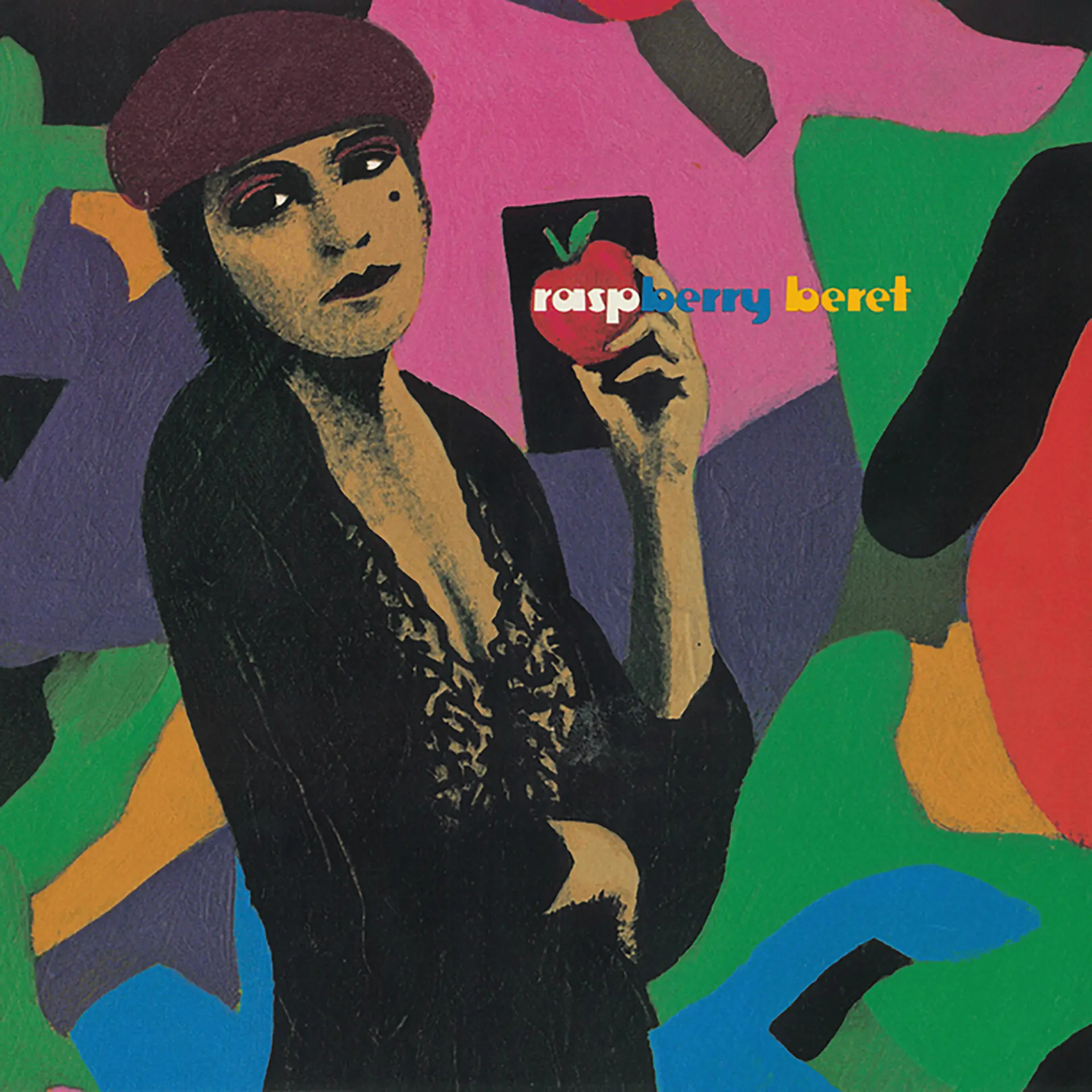
To the right of the weeping elderly woman is ‘A beautiful woman Exotic looking wearing a black cape and a raspberry beret.’
Next is a ‘Pretty little girl aged 3 or 4 on a seesaw. (She should be laughing)’.[33]
The ‘girl on the seesaw […] laughing’ as described in Paisley Park's chorus[34] didn't make it onto the single's picture sleeve, which features paisley-patterned cloth, perhaps because of the peculiar imbalance of her lack of a seesaw partner — how does her end of the playground equipment tip upwards without someone opposite her?
‘A naked black baby running with an American flag’[35] completes the singles' illustrations. However, given the apocalyptic outcome of America's lyrics, the ‘small Russian fighter jet flying through the sky’ also indicates that song.
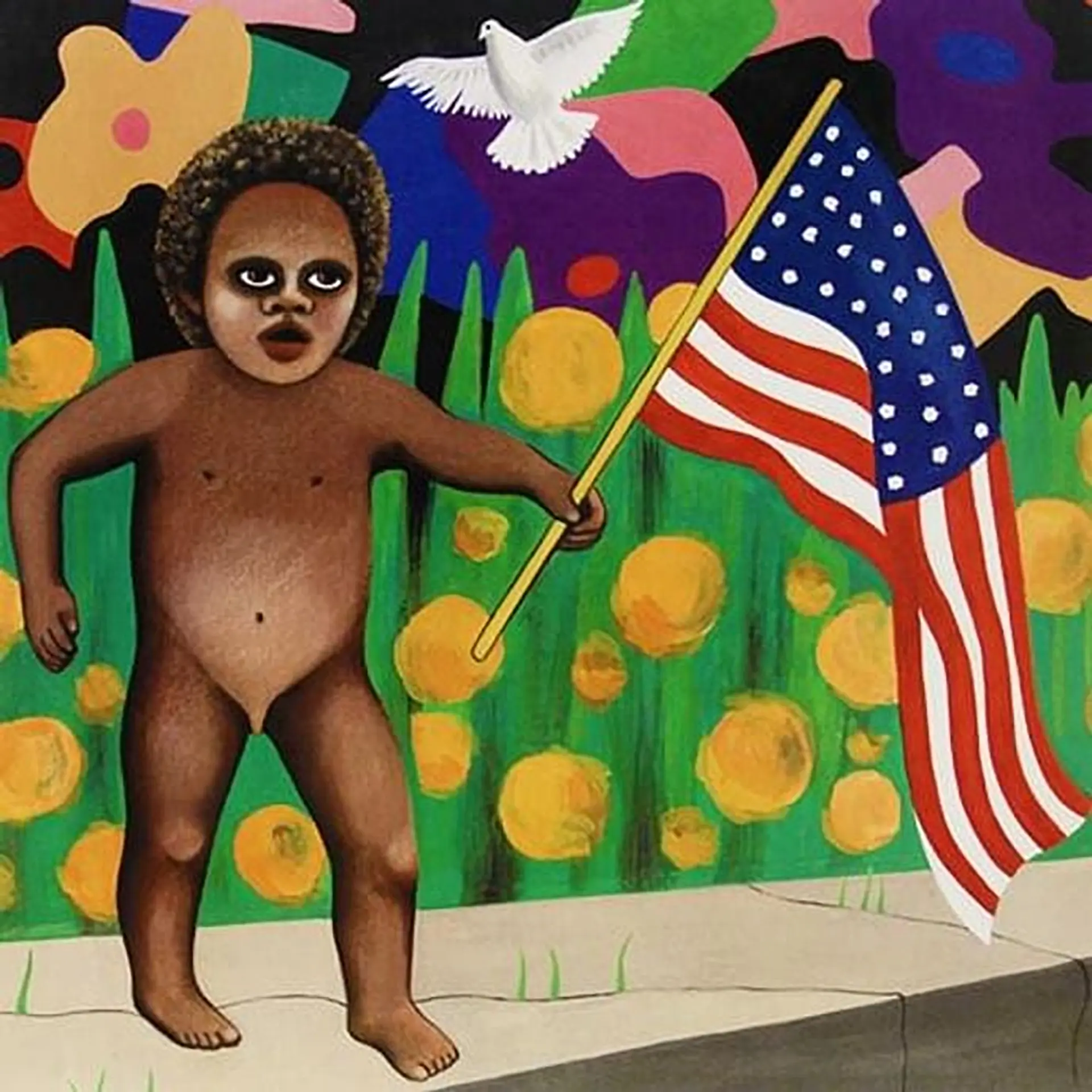
Henders' painting resonates with Peter Blake's live and collage frontispiece for Sgt Pepper's Lonely Hearts Club Band,[37] both in its pop art aspect and in that it shows psychedelic flora (‘Paisley lawns with dandelions of yellow and violets. Lots of violets.’[38]) and a disparate gathering beneath a blue sky.
To select the members of the collage crowd on the cover of Sgt Pepper, Blake asked the Beatles to ‘make lists of people they'd most like to have in the audience at [an] imaginary concert.’[39]
The artwork of Around the World in a Day echoes this concept with ‘A laughing woman dressed in black who resembles Clara Bow. The woman should be hysterically laughing.’[40]
The silent era starlet's lookalike is part of the group on the steps on the right, immediately beneath the ‘Olive skinned people wearing hoods & capes of purple.’ She seems amused, but I'm unsure if this amounts to ‘hysterically laughing’…
Bow's double features to represent the lyric from Condition of the Heart: ‘There was a woman from the ghetto who made funny faces / Just like Clara Bow, how was I to know’.[41]
Prince's brief creates a collage effect for the painting by combining the individual illustrations of the album tracks. Henders extends this to a photomontage effect, which blends images to produce an alternative overall impression, for the background.
The psychedelic hillscape (if I'm not getting too Rorschach) is the silhouette of a recumbent nude.
More eclectically, the background's colour scheme reminds me of Elmer the Patchwork Elephant from the enduring series of children's books by David McKee.[42] The first in the series was originally published in 1968, during the psychedelic era, but it seems unlikely that the counterculture significantly influenced it.
Presenting Henders' artwork unadorned was prioritised in the album's packaging, with the customary titles and marketing text added removably.
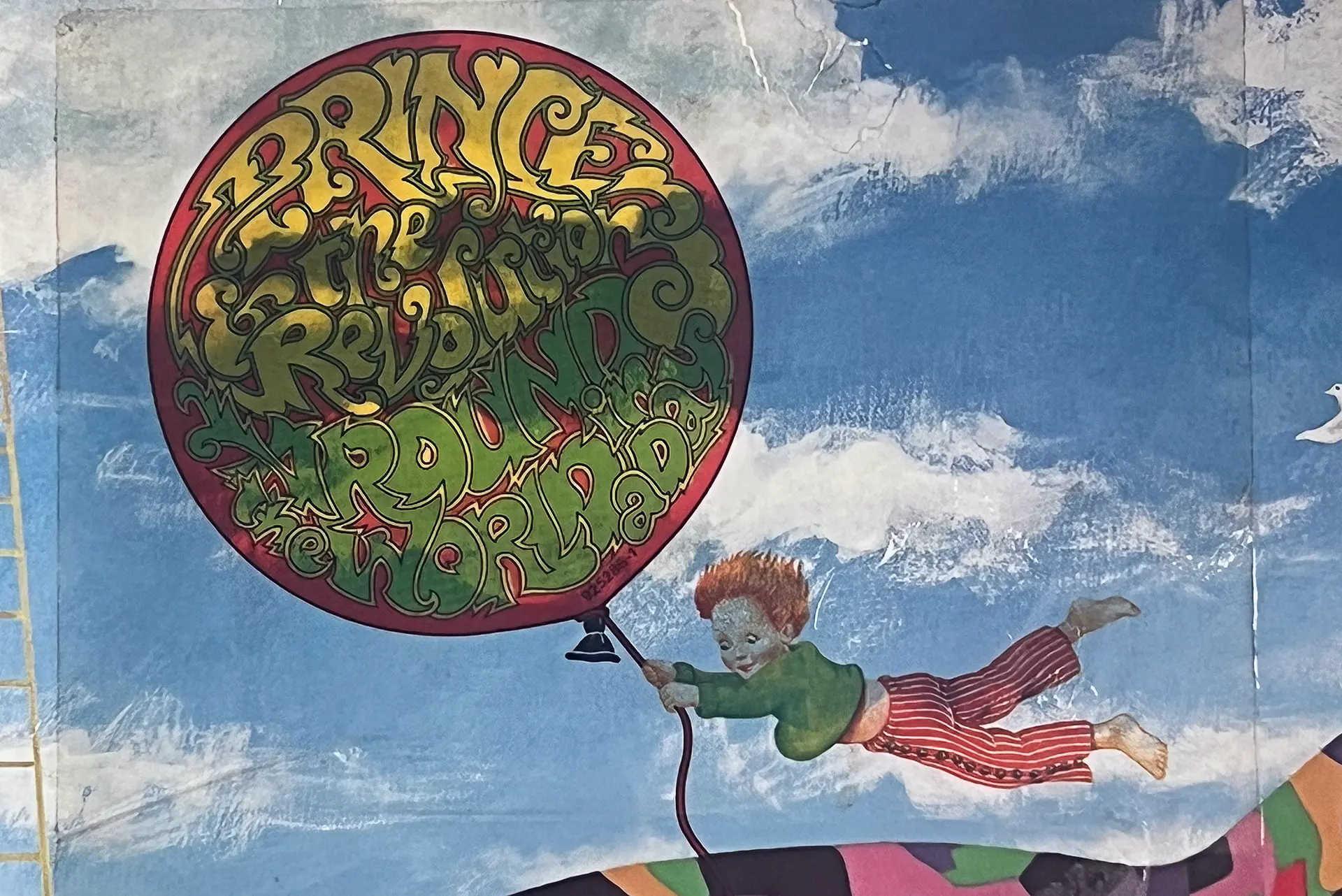
Discogs' listing for the LP[43] notes that the ‘balloon boy’ hype sticker showing the artist and title was stuck originally to the shrink wrap.
The cover also incorporated a flap on the right of the front half of the gatefold that folded around the sleeve to form a spine over its opening. The spine showed the usual details for that part of the cover, with a track listing on the section of the flap extending around to the back of the sleeve.
My shabby eBay copy of the album attests that the flap was not a robust feature of the cover, as it's no longer attached. However, it retains the ‘balloon boy’ sticker, which the original owner has unevenly stuck to the cover.
Bona fide Eighties, not ersatz Sixties
Prince was ambivalent about the apparent Beatles influence on Around the World in a Day's cover artwork, telling Rolling Stone:
The influence wasn't the Beatles. They were great for what they did, but I don't know how that would hang today. The cover art came about because I thought people were tired of looking at me. Who wants another picture of him?[44]
His slightly self-abnegating denial of The Beatles' influence on his album's sleeve design did not extend to the record's content being labelled ‘psychedelic’:
I don't mind that, because that was the only period in recent history that delivered songs and colors. Led Zeppelin, for example, would make you feel differently on each song.[45]
It's harder to spot Led Zeppelin's influence on Around the World in a Day — except that the woman wearing the raspberry beret debuts by walking ‘in through the out door’.[46]
Prince congratulates himself not on where he drew inspiration for the album, but on how he rang the changes on his previous LP:
I think the smartest thing I did was record Around the World in a Day right after I finished Purple Rain. I didn't wait to see what would happen with Purple Rain. That's why the two albums sound completely different.[47]
As Simon Price[48] puts it in his retrospective ranking of Prince's career output, Around the World in a Day was:
The album that threw the Purple Rain kids off-balance, with its opulent psych-pop textures, but which always sounds better than you think it will, when you revisit.[49]
Revisiting Around the World in a Day offers me the multidimensional perspective of looking back on a bygone era, during which I also looked back on a bygone era.
And it's more than possible to overdo the nostalgia.
Listening to old records is inherently a retrospective activity. However, music can slip its temporal moorings.
As Nick Hornby[50] puts it:
[…] if you love a song, love it enough for it to accompany you throughout the different stages of your life, then any specific memory is rubbed away by use.[51]
I haven't ‘used’ the songs on Around the World in a Day sufficiently to ‘rub away’ the specific memories I associate with them, and so, for me, the album remains rooted firmly in the 1980s.
This is ironically at odds with Prince's creative process for the album as he built on his influences to make a bona fide Eighties album, not an ersatz Sixties throwback.
Notes and references